

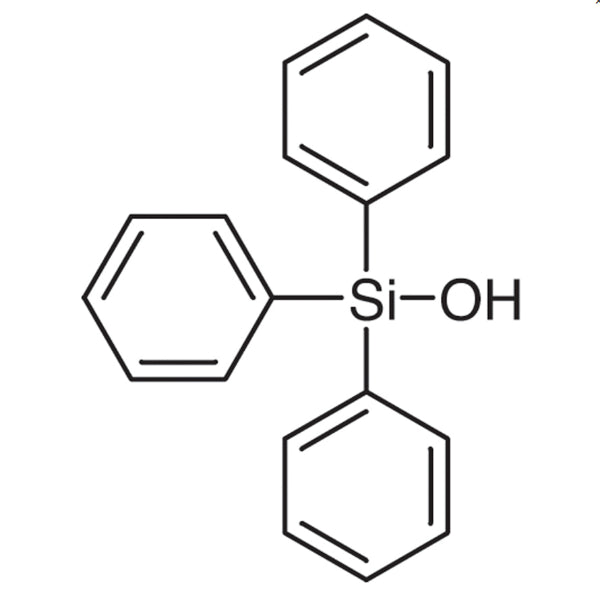
Triphenylsilanol (TCI T0945), with CAS number 791-31-1, is a chemical compound widely used in laboratory settings for its role in organosilicon chemistry. As an organometallic reagent, it plays a crucial part in various synthetic processes, particularly in the field of organosilicon compounds. Its molecular structure features three phenyl groups attached to a central silicon atom, making it a versatile reagent in chemical reactions. This compound is commonly employed in substitution reactions and catalytic processes, where its unique reactivity and stability are highly valued.
One of the key properties that make Triphenylsilanol a preferred choice is its non-polar nature, which allows it to interact effectively in non-polar environments. It is also known for its stability under various reaction conditions, which simplifies its handling and storage. Additionally, its ability to act as a hydride donor or a ligand in organometallic complexes enhances its utility in complex chemical syntheses. These characteristics make it a reliable and efficient reagent for a wide range of chemical applications.
In Indonesian laboratories, Triphenylsilanol is extensively used in organic chemistry research, especially in the synthesis of complex compounds and catalytic reactions. Its chemical stability and reactivity make it a valuable tool for researchers in the fields of pharmaceuticals, materials science, and chemical engineering. The compound's reliability and consistent performance contribute to its widespread adoption in both academic and industrial research settings.
- Organic synthesis applications benefit from Triphenylsilanol's role as a hydride donor and ligand in organometallic complexes, enabling efficient catalytic reactions and substitution processes.
- In material science research, it is used to create advanced organosilicon compounds, which are essential for developing new materials with unique properties.
- Pharmaceutical research leverages its reactivity in synthesizing complex organic molecules, aiding in the development of novel drug compounds.
- Catalytic processes in chemical engineering utilize its stability and reactivity to enhance reaction efficiency and yield.
- Industrial chemical processes rely on its non-polar nature and stability to facilitate reactions in non-polar environments, improving process control and product quality.
| Brand | TCI |
|---|---|
| CAS number | 791-31-1 |
| Molecular formula | — |
| Purity | — |
| Category | Chemistry > Organometallic Reagents > Organosilicon [Organometallic Reagents] |
| Pack sizes | Available in standard laboratory quantities as specified by supplier |
| Physical form | Liquid |
| Storage | Store in a cool, dry place away from moisture and direct sunlight |
Triphenylsilanol should be stored in a cool, dry environment, away from moisture and direct sunlight to maintain its chemical stability. It is recommended to use sealed containers made of glass or inert polymer materials to prevent contamination and evaporation. Due to its non-polar nature, it is important to ensure proper ventilation in the laboratory to avoid inhalation of vapors. Handling should be done with appropriate personal protective equipment, including gloves and safety goggles, to minimize exposure. The compound is generally stable under normal laboratory conditions but should be kept away from strong oxidizing agents to prevent unintended reactions. Regular inspection of storage containers is advised to ensure integrity and safety.
—