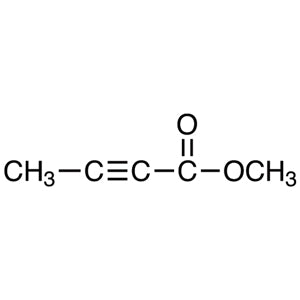
Methyl Tetrolate from TCI (product code T1053) is an organic compound, specifically the methyl ester of tetrolic acid, a carboxylic acid that carries a carbon-carbon triple bond in its chain. In the TCI catalogue it is classified as a non-heterocyclic building block, meaning it serves as a starting material for assembling larger molecules in organic synthesis. In the laboratory, a compound of this kind acts as a small structural unit that brings two reactive functional groups together in one molecule: an alkyne and an ester.
The combination of an alkyne and an ester is what makes Methyl Tetrolate attractive to synthetic chemists. The triple bond sits next to the carbonyl group, so the molecule is known as a reactive acceptor toward nucleophiles in conjugate addition reactions. It can also serve as a dienophile or a dipolarophile in cyclization reactions. Its small molecular size makes it easy to follow reaction outcomes with routine analytical techniques. It is supplied as a liquid in milliliter pack sizes, which suits research-scale work well.
In Indonesia, building blocks of this type are most often used in university organic chemistry laboratories, research centres, and product development units that work on the synthesis of new compounds. Research groups can use it as a starting point for exploring reaction routes, testing synthetic methods, and preparing intermediates for further study. Through AMI Scientific, laboratories can source this TCI reagent for their research and teaching needs.
- Conjugate addition studies: the triple bond next to the ester carbonyl makes Methyl Tetrolate a reactive acceptor for nucleophiles, so it suits research groups investigating how different nucleophiles add to activated alkynes.
- Cycloaddition and cyclization reactions: the alkyne can act as a dienophile or dipolarophile, which makes this compound a useful partner when chemists build ring systems from small, simple components.
- Starting material for multi-step organic synthesis: as a non-heterocyclic building block carrying both alkyne and ester groups, it provides two reactive handles for constructing larger and more complex target molecules.
- Teaching and training in synthetic chemistry: its small structure and clearly defined functional groups let students observe alkyne and ester reactivity and follow the results with routine analytical techniques.
- Exploratory research in product development units: the compact molecule can be used to test new reaction routes and prepare intermediates on a small scale before wider synthetic work is planned.
| Brand | TCI |
|---|---|
| CAS number | 23326-27-4 |
| Molecular formula | — |
| Purity | — |
| Category | Chemistry > Building Blocks > Non-Heterocyclic Building Blocks |
| Pack sizes | supplied in milliliter units, suited to research-scale work |
| Physical form | liquid |
| Storage | — |
- Product code: T1053
Store Methyl Tetrolate in its original tightly closed container, in a cool, dry, well-ventilated place away from heat, sparks, and open flames. Keep it separate from strong oxidizers, strong bases, and other incompatible materials. Glass containers with secure caps are generally suitable for organic liquids of this kind. Always follow the storage instructions on the label and in the supplier's safety data sheet. Handle it in a fume hood while wearing a laboratory coat, chemical-resistant gloves, and safety glasses. Avoid contact with skin and eyes and avoid inhaling vapors. Label any transfer containers clearly, and dispose of waste according to your institution's chemical waste procedures.
—
Produk Terkait
-
TCI B5774 5,10-Bis(4,4,5,5-tetramethyl-1,3,2-dioxaborolan-2-yl)naphtho[1,2-c:5,6-c']bis([1,2,5]oxadiazole)
Regular price Rp 10.307.850,00Regular priceRp 7.224.000,00Sale price Rp 10.307.850,00 -
Dihydroiodide TCI B6569
Regular price From Rp 1.988.700,00Regular priceRp 1.405.950,00Sale price From Rp 1.988.700,00