


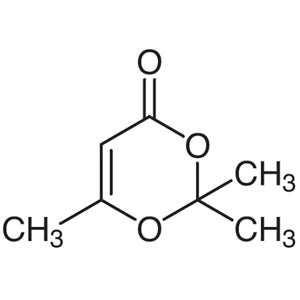
TCI T1099 is 2,2,6-Trimethyl-1,3-dioxin-4-one, CAS number 5394-63-8, a six-membered heterocyclic compound that the TCI catalog groups under non-heterocyclic building blocks. Among organic chemists it is known as a diketene precursor that is easier to handle than diketene itself. When heated, its structure can release acetone and generate the highly reactive acetylketene intermediate. Nucleophiles such as alcohols or amines can then trap this intermediate to form acetoacetate derivatives. In the laboratory, the reagent serves as a convenient source of the acetoacetyl unit for stepwise synthetic work.
The main reason chemists choose this reagent is how simple it is to use compared with pure diketene, which is harder to handle. Because it is supplied as a liquid, the volume can be measured directly, which makes sampling practical. Its reactivity is controlled by temperature, so researchers decide when the reactive intermediate forms. Acetoacetylation reactions can therefore be designed more deliberately in multistep synthesis. This control, together with the convenience of volumetric dosing, makes the product an attractive option wherever an acetoacetylating reagent is needed.
In Indonesian laboratories, this reagent is relevant to organic synthesis groups that prepare beta-carbonyl compounds and acetoacetate esters. It is also useful for groups that need starting materials for heterocycles and natural products. Research teams in universities and institutes can use it in their synthetic routes, and it is available in 25 mL and 500 mL packs to suit different scales of work. AMI Scientific supplies the TCI brand to laboratories across the country.
Related TCI products
- TCI T1222 87769-39-9 2,2,5,6-Tetramethyl-4H-1,3-dioxin-4-one
- TCI D5447 146796-02-3 (2,3-Dihydrothieno[3,4-b][1,4]dioxin-2-yl)methanol
- TCI T4332 147-47-7 2,2,4-Trimethyl-1,2-dihydroquinoline
- TCI T4294 63666-10-4 3-(1,1,2-Trimethyl-1H-benzo[e]indol-3-ium-3-yl)propane-1-sulfonate
- TCI T4293 1,1,2-Trimethyl-1H-benzo[e]indole-7-sulfonic Acid Monohydrate
- TCI T4291 63149-24-6 4-(1,1,2-Trimethyl-1H-benzo[e]indol-3-ium-3-yl)butane-1-sulfonate
- Acetoacetylation of alcohols: on heating, the reagent releases acetone and forms acetylketene, which alcohols trap to give acetoacetate esters, making it well suited to this transformation.
- Acetoacetylation of amines: the reactive acetylketene intermediate is captured by amine nucleophiles to form acetoacetamide derivatives, and its temperature-controlled generation lets researchers time the reaction deliberately.
- Synthesis of beta-carbonyl compounds: as a convenient acetoacetyl source, the reagent supports groups preparing beta-carbonyl structures, and it is easier to handle than the pure diketene it stands in for.
- Preparation of acetoacetate esters: the liquid form can be measured by volume, so organic synthesis laboratories can dose it accurately when building these esters in stepwise synthetic sequences.
- Starting material for heterocycles and natural products: the controlled generation of a reactive intermediate lets chemists plan multistep routes more precisely, which suits work toward heterocyclic compounds and natural product targets.
| Brand | TCI (product code T1099) |
|---|---|
| CAS number | 5394-63-8 |
| Molecular formula | — |
| Purity | — |
| Category | Chemistry > Building Blocks > Non-Heterocyclic Building Blocks |
| Pack sizes | 25 mL and 500 mL |
| Physical form | liquid |
| Storage | keep tightly closed in a suitable laboratory chemical store and follow the supplier's safety data sheet |
Store the reagent in its original, tightly closed container in a suitable laboratory chemical store. Because heat triggers the release of acetone and the formation of the reactive intermediate, keep it away from heat sources and follow the storage conditions given on the supplier's label and safety data sheet. Read the safety data sheet before first use. Handle the liquid in a well-ventilated area or a fume hood, and wear gloves, safety glasses and a laboratory coat. Use clean, dry measuring tools when taking volumes, and reseal the container promptly after each use. Dispose of waste according to your institution's chemical waste procedures.
—
Produk Terkait
-
2,2,5,6-Tetramethyl-4H-1,3-dioxin-4-one TCI T1222
Regular price From Rp 4.425.750,00Regular priceRp 3.110.100,00Sale price From Rp 4.425.750,00 -
(2,3-Dihydrothieno[3,4-b][1,4]dioxin-2-yl)methanol TCI D5447
Regular price From Rp 2.411.850,00Regular priceRp 1.702.050,00Sale price From Rp 2.411.850,00 -
2,2,4-Trimethyl-1,2-dihydroquinoline TCI T4332
Regular price From Rp 2.914.800,00Regular priceRp 2.053.800,00Sale price From Rp 2.914.800,00 -
3-(1,1,2-Trimethyl-1H-benzo[e]indol-3-ium-3-yl)propane-1-sulfonate TCI T4294
Regular price From Rp 557.550,00Regular priceRp 405.300,00Sale price From Rp 557.550,00 -
AcidMonohydrate TCI T4293
Regular price From Rp 1.749.300,00Regular priceRp 1.239.000,00Sale price From Rp 1.749.300,00 -
4-(1,1,2-Trimethyl-1H-benzo[e]indol-3-ium-3-yl)butane-1-sulfonate TCI T4291
Regular price From Rp 557.550,00Regular priceRp 405.300,00Sale price From Rp 557.550,00 -
2,4,6-Trimethyl-1,3,5-triazine TCI T4122
Regular price Rp 3.180.450,00Regular priceRp 2.239.650,00Sale price Rp 3.180.450,00 -
2,2,5-Trimethyl-1,3-dioxane-5-carboxylicAcid TCI T3839
Regular price From Rp 2.862.300,00Regular priceRp 2.017.050,00Sale price From Rp 2.862.300,00


