

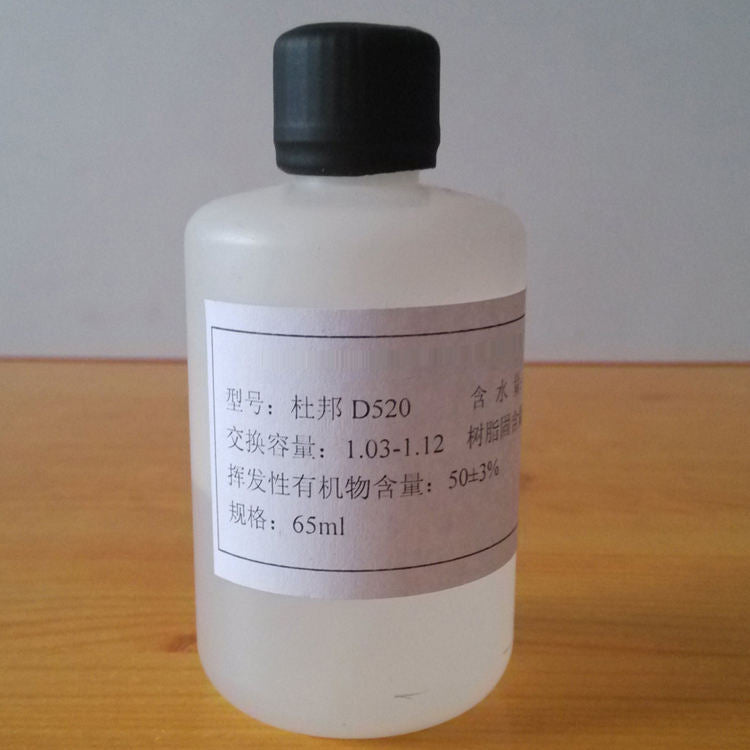
Nafion solution D520 20mL from Yunji is a dispersion of Nafion ionomer. Nafion is a perfluorinated sulfonic acid polymer known for its ability to conduct protons. Solutions such as D520 make the ionomer easy to mix, coat, or drop-cast onto electrode surfaces. In electrochemistry and energy laboratories, it is used as a catalyst binder in catalyst inks, as an electrode coating, and as a key component in preparing membrane electrode assemblies for fuel cells and water electrolysis devices.
Researchers choose Nafion because it combines two properties that rarely occur together. Its fluorinated polymer backbone gives it excellent chemical and thermal resistance. The sulfonic acid groups on its side chains form proton-conducting pathways when the polymer is hydrated. When mixed with catalyst powders, the ionomer binds the particles to the electrode and also gives ions a path to the active sites. Nafion layers are cation-exchanging, so they can also screen out anionic interferences in electrochemical sensors. In liquid form, the ionomer is easy to measure and work into reproducible formulations.
In Indonesia, research on renewable energy, green hydrogen, batteries, and electrochemical sensors continues to grow in universities, research institutes, and industrial laboratories. Nafion solution D520 is routinely used in these settings to prepare working electrodes for catalyst testing, to fabricate membrane electrode assemblies for prototype fuel cells and electrolyzers, and to modify electrodes for analytical sensing. The 20 mL pack suits laboratories that run small-scale experiments and need a convenient amount for repeated electrode preparation.
- Catalyst ink formulation: the ionomer binds catalyst powders to the electrode while giving protons a path to the active sites, which supports reliable electrochemical measurements.
- Membrane electrode assembly fabrication: Nafion solution is an essential component for building catalyst layers in fuel cells and water electrolysis devices, where proton transport is critical.
- Electrode coating and modification: the dispersion can be drop-cast or coated onto electrode surfaces to form a thin, chemically resistant, proton-conducting film for experimental work.
- Electrochemical sensor development: the cation-exchange character of Nafion layers helps screen out anionic interferences, which improves selectivity in many electroanalytical sensing applications.
- Green hydrogen and energy research: the material's chemical and thermal stability makes it well suited for studying catalysts and devices used in hydrogen production and conversion.
| Brand | Yunji |
|---|---|
| CAS number | — |
| Molecular formula | — |
| Purity | — |
| Category | Yunji |
| Pack sizes | 20 mL |
| Physical form | liquid dispersion of Nafion ionomer |
| Storage | keep tightly closed according to the manufacturer's label and safety data sheet |
- Product name: Nafion solution D520
Store Nafion solution D520 in its original, tightly sealed container in a cool, dry, well-ventilated area, away from direct sunlight, heat sources, and ignition sources. Close the bottle promptly after each use to prevent solvent evaporation and contamination, which can change the concentration of the dispersion. Mix gently before use so the dispersion stays uniform. Wear laboratory gloves, safety glasses, and a lab coat, and work in a fume hood or well-ventilated space. Check the product label and safety data sheet for the solvent composition and any specific hazard information before use. Dispose of residues according to local laboratory waste regulations.
—
Produk Terkait
-
YJ Electrolyte LiPF6 for Lithium-ion Battery R&D
Regular price From Rp 3.639.300,00Regular price -
YJ Carbon Super P For Lithium Ion Batteries
Regular price From Rp 55.125,00Regular price -
YJ 1 M NaCLO4 in EC:DEC 1:1 v/v
Regular price Rp 4.533.900,00Regular price -
YJ PVDF Binder (25 gr)
Regular price Rp 611.887,50Regular price -
YJ Cu Foil 9 um (200 x 1000 mm)
Regular price Rp 2.073.750,00Regular price -
YJ Sagger 410 mL (150*150*40) mm
Regular price Rp 1.086.750,00Regular price -
YJ Cylinder Cell Semi-Automatic Winding Machine
Regular price Rp 400.429.575,00Regular price -
YJ Three-layer single-door vacuum oven
Regular price Rp 200.737.845,00Regular price


