

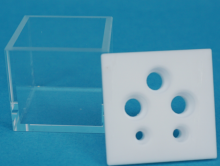
The CS933 Photoelectrochemical cell (quartz) is a specialized laboratory instrument designed for measuring electrochemical responses on material surfaces under light exposure. It plays a crucial role in photovoltaic and photokimic research by enabling the analysis of how materials interact with light. This device is essential for evaluating the efficiency of converting light energy into electrical energy in various materials, such as solar cells and semiconductors. Its design ensures reliable and accurate data collection in controlled experimental environments, supporting scientific investigations in energy and material sciences.
The cell is constructed from high-quality quartz, which offers exceptional transparency and resistance to UV radiation. These properties make it ideal for experiments requiring consistent light transmission and minimal interference. The material's durability against heat and corrosion further enhances its reliability in long-term use. The compact size and robust design of the CS933 Photoelectrochemical cell ensure ease of integration into diverse experimental setups, while its ability to minimize external light interference maintains measurement accuracy. These characteristics collectively make it a preferred choice for researchers seeking precision and consistency in their experiments.
In Indonesian laboratories, the CS933 Photoelectrochemical cell is widely used in renewable energy research, environmental chemistry, and material science. It supports studies on solar energy conversion, photochemical reactions, and the development of advanced materials. Its versatility and performance make it an essential tool for both academic and industrial research, contributing to the advancement of scientific knowledge in these fields.
Related products
- CS310M Single channel models (ordinary benchtope type) (±2A,±10V)
- CS350M CORRRTEST SINGLE CHANNEL MODELS EIS / POTENTIOSTAT / GALVANOSTAT
- CS900 Saturated Calomel Electrode
- CS901 Ag/AgCl reference electrode "Ø4mm/Ø6mm 3.5M KCl refilling solution"
- CS902 Hg/HgO reference electrode
- CS903 Mercury/Mercurous sulfate electrode
- Renewable energy research utilizes the CS933 Photoelectrochemical cell to evaluate the efficiency of solar cells and photovoltaic materials under controlled light conditions.
- Environmental chemistry studies benefit from this cell by analyzing the photochemical reactions of pollutants and their degradation mechanisms under UV light.
- Material science experiments rely on the cell to investigate the optical and electrochemical properties of semiconductors and other light-sensitive materials.
- Photoelectrochemical analysis in electrochemistry uses the cell to study the interaction between light and electrode surfaces for energy conversion applications.
- Semiconductor research employs the cell to assess the performance of photovoltaic materials and their response to varying light intensities and wavelengths.
| Brand | Corrtest |
|---|---|
| CAS number | — |
| Molecular formula | — |
| Purity | — |
| Category | Corrtest |
| Pack sizes | — |
| Physical form | Quartz cell |
| Storage | Store in a cool, dry place away from direct sunlight |
- Dimensions: 35*15*45mm
The CS933 Photoelectrochemical cell should be stored in a cool, dry environment to prevent degradation of the quartz material. It is recommended to keep the cell in a sealed container to protect it from dust and moisture. Avoid exposure to direct sunlight or extreme temperatures, as these can affect the optical properties of the quartz. When handling, ensure that the surface remains clean to maintain measurement accuracy. The cell should be stored upright to prevent any physical damage. In a laboratory setting, always use appropriate safety equipment when handling the cell to ensure safe and effective use.
—
Produk Terkait
-
CS310M Single channel models (ordinary benchtope type) (±2A,±10V)
Regular price Rp 129.438.000,00Regular price -
CS350M CORRRTEST SINGLE CHANNEL MODELS EIS / POTENTIOSTAT / GALVANOSTAT
Regular price Rp 167.884.000,00Regular price -
CS900 Saturated Calomel Electrode
Regular price Rp 2.066.000,00Regular price -
CS901 Ag/AgCl reference electrode "Ø4mm/Ø6mm 3.5M KCl refilling solution"
Regular price Rp 2.149.000,00Regular price -
CS902 Hg/HgO reference electrode
Regular price Rp 3.526.000,00Regular price -
CS903 Mercury/Mercurous sulfate electrode
Regular price Rp 2.341.000,00Regular price -
CS905 Non-aqueous Ag/Ag+ reference electrode
Regular price Rp 2.149.000,00Regular price -
CS910 Platinum conductivity electrode
Regular price Rp 3.030.000,00Regular price


