

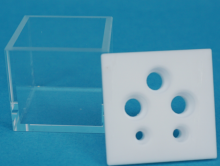
The CS933 Photoelectrochemical Cell (Quartz) 50*50*50mm is a specialized laboratory instrument designed for measuring electrochemical reactions influenced by light. This device plays a crucial role in photokemical research by enabling precise analysis of redox processes, photovoltaic effects, and photocatalytic reactions. Its construction from high-quality quartz ensures durability and optical clarity, making it ideal for experiments requiring exposure to ultraviolet and visible light. The cell is widely used in scientific laboratories for its ability to provide accurate and reliable data under controlled experimental conditions.
The choice of quartz as the material for the CS933 Photoelectrochemical Cell is due to its exceptional properties. It is highly transparent across a broad spectrum of light, including UV, visible, and near-infrared wavelengths, which is essential for photoreactive experiments. Additionally, quartz exhibits excellent resistance to thermal and chemical degradation, making it suitable for use in harsh laboratory environments. Its inert nature ensures that it does not interfere with the chemical reactions being studied, maintaining the integrity of the experimental results.
In Indonesian laboratories, the CS933 Photoelectrochemical Cell is commonly used in research related to chemistry, environmental science, and energy. It is particularly favored for its long-lasting performance and accuracy, which are critical for conducting periodic and precise electrochemical measurements. The consistent rectangular shape of the cell also facilitates easy handling and integration into various experimental setups, reducing the risk of damage during use.
Related products
- CS310M Single channel models (ordinary benchtope type) (±2A,±10V)
- CS350M CORRRTEST SINGLE CHANNEL MODELS EIS / POTENTIOSTAT / GALVANOSTAT
- CS900 Saturated Calomel Electrode
- CS901 Ag/AgCl reference electrode "Ø4mm/Ø6mm 3.5M KCl refilling solution"
- CS902 Hg/HgO reference electrode
- CS903 Mercury/Mercurous sulfate electrode
- Photocatalytic reaction studies benefit from the cell's UV transparency and chemical inertness, allowing precise monitoring of light-induced chemical transformations.
- Redox potential analysis in photoelectrochemical systems relies on the cell's ability to maintain stable conditions under light exposure, ensuring accurate electrochemical measurements.
- Solar cell efficiency testing uses the cell to simulate light conditions, aiding in the evaluation of photovoltaic material performance under controlled environments.
- Environmental pollutant degradation experiments utilize the cell to study the breakdown of contaminants under UV light, supporting research in environmental remediation.
- Electrochemical sensor calibration requires the cell's consistent optical and electrical properties, ensuring reliable and reproducible results in analytical testing.
| Brand | Corrtest |
|---|---|
| CAS number | — |
| Molecular formula | — |
| Purity | — |
| Category | Corrtest |
| Pack sizes | — |
| Physical form | Quartz cell |
| Storage | Store in a cool, dry place away from direct sunlight |
- Dimensions: 50*50*50mm
The CS933 Photoelectrochemical Cell should be stored in a cool, dry environment to prevent any degradation of its optical and structural properties. It is recommended to keep the cell in a sealed container to protect it from dust and moisture. Since quartz is sensitive to extreme temperatures, it should not be exposed to direct sunlight or high-temperature storage areas. In laboratory settings, the cell should be handled with care to avoid mechanical stress or scratches that could compromise its transparency or integrity. Regular inspection for any signs of damage is advised to ensure its continued performance in experimental applications. Proper storage and handling are essential to maintain the accuracy and reliability of the cell in photokemical research.
—
Produk Terkait
-
CS310M Single channel models (ordinary benchtope type) (±2A,±10V)
Regular price Rp 129.438.000,00Regular price -
CS350M CORRRTEST SINGLE CHANNEL MODELS EIS / POTENTIOSTAT / GALVANOSTAT
Regular price Rp 167.884.000,00Regular price -
CS900 Saturated Calomel Electrode
Regular price Rp 2.066.000,00Regular price -
CS901 Ag/AgCl reference electrode "Ø4mm/Ø6mm 3.5M KCl refilling solution"
Regular price Rp 2.149.000,00Regular price -
CS902 Hg/HgO reference electrode
Regular price Rp 3.526.000,00Regular price -
CS903 Mercury/Mercurous sulfate electrode
Regular price Rp 2.341.000,00Regular price -
CS905 Non-aqueous Ag/Ag+ reference electrode
Regular price Rp 2.149.000,00Regular price -
CS910 Platinum conductivity electrode
Regular price Rp 3.030.000,00Regular price


