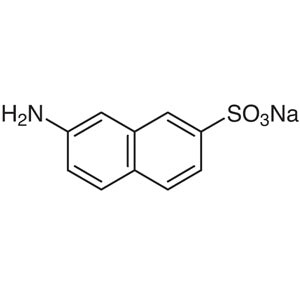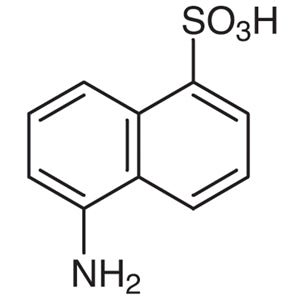
5-Amino-1-naphthalenesulfonic Acid is a chemical compound widely used in organic synthesis reactions within laboratory settings. It serves as a key building block for the development of complex molecules, including dyes, pharmaceuticals, and industrial chemicals. Its role in laboratory research is crucial due to its ability to participate in various chemical transformations, such as substitution and reduction reactions. This compound is particularly valued for its stability and reactivity, which facilitate efficient synthesis processes. Its chemical properties make it a versatile reagent in organic chemistry, supporting a wide range of experimental applications.
The compound is preferred for its stable molecular structure and consistent reactivity, which ensure predictable outcomes in chemical reactions. Its ability to form stable intermediates and participate in multiple reaction pathways makes it a reliable choice for synthetic chemists. The compound’s solubility and compatibility with various solvents further enhance its utility in laboratory environments. These characteristics contribute to its popularity among researchers working on complex chemical syntheses and industrial applications.
In Indonesian laboratories, 5-Amino-1-naphthalenesulfonic Acid is commonly used in chemical research and pharmaceutical development. It is a staple in academic institutions and research organizations, supporting the creation of new products and scientific advancements. Its availability in solid form and ease of handling make it a preferred material for laboratory-scale experiments. Its role in color compound synthesis for the paint and textile industries also highlights its practical importance in industrial applications.
Related TCI products
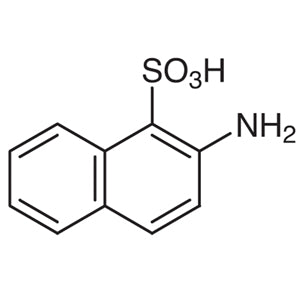
- TCI A0343 81-16-3 2-Amino-1-naphthalenesulfonic Acid
- TCI A0346 119-79-9 5-Amino-2-naphthalenesulfonic Acid
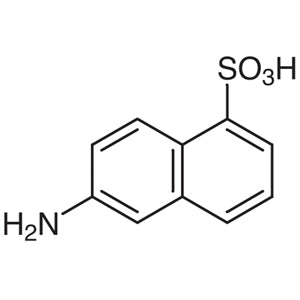
- TCI A0347 81-05-0 6-Amino-1-naphthalenesulfonic Acid
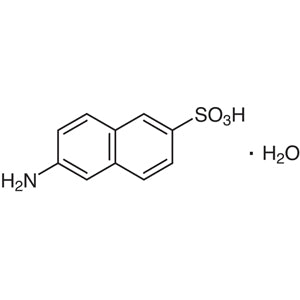
- TCI A0348 93-00-5 6-Amino-2-naphthalenesulfonic Acid Monohydrate
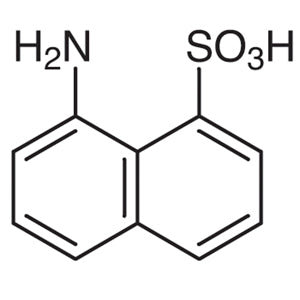
- TCI A0350 82-75-7 8-Amino-1-naphthalenesulfonic Acid
- TCI A0356 119-28-8 8-Amino-2-naphthalenesulfonic Acid
- Organic synthesis of dyes and pigments due to its ability to form stable intermediates and participate in color compound reactions.
- Pharmaceutical research for the development of complex drug molecules through substitution and reduction reactions.
- Industrial chemical production as a building block for the synthesis of various chemical compounds.
- Textile industry applications in the creation of colorants for fabric dyeing processes.
- Academic research in chemistry departments for teaching and experimental purposes.
| Brand | TCI |
|---|---|
| CAS number | 84-89-9 |
| Molecular formula | — |
| Purity | — |
| Category | Chemistry > Building Blocks > Non-Heterocyclic Building Blocks |
| Pack sizes | Available in various quantities as per standard laboratory supply |
| Physical form | Solid |
| Storage | Store in a cool, dry place away from moisture and direct sunlight |
This compound should be stored in a cool, dry environment to maintain its stability and prevent degradation. It is recommended to use airtight containers to protect it from moisture and air exposure. Due to its chemical nature, it should be handled with care, using appropriate personal protective equipment such as gloves and safety goggles. Avoid direct contact with skin and eyes, and ensure proper ventilation in the workspace. It is important to keep the compound away from incompatible materials to prevent any potential chemical reactions. Regular inspection of storage conditions ensures the material remains suitable for use in laboratory applications.
—
Produk Terkait
-
2-Amino-1-naphthalenesulfonicAcid TCI A0343
Regular price Rp 477.750,00Regular priceRp 333.900,00Sale price Rp 477.750,00 -
5-Amino-2-naphthalenesulfonicAcid TCI A0346
Regular price Rp 717.150,00Regular priceRp 500.850,00Sale price Rp 717.150,00 -
6-Amino-1-naphthalenesulfonicAcid TCI A0347
Regular price Rp 955.500,00Regular priceRp 667.800,00Sale price Rp 955.500,00 -
6-Amino-2-naphthalenesulfonicAcidMonohydrate TCI A0348
Regular price Rp 1.405.950,00Regular priceRp 982.800,00Sale price Rp 1.405.950,00 -
8-Amino-1-naphthalenesulfonicAcid TCI A0350
Regular price Rp 1.008.000,00Regular priceRp 704.550,00Sale price Rp 1.008.000,00 -
8-Amino-2-naphthalenesulfonicAcid TCI A0356
Regular price Rp 1.431.150,00Regular priceRp 1.000.650,00Sale price Rp 1.431.150,00 -
4-Amino-1-naphthalenesulfonicAcid TCI A0344
Regular price Rp 3.817.800,00Regular priceRp 2.669.100,00Sale price Rp 3.817.800,00 -
Sodium7-Amino-2-naphthalenesulfonate TCI A0355
Regular price Rp 1.193.850,00Regular priceRp 834.750,00Sale price Rp 1.193.850,00