


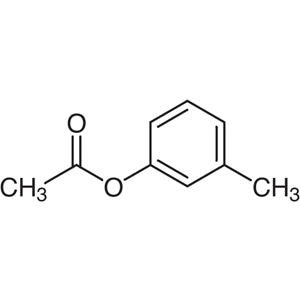
m-Tolyl Acetate (m-TA), with CAS number 122-46-3, is a chemical compound widely used in various organic reactions within laboratory settings. It is an ester formed from acetic acid and m-tolyl alcohol, making it a versatile building block in synthetic chemistry. Due to its reactive nature and structural complexity, m-TA is frequently employed in the synthesis of complex compounds, including aromatic and heterocyclic derivatives. Its role as a key component in esterification and transesterification reactions makes it essential for the development of new compounds with applications in pharmaceuticals, materials science, and organic chemistry.
The chemical properties of m-TA, such as its stability under controlled conditions and sensitivity to high temperatures and UV light, make it a preferred choice for laboratory use. Its distinct aroma also plays a role in laboratory environments, influencing odor control measures. The compound's reactivity and chemical versatility make it a valuable reagent for chemists seeking to create a wide range of functional molecules. Its ability to participate in multiple reaction pathways enhances its utility in both research and industrial applications.
In Indonesian laboratories, m-Tolyl Acetate is commonly used in organic chemistry research, particularly in academic institutions and research centers. It is a staple in synthetic chemistry workflows, supporting the creation of new compounds for pharmaceutical development and material science. Its availability and reliability make it a standard reagent in both educational and industrial laboratory settings across Indonesia.
- Organic synthesis is a key application where m-Tolyl Acetate is used for creating complex aromatic and heterocyclic compounds due to its reactivity and structural versatility.
- Esterification reactions benefit from m-Tolyl Acetate as it serves as a key reagent in the formation of ester functional groups in synthetic pathways.
- Transesterification processes utilize m-Tolyl Acetate to facilitate the exchange of ester groups, making it valuable in the development of new chemical structures.
- Pharmaceutical research employs m-Tolyl Acetate to synthesize compounds with potential therapeutic applications, leveraging its chemical reactivity.
- Material science applications use m-Tolyl Acetate to create functional materials, taking advantage of its ability to participate in diverse chemical reactions.
| Brand | TCI |
|---|---|
| CAS number | 122-46-3 |
| Molecular formula | — |
| Purity | — |
| Category | Chemistry > Building Blocks > Non-Heterocyclic Building Blocks |
| Pack sizes | Available in various quantities as per standard laboratory supply |
| Physical form | Liquid |
| Storage | Store in a closed container away from heat and UV light |
m-Tolyl Acetate should be stored in a closed container to prevent evaporation and unwanted reactions. It is recommended to keep it in a cool, dark place away from direct sunlight and high temperatures. Due to its sensitivity to heat and UV light, it should be handled with care to avoid decomposition. In laboratory settings, proper ventilation is essential to manage its characteristic aroma. The compound should be stored in airtight containers to maintain its chemical stability and ensure safe handling. Always follow standard safety protocols when working with reactive chemicals like m-Tolyl Acetate.
—
Produk Terkait
-
p-TolylAcetate TCI A0670
Regular price From Rp 584.850,00Regular priceRp 408.450,00Sale price From Rp 584.850,00 -
o-TolylAcetate TCI A0669
Regular price Rp 1.220.100,00Regular priceRp 852.600,00Sale price Rp 1.220.100,00 -
Ethyl2-Oxo-2-(p-tolyl)acetate TCI E1516
Regular price From Rp 1.829.100,00Regular priceRp 1.294.650,00Sale price From Rp 1.829.100,00 -
2-(p-Tolyl)acetaldehyde TCI T4311
Regular price From Rp 3.100.650,00Regular priceRp 2.168.250,00Sale price From Rp 3.100.650,00 -
3-Oxo-3-(p-tolyl)propanenitrile TCI T3700
Regular price Rp 1.326.150,00Regular priceRp 942.900,00Sale price Rp 1.326.150,00 -
1-(p-Tolyl)-1-cyclohexanecarboxylicAcid TCI T3097
Regular price From Rp 1.696.800,00Regular priceRp 1.202.250,00Sale price From Rp 1.696.800,00 -
3-(p-Tolyl)propionicAcid TCI T2797
Regular price From Rp 2.411.850,00Regular priceRp 1.702.050,00Sale price From Rp 2.411.850,00 -
2-(p-Tolyl)benzoicAcid TCI T2377
Regular price From Rp 822.150,00Regular priceRp 590.100,00Sale price From Rp 822.150,00


