


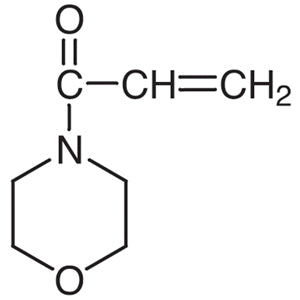
4-Acryloylmorpholine is a chemical compound widely used in polymerization reactions to produce polymers with specific properties. It serves as a monomer in materials science and chemical laboratories, offering versatility in forming complex compounds through targeted chemical reactions. Its molecular structure enables bonding with various functional groups, making it a valuable component in polymer and macromolecule research. This compound is particularly favored for its ability to participate in free radical and efficient polymerization reactions, which are essential in synthetic chemistry and material development.
The compound's chemical properties and stability make it a preferred choice in laboratory settings. It is stabilized with MEHQ (methyl ethyl glycol hydroquinone), which helps prevent degradation before use. This stabilization ensures consistent performance in experiments and enhances its reliability in research applications. Its stability under certain conditions allows for extended shelf life and safe handling, contributing to its popularity among scientists and researchers.
In Indonesian laboratories, 4-Acryloylmorpholine is commonly used in material and chemical research for the development of new polymers, surface modification, and composite material creation. It plays a crucial role in advancing scientific studies and industrial applications, supporting innovation in polymer science and related fields.
TCI brochures (PDF)
- Biomaterials Research Reagents 2025-02-19 · p. 11
- Monomers 2025-05-28 · p. 10
- Polymer synthesis and modification: 4-Acryloylmorpholine is ideal for creating new polymers and modifying existing ones due to its reactivity and functional group compatibility.
- Surface functionalization: Its ability to bond with various functional groups makes it suitable for modifying surfaces in material science applications.
- Composite material development: It is used in the formulation of composite materials, enhancing their structural and chemical properties.
- Free radical polymerization reactions: The compound’s participation in free radical reactions makes it a key reagent in polymer synthesis processes.
- Research in macromolecular chemistry: It is widely used in studies involving macromolecules, contributing to the understanding of polymer behavior and structure.
| Brand | TCI |
|---|---|
| CAS number | 5117-12-4 |
| Molecular formula | — |
| Purity | — |
| Category | Materials Science > Polymer/Macromolecule Reagents > Monomers |
| Pack sizes | Available in standard laboratory quantities as per supplier specifications |
| Physical form | Liquid |
| Storage | Store in a cool, dark place away from heat and direct sunlight |
4-Acryloylmorpholine should be stored in a cool, dark environment to maintain its stability and prevent degradation. It is recommended to use airtight containers to minimize exposure to air and moisture. Due to its chemical nature, it should be handled in a well-ventilated area, and appropriate personal protective equipment should be worn. Avoid contact with incompatible substances, and ensure that storage conditions are consistent with standard laboratory safety protocols. Proper labeling and storage practices help ensure the compound remains effective and safe for use in research applications.
—
Product Categories
Produk Terkait
-
TetramethyleneGlycolDimethacrylate(stabilizedwithMEHQ) TCI T3488
Regular price Rp 3.763.200,00Regular priceRp 2.631.300,00Sale price Rp 3.763.200,00 -
TetraethyleneGlycolDimethacrylate(stabilizedwithHQ) TCI T3486
Regular price From Rp 1.298.850,00Regular priceRp 908.250,00Sale price From Rp 1.298.850,00


