

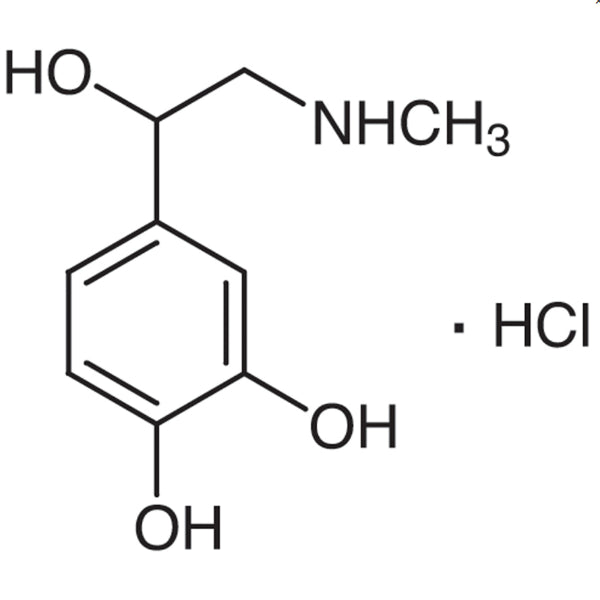
DL-Adrenaline Hydrochloride is a chemical compound widely used in various laboratory experiments, particularly in the fields of biochemistry and pharmacology. This compound represents the active form of adrenaline, a hormone and neurotransmitter that plays a crucial role in the body's response to stress or emergency situations. In laboratory settings, DL-Adrenaline Hydrochloride serves as a key reagent for the synthesis of other compounds or as a component in specific chemical reactions. Its presence allows researchers to study the physiological and biochemical effects of adrenaline in controlled environments.
DL-Adrenaline Hydrochloride is known for its chemical stability and solubility in water, making it a reliable and versatile material for laboratory use. These properties ensure consistent performance in experiments, reducing variability and enhancing the accuracy of results. Additionally, its strong biological activity makes it suitable for studies involving the nervous system and physiological responses. The compound's specificity and potency make it an essential tool for researchers requiring precise and reproducible outcomes.
In Indonesian laboratories, DL-Adrenaline Hydrochloride is commonly used in scientific research conducted by both academic institutions and research organizations. It is an integral part of experiments related to biochemistry, pharmacology, and physiological studies. Its availability and reliability have made it a preferred choice for researchers aiming to explore the mechanisms of adrenaline and its effects on biological systems.
TCI brochures (PDF)
- Alkaloids 2025-10-10 · p. 4
- Biochemical Research - DL-Adrenaline Hydrochloride is ideal for studying the biochemical pathways and metabolic processes involving adrenaline.
- Pharmacological Testing - The compound is used to evaluate the effects of adrenaline on various physiological responses and drug interactions.
- Neurophysiological Studies - Its strong biological activity makes it suitable for investigating the role of adrenaline in the nervous system and neurotransmission.
- Drug Synthesis - DL-Adrenaline Hydrochloride serves as a precursor in the synthesis of other pharmaceutical compounds and derivatives.
- Stress Response Analysis - Researchers use this compound to simulate and analyze the body's response to stress and emergency conditions in controlled environments.
| Brand | TCI |
|---|---|
| CAS number | 329-63-5 |
| Molecular formula | — |
| Purity | — |
| Category | Life Science > Biochemicals and Reagents > Alkaloids |
| Pack sizes | Available in various quantities as per standard laboratory requirements |
| Physical form | White crystalline powder |
| Storage | Store in a cool, dry place away from light and moisture |
DL-Adrenaline Hydrochloride should be stored in a cool, dry place, away from direct light and moisture to maintain its chemical stability. It is recommended to use airtight containers to prevent contamination and degradation. Due to its biological activity, it should be handled with care, using appropriate personal protective equipment such as gloves and safety goggles. The compound is not flammable but may cause irritation if inhaled or contacted with skin. It should be stored separately from incompatible materials to ensure safety in the laboratory environment. Proper labeling and storage conditions are essential to maintain the integrity and effectiveness of the compound during experiments.
—
Product Categories
Produk Terkait
-
L-AdrenalineBitartrate TCI A0175
Regular price From Rp 1.563.450,00Regular priceRp 1.108.800,00Sale price From Rp 1.563.450,00 -
L-Adrenaline TCI A0173
Regular price Rp 1.351.350,00Regular priceRp 960.750,00Sale price Rp 1.351.350,00 -
DL-Adrenaline TCI A0172
Regular price From Rp 822.150,00Regular priceRp 590.100,00Sale price From Rp 822.150,00 -
L-NoradrenalineBitartrateMonohydrate TCI A0906
Regular price Rp 4.266.150,00Regular priceRp 2.998.800,00Sale price Rp 4.266.150,00 -
(-)-Synephrine TCI Y0012
Regular price From Rp 900.900,00Regular priceRp 645.750,00Sale price From Rp 900.900,00 -
AdrenaloneHydrochloride TCI A1234
Regular price From Rp 1.272.600,00Regular priceRp 905.100,00Sale price From Rp 1.272.600,00 -
SynephrineTartrate TCI S0233
Regular price Rp 2.147.250,00Regular priceRp 1.517.250,00Sale price Rp 2.147.250,00 -
OctopamineHydrochloride TCI O0413
Regular price From Rp 662.550,00Regular priceRp 478.800,00Sale price From Rp 662.550,00


