


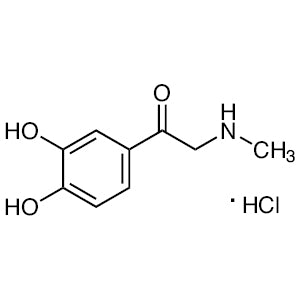
Adrenalone Hydrochloride is a chemical compound widely used in laboratory settings for its versatility and reactivity. It serves as a foundational building block in organic chemistry, particularly in the synthesis of bioactive compounds. This compound plays a crucial role in various research areas, including pharmacology and biochemical studies, where it is employed to develop and test new pharmaceutical agents. Its importance lies in its ability to participate in complex chemical reactions, making it an essential tool for scientists seeking to explore molecular interactions and biological activities.
The properties of Adrenalone Hydrochloride that make it a preferred choice include its solubility in organic solvents and its chemical reactivity. These characteristics enable efficient chemical transformations and make it suitable for a wide range of experimental applications. Additionally, its stability under certain conditions ensures reliable results in laboratory experiments. The compound’s reactivity and solubility allow it to be a key component in the synthesis of hormones and other bioactive molecules, contributing to its widespread use in scientific research.
In Indonesian laboratories, Adrenalone Hydrochloride is commonly used in scientific research, especially in pharmacology, organic chemistry, and biochemistry. Its role in understanding the metabolism and biological activity of compounds makes it an important material for both academic and industrial research. Researchers rely on its properties to conduct experiments that aim to develop new drugs and improve existing therapeutic agents.
TCI brochures (PDF)
- Alkaloids 2025-10-10 · p. 4
- Pharmacological research utilizes Adrenalone Hydrochloride to synthesize and test compounds with potential therapeutic applications.
- Organic chemistry experiments benefit from its reactivity and solubility, enabling the creation of complex molecular structures.
- Biochemical studies leverage its role in hormone synthesis, aiding in the investigation of metabolic pathways and biological functions.
- Drug development projects incorporate it as a precursor in the production of bioactive molecules and pharmaceutical intermediates.
- Analytical chemistry applications use it as a reference standard for qualitative and quantitative analysis in chemical testing.
| Brand | TCI |
|---|---|
| CAS number | 62-13-5 |
| Molecular formula | — |
| Purity | — |
| Category | Chemistry > Building Blocks > Non-Heterocyclic Building Blocks |
| Pack sizes | Available in various quantities as per supplier specifications |
| Physical form | Solid powder |
| Storage | Store in a cool, dry place away from moisture and light |
Adrenalone Hydrochloride should be stored in a cool, dry environment to maintain its chemical integrity and prevent degradation. It is recommended to keep it in a tightly sealed container to avoid exposure to moisture and air, which can affect its stability. Due to its reactivity, it should be handled with care in a well-ventilated area, and appropriate personal protective equipment should be worn when working with it. The compound should not be stored near incompatible substances, and it is important to follow standard laboratory safety protocols to ensure safe handling and storage practices. Regular inspection of storage conditions is advised to ensure the material remains in optimal condition for use in experiments.
—
Produk Terkait
-
DL-Adrenaline TCI A0172
Regular price From Rp 822.150,00Regular priceRp 590.100,00Sale price From Rp 822.150,00 -
L-AdrenalineBitartrate TCI A0175
Regular price From Rp 1.563.450,00Regular priceRp 1.108.800,00Sale price From Rp 1.563.450,00 -
L-Adrenaline TCI A0173
Regular price Rp 1.351.350,00Regular priceRp 960.750,00Sale price Rp 1.351.350,00 -
(-)-Synephrine TCI Y0012
Regular price From Rp 900.900,00Regular priceRp 645.750,00Sale price From Rp 900.900,00 -
DL-AdrenalineHydrochloride TCI A0909
Regular price From Rp 3.285.450,00Regular priceRp 2.313.150,00Sale price From Rp 3.285.450,00 -
L-NoradrenalineBitartrateMonohydrate TCI A0906
Regular price Rp 4.266.150,00Regular priceRp 2.998.800,00Sale price Rp 4.266.150,00 -
SynephrineTartrate TCI S0233
Regular price Rp 2.147.250,00Regular priceRp 1.517.250,00Sale price Rp 2.147.250,00 -
OctopamineHydrochloride TCI O0413
Regular price From Rp 662.550,00Regular priceRp 478.800,00Sale price From Rp 662.550,00


