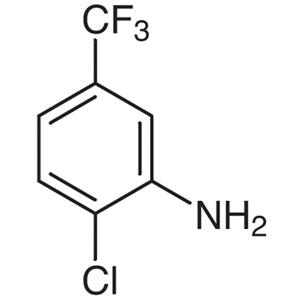
3-Amino-4-chlorobenzotrifluoride is a chemical compound widely used as a building block in the synthesis of complex organic molecules. Its structural simplicity and functional versatility make it a valuable tool for chemists working in both academic and industrial settings. This compound plays a crucial role in laboratory environments where the development of new chemical entities is required, particularly in the field of organic chemistry. Its ability to participate in various chemical reactions, such as substitution and electrophilic reactions, enhances its applicability in a wide range of synthetic pathways.
The compound's chemical properties, including its stability and reactivity, make it a preferred choice for synthetic chemists. The presence of an amino group and a chloro substituent contributes to its reactivity, while the trifluoromethyl group on the benzene ring imparts unique electronic characteristics. These properties allow for precise and efficient chemical transformations, making it ideal for the synthesis of bioactive compounds and functional materials. The combination of these functional groups ensures that the compound can be tailored for specific applications in chemical research.
In Indonesian laboratories, 3-Amino-4-chlorobenzotrifluoride is commonly used in research focused on organic synthesis, pharmaceutical development, and material science. Its availability and reliability make it a go-to reagent for scientists aiming to create new compounds with specific properties. The compound's role in both fundamental and applied research underscores its importance in the Indonesian scientific community.
Related TCI products
- TCI A1511 39885-50-2 4-Amino-3-chlorobenzotrifluoride
- TCI A1058 445-03-4 2-Amino-5-chlorobenzotrifluoride
- TCI C0922 320-51-4 5-Amino-2-chlorobenzotrifluoride
- TCI B3686 367-67-9 2-Bromo-5-nitrobenzotrifluoride
- TCI B3074 349-03-1 4-Bromo-3-nitrobenzotrifluoride
- TCI B2853 344-38-7 5-Bromo-2-nitrobenzotrifluoride
- Organic synthesis is a primary application where this compound serves as a versatile building block for creating complex molecules with specific functional groups.
- Pharmaceutical research benefits from its ability to participate in reactions that lead to the development of bioactive compounds and drug candidates.
- Material science applications leverage its unique electronic properties for the synthesis of advanced functional materials and polymers.
- Analytical chemistry uses it as a standard reference in qualitative and quantitative analysis of organic compounds.
- Environmental studies incorporate it in the investigation of chemical behavior and degradation pathways in various environmental matrices.
| Brand | TCI |
|---|---|
| CAS number | 121-50-6 |
| Molecular formula | — |
| Purity | — |
| Category | Chemistry > Building Blocks > Non-Heterocyclic Building Blocks |
| Pack sizes | Available in various quantities as per standard laboratory supply |
| Physical form | Solid |
| Storage | Store in a cool, dry place away from light and incompatible materials |
This compound should be stored in a cool, dry place, away from direct light and sources of heat. It is recommended to use airtight containers made of materials that are chemically inert, such as glass or polyethylene. Due to its reactivity, it should be handled with care, using appropriate personal protective equipment like gloves and safety goggles. It is important to ensure good ventilation in the laboratory when working with this compound to minimize exposure. Avoid contact with incompatible substances such as strong oxidizers or acids to prevent unwanted reactions. Proper storage and handling practices help maintain the compound's stability and ensure safe laboratory operations.
—
Produk Terkait
-
4-Amino-3-chlorobenzotrifluoride TCI A1511
Regular price From Rp 689.850,00Regular price -
2-Amino-5-chlorobenzotrifluoride TCI A1058
Regular price From Rp 955.500,00Regular price -
5-Amino-2-chlorobenzotrifluoride TCI C0922
Regular price From Rp 452.550,00Regular price -
2-Bromo-5-nitrobenzotrifluoride TCI B3686
Regular price From Rp 769.650,00Regular price -
4-Bromo-3-nitrobenzotrifluoride TCI B3074
Regular price From Rp 1.724.100,00Regular price -
5-Bromo-2-nitrobenzotrifluoride TCI B2853
Regular price From Rp 717.150,00Regular price -
2-Amino-5-nitrobenzotrifluoride TCI A0805
Regular price From Rp 477.750,00Regular price -
3,5-Dinitrobenzotrifluoride TCI D2699
Regular price From Rp 557.550,00Regular price