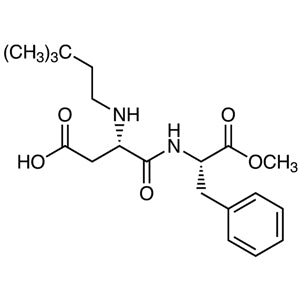
Aspartame, with CAS number 22839-47-0, is a widely used chemical compound in life sciences and organic chemistry. It is an ester formed from aspartic acid and phenylalanine, possessing a complex molecular structure and unique chemical properties. This compound plays a crucial role in laboratory settings, particularly in biochemical research and synthetic applications. Its versatility makes it a valuable resource for scientists working on molecular interactions, enzyme studies, and protein-related experiments. Aspartame’s ability to participate in various chemical reactions contributes to its significance in both academic and industrial research environments.
Aspartame is preferred due to its high solubility in water, good thermal stability, and compatibility with a wide range of functional groups. These properties allow it to be easily incorporated into chemical reactions and molecular modifications. Its stability under various experimental conditions ensures reliable results in laboratory settings. Additionally, aspartame exhibits good reactivity with different reagents, making it a versatile tool for synthesis and analytical purposes. These characteristics make it an essential component in biochemistry and organic chemistry experiments.
In Indonesian laboratories, aspartame is commonly used in research related to biochemistry, molecular biology, and chemical synthesis. It is particularly favored for its role in protein studies, enzyme activity investigations, and the development of new chemical compounds. Its availability and cost-effectiveness make it a popular choice among researchers in various scientific disciplines. Aspartame supports a wide range of experimental needs, contributing to the advancement of scientific knowledge in the region.
TCI brochures (PDF)
- Obesity_Diabete Research Reagents 2026-07-10 · p. 1
- Amino Acids and Peptide Synthesis Reagents 2025-08-14 · p. 33
- Reagents for Biological Research 2025-03-11 · p. 52
- Aspartame is used in biochemical research for studying molecular interactions due to its ability to form stable complexes with various functional groups.
- It is applied in protein synthesis experiments because of its structural similarity to amino acids, aiding in the study of peptide bonds and protein folding.
- Aspartame supports enzyme activity assays due to its role as a substrate or inhibitor in enzymatic reactions, allowing researchers to analyze enzyme kinetics.
- It is utilized in organic synthesis for its reactivity with different reagents, enabling the creation of complex molecules through esterification and other chemical reactions.
- Aspartame is used in analytical chemistry for its solubility and stability, making it suitable for chromatographic and spectroscopic analyses.
From the TCI brochure
- Artificial non-saccharide sweetener (cited as example of a peptide)
| Brand | TCI |
|---|---|
| CAS number | 22839-47-0 |
| Molecular formula | — |
| Purity | — |
| Category | Life Science > Biochemicals and Reagents > Peptides |
| Pack sizes | Available in various quantities as per standard laboratory requirements |
| Physical form | Solid powder |
| Storage | Store in a cool, dry place away from direct sunlight and moisture |
Aspartame should be stored in a cool, dry environment to maintain its chemical integrity and prevent degradation. It is recommended to keep it in airtight containers to avoid exposure to moisture and air, which can affect its stability. Laboratory personnel should handle aspartame with care, using appropriate personal protective equipment when necessary. Due to its chemical nature, it should be stored away from incompatible substances such as strong acids or bases. Proper labeling of storage containers is essential to ensure safe handling and prevent accidental contamination. Regular monitoring of storage conditions helps maintain the quality and usability of aspartame in laboratory applications.
—
Produk Terkait
-
Neotame TCI N1112
Regular price From Rp 1.008.000,00Regular priceRp 720.300,00Sale price From Rp 1.008.000,00 -
N-Acetyl-D-glucosamine TCI A0092
Regular price From Rp 980.700,00Regular priceRp 701.400,00Sale price From Rp 980.700,00 -
Xylitol TCI X0018
Regular price From Rp 505.050,00Regular priceRp 368.550,00Sale price From Rp 505.050,00 -
D-(+)-TrehaloseDihydrate[forBiochemicalResearch] TCI T4320
Regular price From Rp 662.550,00Regular priceRp 478.800,00Sale price From Rp 662.550,00 -
o-SulfobenzimideSodiumSaltDihydrate TCI B0131
Regular price From Rp 530.250,00Regular priceRp 386.400,00Sale price From Rp 530.250,00 -
Advantame TCI A3471
Regular price Rp 3.207.750,00Regular priceRp 2.258.550,00Sale price Rp 3.207.750,00 -
AcesulfameK TCI A1490
Regular price From Rp 955.500,00Regular priceRp 683.550,00Sale price From Rp 955.500,00 -
Thaumatin TCI T1144
Regular price From Rp 557.550,00Regular priceRp 405.300,00Sale price From Rp 557.550,00