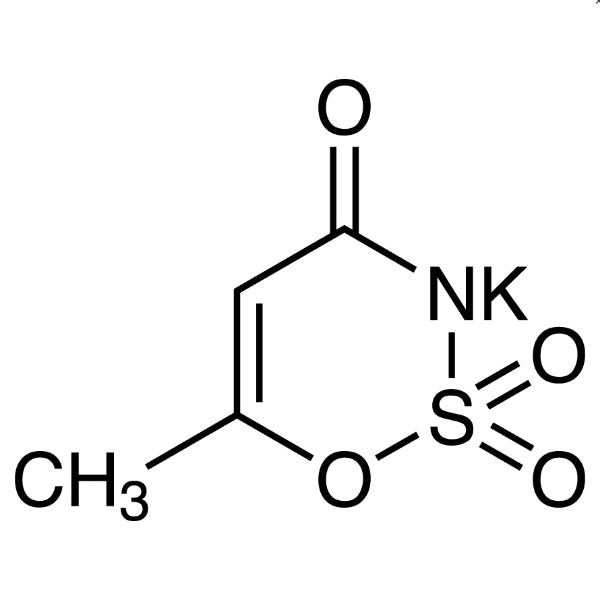

Acesulfame K, with CAS number 55589-62-3, is a widely used synthetic sweetener in nutrition and cell biology research. It serves as a key component in experiments that require precise control over sweetness without affecting blood glucose levels. This makes it particularly valuable for studying carbohydrate metabolism and metabolic disorders. In the laboratory, it is commonly used as a standard reference material for chemical analysis and sensory testing. Its stability and non-toxic nature make it a reliable choice for long-term storage and repeated use in various research settings.
Acesulfame K is known for its chemical stability, non-toxicity, and lack of odor or color, which ensures it does not interfere with analytical results. These properties make it ideal for use in both qualitative and quantitative studies. Its high sweetness intensity allows for accurate dilution and measurement in experiments, ensuring consistent results. Additionally, its resistance to degradation under normal storage conditions enhances its usability in long-term research projects. These characteristics contribute to its popularity among researchers working in the field of nutrition and cell biology.
In Indonesian laboratories, Acesulfame K is frequently employed in food composition testing, research on the effects of sweeteners on metabolism, and sensory evaluation of food products. Its role in these applications highlights its importance in advancing nutritional science and food safety research. The material is also used in studies related to health and dietary habits, supporting a wide range of scientific investigations.
TCI brochures (PDF)
- Obesity_Diabete Research Reagents 2026-07-10 · p. 1
- Reagents for Biological Research 2025-03-11 · p. 52
- Used in food composition analysis to determine the presence and concentration of sweeteners in various food samples.
- Applied in metabolic studies to assess the impact of artificial sweeteners on glucose metabolism and insulin response.
- Employed in sensory evaluation experiments to compare the taste profiles of different sweetening agents.
- Utilized in nutritional research to evaluate the effects of sweeteners on dietary habits and consumer behavior.
- Incorporated in quality control testing to ensure consistency and safety in food manufacturing processes.
| Brand | TCI |
|---|---|
| CAS number | 55589-62-3 |
| Molecular formula | — |
| Purity | — |
| Category | Life Science > Cell Biology > Nutrition Research |
| Pack sizes | Available in various quantities as per standard laboratory supply |
| Physical form | White crystalline powder |
| Storage | Store in a cool, dry place away from direct sunlight |
Acesulfame K should be stored in a cool, dry environment to maintain its chemical stability. It is recommended to keep it in a sealed container to prevent moisture absorption and contamination. Due to its non-toxic nature, it is generally safe to handle, but standard laboratory precautions should still be followed when working with chemical substances. Avoid exposure to high temperatures or direct sunlight to ensure long-term preservation. Proper labeling of containers is essential to prevent mix-ups and ensure safe handling in a laboratory setting. Always use appropriate personal protective equipment when handling this material to maintain a safe and controlled environment.
—
Produk Terkait
-
N-Acetyl-D-glucosamine TCI A0092
Regular price From Rp 980.700,00Regular priceRp 701.400,00Sale price From Rp 980.700,00 -
Xylitol TCI X0018
Regular price From Rp 505.050,00Regular priceRp 368.550,00Sale price From Rp 505.050,00 -
D-(+)-TrehaloseDihydrate[forBiochemicalResearch] TCI T4320
Regular price From Rp 662.550,00Regular priceRp 478.800,00Sale price From Rp 662.550,00 -
o-SulfobenzimideSodiumSaltDihydrate TCI B0131
Regular price From Rp 530.250,00Regular priceRp 386.400,00Sale price From Rp 530.250,00 -
Advantame TCI A3471
Regular price Rp 3.207.750,00Regular priceRp 2.258.550,00Sale price Rp 3.207.750,00 -
Aspartame TCI A0997
Regular price From Rp 769.650,00Regular priceRp 553.350,00Sale price From Rp 769.650,00 -
Thaumatin TCI T1144
Regular price From Rp 557.550,00Regular priceRp 405.300,00Sale price From Rp 557.550,00 -
D-(+)-TrehaloseAnhydrous TCI T0832
Regular price From Rp 1.167.600,00Regular priceRp 831.600,00Sale price From Rp 1.167.600,00