

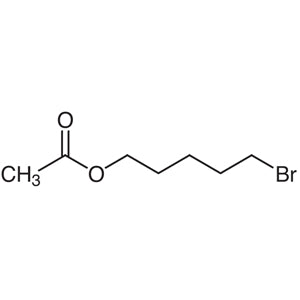
5-Bromopentyl Acetate is a chemical compound widely used as a building block in the synthesis of complex organic compounds. It plays a crucial role in organic chemistry laboratories by serving as a versatile intermediate for various synthetic pathways. Its structural simplicity allows for efficient modification through chemical reactions, making it a valuable tool for researchers aiming to create new molecules with specific functional groups. This compound is commonly employed in the development of pharmaceuticals, agrochemicals, and specialty chemicals due to its reactivity and compatibility with a range of synthetic strategies.
The compound’s stability and controlled reactivity make it a preferred choice for laboratory use. It exhibits good solubility in common organic solvents such as ethyl acetate and ethanol, which facilitates its use in reaction mixtures and purification processes. Its moderate reactivity ensures that it can be selectively modified under appropriate conditions, reducing the risk of side reactions. These properties contribute to its reliability in both academic and industrial research settings, where reproducibility and safety are paramount.
In Indonesian laboratories, 5-Bromopentyl Acetate is extensively used in organic chemistry research, particularly in the synthesis of pharmaceutical compounds and industrial chemicals. It is a staple in university research labs and chemical manufacturing facilities, supporting a wide array of experimental applications. Its availability and predictable behavior make it an essential component in the toolkit of chemists working on complex molecular structures.
Related TCI products
- Organic synthesis of pharmaceutical compounds where bromo groups are required for functional group modification.
- Development of agrochemicals and specialty chemicals through controlled alkylation and substitution reactions.
- Research in industrial chemistry for the production of intermediates used in polymer synthesis and dye manufacturing.
- Educational use in university laboratories for teaching fundamental organic reaction mechanisms and synthetic strategies.
- Preparation of brominated derivatives for further chemical transformations in medicinal chemistry and material science.
| Brand | TCI |
|---|---|
| CAS number | 15848-22-3 |
| Molecular formula | — |
| Purity | — |
| Category | Chemistry > Building Blocks > Non-Heterocyclic Building Blocks |
| Pack sizes | Available in various quantities as per standard laboratory supply practices |
| Physical form | Liquid |
| Storage | Store in a cool, dry place away from direct sunlight and incompatible materials |
5-Bromopentyl Acetate should be stored in a cool, dry environment to maintain its chemical stability. It is recommended to keep the compound in a tightly sealed container to prevent evaporation and contamination. Due to its moderate reactivity, it should be handled with care, using appropriate personal protective equipment such as gloves and safety goggles. It is important to store it away from strong oxidizing agents and incompatible substances to avoid potential chemical interactions. In laboratory settings, proper ventilation should be maintained to ensure safe handling and minimize exposure risks. Regular inspection of storage conditions is advised to ensure the compound remains in optimal condition for use.
—
Produk Terkait
-
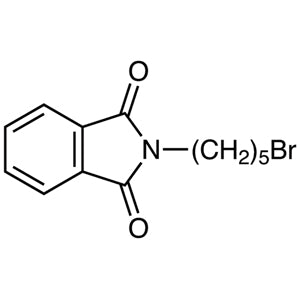
N-(5-Bromopentyl)phthalimide TCI B4986
Regular price Rp 2.571.450,00Regular priceRp 1.813.350,00Sale price Rp 2.571.450,00 -
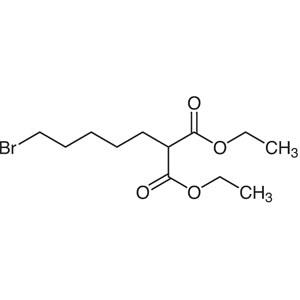
Diethyl(5-Bromopentyl)malonate TCI B2083
Regular price Rp 2.306.850,00Regular priceRp 1.628.550,00Sale price Rp 2.306.850,00 -
ButylAcetate[forSpectrophotometry] TCI A0228
Regular price Rp 1.538.250,00Regular priceRp 1.075.200,00Sale price Rp 1.538.250,00 -
VinylAcetateMonomer(stabilizedwithHQ) TCI A0045
Regular price Rp 477.750,00Regular priceRp 333.900,00Sale price Rp 477.750,00 -
PropylAcetate TCI A0044
Regular price Rp 477.750,00Regular priceRp 333.900,00Sale price Rp 477.750,00 -
PhenylAcetate TCI A0043
Regular price Rp 452.550,00Regular priceRp 316.050,00Sale price Rp 452.550,00 -
n-OctylAcetate TCI A0042
Regular price Rp 505.050,00Regular priceRp 352.800,00Sale price Rp 505.050,00 -
NonylAcetate TCI A0041
Regular price Rp 505.050,00Regular priceRp 352.800,00Sale price Rp 505.050,00
![123-86-4 Butyl Acetate [for Spectrophotometry] - AMI Scientific](http://amiscientific.com/cdn/shop/files/TCI2510A0228.jpg?v=1767078302&width=533)


