

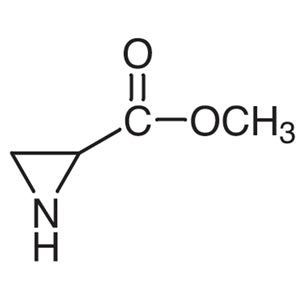
Methyl Aziridine-2-carboxylate (stabilized with HQ), with CAS number 5950-34-5, is a chemical compound widely used in laboratory settings for the synthesis of heterocyclic compounds. This building block plays a crucial role in organic chemistry by enabling the formation of complex cyclic structures. Its stability and reactivity make it a valuable tool for researchers aiming to develop new compounds in various fields, including pharmaceuticals and industrial chemicals. The presence of HQ as a stabilizer ensures that the compound remains chemically stable during storage and use, reducing the risk of degradation.
The compound's unique molecular structure allows it to participate in a variety of reaction mechanisms, such as nucleophilic, electrophilic, and substitution reactions. These properties make it highly versatile in synthetic pathways. Its ability to undergo multiple reaction types enhances its utility in the creation of diverse heterocyclic compounds. As a result, it is frequently selected by chemists for its reliability and effectiveness in synthetic processes.
In Indonesian laboratories, Methyl Aziridine-2-carboxylate is commonly used in organic chemistry research, particularly in academic institutions and research centers. It is integral to projects focused on the synthesis of new compounds, especially those with complex molecular frameworks. Its availability and stability make it a preferred choice for both educational and industrial applications in the chemical industry.
Related TCI products
- TCI B5501 147804-30-6 tert-Butyl 1-Oxa-6-azaspiro[2.5]octane-6-carboxylate
- TCI B5385 114214-49-2 tert-Butyl 6-Oxa-3-azabicyclo[3.1.0]hexane-3-carboxylate
- TCI B5248 122684-34-8 tert-Butyl 3-Carbamoylpyrrolidine-1-carboxylate
- TCI B5032 1041026-70-3 tert-Butyl 2,6-Diazaspiro[3.3]heptane-2-carboxylate
- TCI B5002 877399-74-1 tert-Butyl 4-[4-(4,4,5,5-Tetramethyl-1,3,2-dioxaborolan-2-yl)pyrazol-1-yl]piperidine-1-carboxylate
- TCI B4271 325775-44-8 tert-Butyl 3-(Aminomethyl)azetidine-1-carboxylate
- Organic synthesis of heterocyclic compounds due to its reactivity and structural versatility in forming complex cyclic frameworks.
- Development of pharmaceutical compounds as a building block for creating new drug molecules with desired biological activities.
- Industrial chemical production for the creation of specialty chemicals and intermediates used in various manufacturing processes.
- Educational research in chemistry laboratories for teaching and training in synthetic organic chemistry techniques.
- Research in material science for the synthesis of functional materials with specific chemical properties and applications.
| Brand | TCI |
|---|---|
| CAS number | 5950-34-5 |
| Molecular formula | — |
| Purity | — |
| Category | Chemistry > Building Blocks > Heterocyclic Building Blocks |
| Pack sizes | Available in various quantities as per standard chemical supply practices |
| Physical form | Liquid (as per standard chemical descriptions for this compound) |
| Storage | Store in a cool, dry place away from light and incompatible substances |
Methyl Aziridine-2-carboxylate should be stored in a cool, dry environment, away from direct sunlight and sources of heat. It is recommended to keep the compound in a sealed container to prevent exposure to air and moisture. Suitable storage containers include glass or high-density polyethylene (HDPE) bottles with tight-fitting lids. As a reactive chemical, it should be handled with appropriate personal protective equipment, such as gloves and safety goggles, to minimize exposure. Avoid contact with incompatible materials, such as strong acids or bases, to ensure safety during storage and use. Regular inspection of storage conditions is advised to maintain the compound's stability and integrity over time.
—
Produk Terkait
-
tert-Butyl1-Oxa-6-azaspiro[2.5]octane-6-carboxylate TCI B5501
Regular price Rp 3.074.400,00Regular priceRp 2.165.100,00Sale price Rp 3.074.400,00 -
tert-Butyl6-Oxa-3-azabicyclo[3.1.0]hexane-3-carboxylate TCI B5385
Regular price Rp 742.350,00Regular priceRp 534.450,00Sale price Rp 742.350,00 -
tert-Butyl3-Carbamoylpyrrolidine-1-carboxylate TCI B5248
Regular price Rp 1.113.000,00Regular priceRp 793.800,00Sale price Rp 1.113.000,00 -
tert-Butyl2,6-Diazaspiro[3.3]heptane-2-carboxylate TCI B5032
Regular price Rp 3.285.450,00Regular priceRp 2.313.150,00Sale price Rp 3.285.450,00 -
tert-Butyl4-[4-(4,4,5,5-Tetramethyl-1,3,2-dioxaborolan-2-yl)pyrazol-1-yl]piperidine-1-carboxylate TCI B5002
Regular price Rp 1.749.300,00Regular priceRp 1.239.000,00Sale price Rp 1.749.300,00 -
tert-Butyl3-(Aminomethyl)azetidine-1-carboxylate TCI B4271
Regular price Rp 2.862.300,00Regular priceRp 2.017.050,00Sale price Rp 2.862.300,00 -
Benzyl3-Oxopiperazine-1-carboxylate TCI B4100
Regular price Rp 1.378.650,00Regular priceRp 979.650,00Sale price Rp 1.378.650,00 -
tert-Butyl3-Oxopiperazine-1-carboxylate TCI B3804
Regular price Rp 1.167.600,00Regular priceRp 831.600,00Sale price Rp 1.167.600,00
![147804-30-6 tert-Butyl 1-Oxa-6-azaspiro[2.5]octane-6-carboxylate - AMI Scientific](http://amiscientific.com/cdn/shop/files/TCI2510B5501_08674994-ba62-46fc-acd1-54c812460ed8.jpg?v=1767862194&width=533)
![114214-49-2 tert-Butyl 6-Oxa-3-azabicyclo[3.1.0]hexane-3-carboxylate - AMI Scientific](http://amiscientific.com/cdn/shop/files/TCI2510B5385_5494a0f2-ca27-4c7c-b2aa-345805a88f08.jpg?v=1767861794&width=533)

![1041026-70-3 tert-Butyl 2,6-Diazaspiro[3.3]heptane-2-carboxylate - AMI Scientific](http://amiscientific.com/cdn/shop/files/TCI2510B5032.jpg?v=1767091949&width=533)
![877399-74-1 tert-Butyl 4-[4-(4,4,5,5-Tetramethyl-1,3,2-dioxaborolan-2-yl)pyrazol-1-yl]piperidine-1-carboxylate - AMI Scientific](http://amiscientific.com/cdn/shop/files/TCI2510B5002_79e00c7c-6778-4604-beae-188e01d7ad50.jpg?v=1767854889&width=533)


