


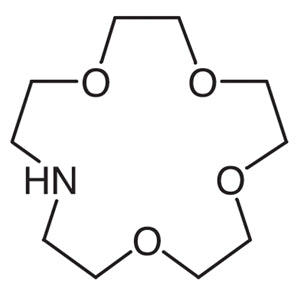
1-Aza-15-crown-5-ether is a chemical compound widely used in laboratory settings, particularly in synthetic chemistry and complexation reactions. It plays a crucial role in facilitating the formation of metal complexes by interacting with specific metal ions. Its unique molecular structure allows it to act as a ligand, binding to metal ions such as sodium, potassium, and magnesium. This makes it an essential reagent for researchers working on metal-based reactions and complex formation. Due to its ability to stabilize metal ions in solution, it is frequently employed in chemical synthesis and analytical procedures.
The compound’s ability to form stable complexes with metal ions is a key factor in its popularity among chemists. Its molecular structure, featuring a large ring system, enables it to encapsulate metal ions effectively, enhancing the efficiency of chemical reactions. This property is especially valuable in applications requiring precise control over metal ion interactions. Additionally, its chemical stability under various conditions ensures reliable performance in laboratory experiments. These characteristics make it a preferred choice for both academic and industrial research.
In Indonesian laboratories, 1-Aza-15-crown-5-ether is commonly used in organic synthesis and metal complex studies. It supports research in various fields, including coordination chemistry and catalytic processes. Many research institutions and universities rely on this compound for experiments that require the controlled interaction of metal ions with organic molecules. Its consistent performance and reliability make it a trusted reagent in the chemical research community in Indonesia.
TCI brochures (PDF)
- Macrocycles for Host-Guest Chemistry 2026-03-24 · p. 4
- Metal Complex Synthesis: This compound is ideal for creating metal complexes due to its ability to bind with specific metal ions, enhancing reaction efficiency and selectivity.
- Organic Synthesis: It is frequently used in organic reactions where metal ion coordination is necessary for catalytic or structural purposes.
- Analytical Chemistry: Its stability and complexation properties make it useful in analytical techniques that require precise metal ion detection and quantification.
- Coordination Chemistry Research: It supports studies on coordination compounds, providing a reliable ligand for metal ion interactions.
- Catalytic Reactions: The compound facilitates catalytic processes by stabilizing metal ions, improving reaction rates and selectivity in various chemical transformations.
| Brand | TCI |
|---|---|
| CAS number | 66943-05-3 |
| Molecular formula | — |
| Purity | — |
| Category | Chemistry > Synthetic Reagents > Chelation/Complexation Compounds |
| Pack sizes | Available in various quantities as per standard laboratory supply |
| Physical form | Solid or powder, depending on the specific product variant |
| Storage | Store in a cool, dry place away from moisture and direct sunlight |
This compound should be stored in a cool, dry environment to maintain its chemical integrity and prevent degradation. It is recommended to use airtight containers to protect it from moisture and contaminants. Since it is a synthetic reagent, it should be handled with care to avoid exposure to incompatible substances. Proper labeling and storage conditions are essential to ensure safety and effectiveness in laboratory use. Always follow standard laboratory safety protocols when handling and storing chemical reagents.
—