


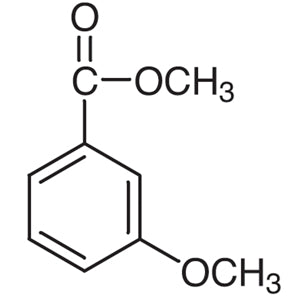
Methyl m-Anisate is a chemical compound widely used in organic laboratory reactions. It serves as a fundamental building block in the synthesis of complex organic molecules. As a key component in chemical synthesis, it is often employed in the formation of aromatic compounds and esters. Its role in laboratory settings is critical for researchers and scientists working on organic chemistry projects. This compound is valued for its stability and controlled reactivity, making it a reliable choice for various chemical processes. Its molecular structure consists of an anisate group and a methyl group, contributing to its functional versatility in chemical reactions.
Methyl m-Anisate is preferred due to its stable chemical properties and predictable reactivity. These characteristics make it suitable for use in a wide range of laboratory conditions. Its non-reactive nature ensures that it can be safely stored and used without the risk of unintended side reactions. Additionally, its consistent quality and availability make it a popular choice among researchers. The compound is available in a solid form, which facilitates easy handling and storage. Its chemical inertness also reduces the need for special handling protocols, simplifying its use in standard laboratory environments.
In Indonesian laboratories, methyl m-Anisate is commonly used in organic chemistry research, particularly in the synthesis of aromatic compounds and esters. It is also utilized in the development of pharmaceuticals, cosmetic ingredients, and industrial chemicals. Its reliability and versatility have made it a staple in chemical laboratories across Indonesia. Researchers rely on its consistent performance to achieve accurate and reproducible results in their experiments. The compound’s widespread application highlights its importance in both academic and industrial chemical research.
- Organic synthesis applications benefit from methyl m-Anisate's role in forming aromatic compounds and esters, providing a stable and predictable reagent.
- Pharmaceutical research utilizes this compound as a building block for the synthesis of various drug molecules, supporting the development of new therapeutic agents.
- Cosmetic formulation processes incorporate methyl m-Anisate to create fragrance compounds and other essential components in personal care products.
- Industrial chemical production relies on methyl m-Anisate for the creation of specialty chemicals used in manufacturing and processing.
- Educational laboratories use methyl m-Anisate to teach fundamental organic chemistry concepts and reaction mechanisms to students.
| Brand | TCI |
|---|---|
| CAS number | 5368-81-0 |
| Molecular formula | — |
| Purity | — |
| Category | Chemistry > Building Blocks > Non-Heterocyclic Building Blocks |
| Pack sizes | Available in standard laboratory quantities |
| Physical form | Solid |
| Storage | Store in a cool, dry place away from direct sunlight |
Methyl m-Anisate should be stored in a cool, dry environment to maintain its chemical stability. It is recommended to keep the compound in a sealed container to prevent moisture absorption and contamination. Standard laboratory storage conditions are sufficient for this material, as it does not require refrigeration or special handling. The solid form of methyl m-Anisate makes it easy to handle and measure accurately. Researchers should ensure that the container is properly labeled to avoid confusion with other chemicals. General laboratory safety practices, such as using appropriate personal protective equipment, should be followed when handling this compound.
—
Produk Terkait
-
Methylo-Anisate TCI A0483
Regular price From Rp 1.087.800,00Regular priceRp 775.950,00Sale price From Rp 1.087.800,00 -
Methylp-Anisate TCI A1125
Regular price From Rp 1.140.300,00Regular priceRp 812.700,00Sale price From Rp 1.140.300,00 -
Ethylp-Anisate TCI A0933
Regular price From Rp 742.350,00Regular priceRp 534.450,00Sale price From Rp 742.350,00


