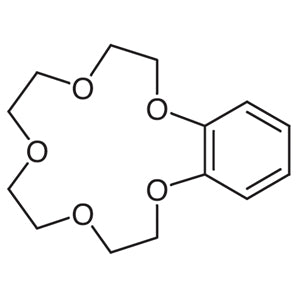
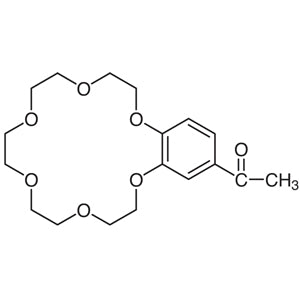
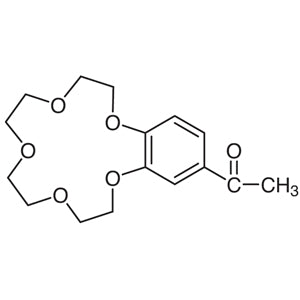
4'-Aminobenzo-15-crown 5-Ether is a synthetic reagent widely used in chemical laboratories for its ability to form stable complexes with alkali metal ions. This compound plays a crucial role in various synthetic reactions, particularly in the field of chelation and complexation chemistry. Its unique molecular structure combines a 15-crown-5 ring with an amino group at the 4' position, making it highly effective in binding metal ions. This property makes it an essential tool for researchers working on metal-ligand interactions and coordination chemistry.
The compound is preferred due to its high reactivity and stability under controlled laboratory conditions. The 15-crown-5 ring provides an efficient binding site for alkali metal ions, while the amino group enhances its polarity and reactivity. These characteristics allow it to function as a versatile ligand in both organic and inorganic reactions. Its chemical stability ensures consistent performance, making it a reliable choice for analytical and synthetic applications.
In Indonesian laboratories, 4'-Aminobenzo-15-crown 5-Ether is commonly used in organic and inorganic chemistry research. It supports a wide range of experiments, including metal ion complexation studies and synthetic pathway development. Its role in facilitating precise chemical interactions makes it a valuable reagent for both academic and industrial research settings.
TCI brochures (PDF)
- Macrocycles for Host-Guest Chemistry 2026-03-24 · p. 4
Related TCI products
- Metal ion complexation studies benefit from this compound's ability to form stable complexes with alkali metals, enhancing the accuracy of analytical procedures.
- Synthetic organic reactions often utilize this reagent to facilitate controlled metal-ligand interactions, improving reaction efficiency and selectivity.
- Coordination chemistry experiments rely on its unique structure to study the binding behavior of metal ions in different environments.
- Analytical chemistry applications use it for the selective detection and quantification of alkali metal ions in solution.
- Inorganic synthesis processes incorporate this compound to create metal-based complexes with tailored properties for specific applications.
| Brand | TCI |
|---|---|
| CAS number | 60835-71-4 |
| Molecular formula | — |
| Purity | — |
| Category | Chemistry > Synthetic Reagents > Chelation/Complexation Compounds |
| Pack sizes | Available in standard laboratory quantities |
| Physical form | Solid or powder, depending on the packaging |
| Storage | Store in a cool, dry place away from moisture and direct sunlight |
This compound should be stored in a cool, dry environment to maintain its chemical stability. It is recommended to keep it in airtight containers to prevent moisture absorption, which could affect its performance. Due to its chemical nature, it should be handled with care, using appropriate personal protective equipment such as gloves and safety goggles. Avoid exposure to strong acids or bases to prevent unwanted reactions. Proper ventilation is essential when working with this reagent to ensure a safe laboratory environment. Regular inspection of storage conditions is advised to maintain the integrity of the material over time.
—
Produk Terkait
-
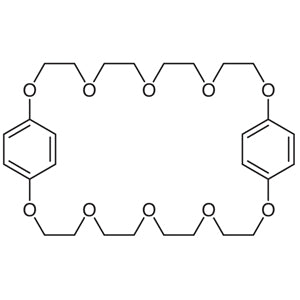
Bis(1,4-phenylene)-34-crown10-Ether TCI B2245
Regular price Rp 12.639.900,00Regular priceRp 8.854.650,00Sale price Rp 12.639.900,00 -
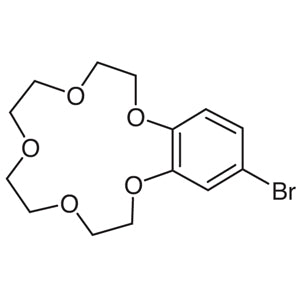
4'-Bromobenzo-15-crown5-Ether TCI B2189
Regular price From Rp 5.246.850,00Regular priceRp 3.684.450,00Sale price From Rp 5.246.850,00 -
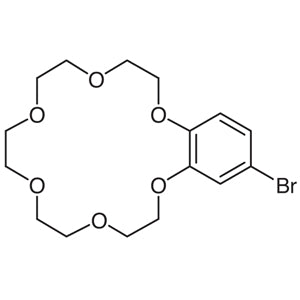
4'-Bromobenzo-18-crown6-Ether TCI B2181
Regular price From Rp 5.141.850,00Regular priceRp 3.610.950,00Sale price From Rp 5.141.850,00 -
Benzo-18-crown6-Ether TCI B1539
Regular price From Rp 1.590.750,00Regular priceRp 1.127.700,00Sale price From Rp 1.590.750,00 -
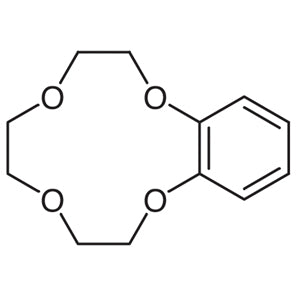
Benzo-12-crown4-Ether TCI B1249
Regular price From Rp 2.491.650,00Regular priceRp 1.757.700,00Sale price From Rp 2.491.650,00 -
Benzo-15-crown5-Ether TCI B1154
Regular price From Rp 1.776.600,00Regular priceRp 1.257.900,00Sale price From Rp 1.776.600,00 -
4'-Acetylbenzo-18-crown6-Ether TCI A1604
Regular price Rp 9.514.050,00Regular priceRp 6.668.550,00Sale price Rp 9.514.050,00 -
4'-Acetylbenzo-15-crown5-Ether TCI A1603
Regular price Rp 3.630.900,00Regular priceRp 2.554.650,00Sale price Rp 3.630.900,00