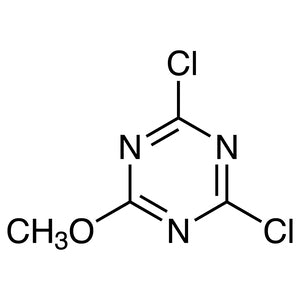
2-Amino-4-methoxy-6-methyl-1,3,5-triazine is a versatile chemical compound widely used in laboratory settings for the synthesis of heterocyclic compounds. As a building block in organic chemistry, it plays a crucial role in creating complex molecular structures that are essential for various scientific applications. This compound is particularly valuable in research areas where precise chemical modifications are required. Its unique molecular framework allows it to participate in a range of chemical reactions, making it an essential tool for chemists working on drug development and material science.
The compound is known for its chemical stability under controlled conditions, which makes it suitable for use in a variety of synthetic processes. Despite its stability, it exhibits reactivity towards acids, bases, and organic solvents, enabling it to be a key player in substitution and coupling reactions. These properties make it a preferred choice for researchers aiming to design new compounds with specific biological or functional properties. Its ability to undergo chemical transformations also enhances its utility in the development of novel materials and pharmaceuticals.
In Indonesian laboratories, 2-Amino-4-methoxy-6-methyl-1,3,5-triazine is commonly used in both academic and industrial research settings. It is a staple in chemical synthesis laboratories, where it supports the creation of new compounds for pharmaceutical, agricultural, and material science applications. Its presence in research institutions and universities underscores its importance in advancing scientific knowledge and innovation in the region.
Related TCI products
- TCI M1865 5248-39-5 2-Methoxy-4-methyl-6-(methylamino)-1,3,5-triazine
- TCI D2232 2827-45-4 2,4-Diamino-6-methoxy-1,3,5-triazine
- TCI T2059 3089-11-0 2,4,6-Tris[bis(methoxymethyl)amino]-1,3,5-triazine
- TCI A0950 7749-47-5 2-Amino-4-methoxy-6-methylpyrimidine
- TCI D3747 3638-04-8 2,4-Dichloro-6-methoxy-1,3,5-triazine
- TCI T4122 823-94-9 2,4,6-Trimethyl-1,3,5-triazine
- Used in organic synthesis for the preparation of heterocyclic compounds due to its reactivity and structural versatility.
- Applied in pharmaceutical research to develop new drugs with specific biological activities through chemical modification.
- Utilized in material science for the synthesis of advanced polymers and functional materials with tailored properties.
- Employed in academic research to explore chemical reactivity and molecular transformation pathways.
- Integrated into industrial chemical processes for the production of specialty chemicals and intermediates.
| Brand | TCI |
|---|---|
| CAS number | 1668-54-8 |
| Molecular formula | — |
| Purity | — |
| Category | Chemistry > Building Blocks > Heterocyclic Building Blocks |
| Pack sizes | Available in various quantities as per standard laboratory supply formats |
| Physical form | Solid, typically in crystalline or powder form |
| Storage | Store in a cool, dry place away from direct sunlight and moisture |
This compound should be stored in a cool, dry environment to maintain its chemical stability. It is recommended to use airtight containers to prevent exposure to moisture and air, which can affect its reactivity. Due to its sensitivity to acids and bases, it should be handled with care, using appropriate personal protective equipment such as gloves and safety goggles. In laboratory settings, it is important to ensure proper ventilation to minimize any potential hazards associated with its chemical nature. Always store the compound away from incompatible substances to maintain safety and efficacy in research applications.
—
Produk Terkait
-
2-Methoxy-4-methyl-6-(methylamino)-1,3,5-triazine TCI M1865
Regular price Rp 1.590.750,00Regular priceRp 1.127.700,00Sale price Rp 1.590.750,00 -
2,4-Diamino-6-methoxy-1,3,5-triazine TCI D2232
Regular price Rp 4.636.800,00Regular priceRp 3.258.150,00Sale price Rp 4.636.800,00 -
2,4,6-Tris[bis(methoxymethyl)amino]-1,3,5-triazine TCI T2059
Regular price From Rp 2.702.700,00Regular priceRp 1.905.750,00Sale price From Rp 2.702.700,00 -
2-Amino-4-methoxy-6-methylpyrimidine TCI A0950
Regular price From Rp 1.538.250,00Regular priceRp 1.090.950,00Sale price From Rp 1.538.250,00 -
2,4-Dichloro-6-methoxy-1,3,5-triazine TCI D3747
Regular price From Rp 1.431.150,00Regular priceRp 1.016.400,00Sale price From Rp 1.431.150,00 -
2,4,6-Trimethyl-1,3,5-triazine TCI T4122
Regular price Rp 3.180.450,00Regular priceRp 2.239.650,00Sale price Rp 3.180.450,00 -
4,4',4''-(1,3,5-Triazine-2,4,6-triyl)tribenzaldehyde TCI T4078
Regular price Rp 4.796.400,00Regular priceRp 3.369.450,00Sale price Rp 4.796.400,00 -
2,4,6-Tris(4-formylphenoxy)-1,3,5-triazine TCI T4077
Regular price Rp 2.121.000,00Regular priceRp 1.498.350,00Sale price Rp 2.121.000,00