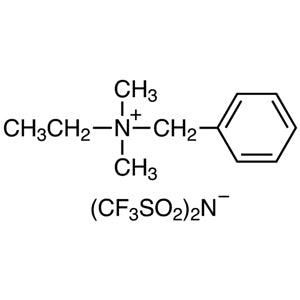
Amyltriethylammonium Bis(trifluoromethanesulfonyl)imide is an ionic liquid widely used in laboratory settings for its unique chemical properties. As a specialty chemical, it plays a crucial role in complex chemical reactions, particularly in organic synthesis and catalytic processes. Its non-volatile nature makes it ideal for applications where a stable reaction environment is essential. This compound is commonly found in advanced research and industrial laboratories, where it serves as a versatile medium for various chemical transformations.
The compound's high ionic conductivity and thermal stability make it a preferred choice for many chemical applications. Unlike traditional solvents, it does not evaporate, reducing the risk of contamination and making it suitable for long-duration experiments. Its ability to maintain chemical integrity under extreme conditions ensures reliable performance in a wide range of chemical processes. Additionally, its low volatility and non-flammability contribute to a safer working environment in the laboratory.
In Indonesian laboratories, this ionic liquid is frequently used in research and development projects. It is particularly popular in academic and industrial settings where stability and reusability are key factors. Its applications span across various fields, including pharmaceuticals, materials science, and environmental chemistry. The compound's versatility and safety profile make it a valuable tool for scientists and researchers in Indonesia.
TCI brochures (PDF)
- Ionic Liquids 2026-06-08 · p. 6
- Quaternary Ammonium Salts 2025-11-10 · p. 9
Related TCI products
- TCI T2761 268536-05-6 Trimethylpropylammonium Bis(trifluoromethanesulfonyl)imide
- TCI T2679 405514-94-5 Tributylmethylammonium Bis(trifluoromethanesulfonyl)imide
- TCI B5427 1186103-43-4 Benzyl(ethyl)dimethylammonium Bis(trifluoromethanesulfonyl)imide
- TCI B3233 258273-75-5 Butyltrimethylammonium Bis(trifluoromethanesulfonyl)imide
- TCI M1660 375395-33-8 Methyltri-n-octylammonium Bis(trifluoromethanesulfonyl)imide
- TCI E1283 1804970-28-2 Ethyl(dimethyl)(2-phenylethyl)ammonium Bis(trifluoromethanesulfonyl)imide
- Organic synthesis reactions benefit from this ionic liquid due to its non-volatile nature and ability to support diverse reaction conditions.
- Catalytic processes often utilize this compound as a reaction medium because of its high ionic conductivity and thermal stability.
- Green chemistry initiatives may employ this material as a sustainable alternative to traditional volatile solvents.
- High-temperature experiments can take advantage of its high melting point and chemical stability under extreme conditions.
- Electrochemical studies may use this ionic liquid as a medium for its excellent ion transport properties and low volatility.
| Brand | TCI |
|---|---|
| CAS number | 906478-91-9 |
| Molecular formula | — |
| Purity | — |
| Category | Chemistry > Specialty Synthesis > Ionic Liquids |
| Pack sizes | Available in various quantities as per standard laboratory supply |
| Physical form | Liquid |
| Storage | Store in a cool, dry place away from direct sunlight |
This ionic liquid should be stored in a cool, dry location, away from direct sunlight and sources of heat. It is recommended to use sealed, airtight containers to prevent any potential exposure to moisture or air. Due to its non-volatile nature, it does not require refrigeration, but it should be kept in a controlled environment to maintain its chemical integrity. Standard laboratory safety protocols should be followed when handling this material, including the use of appropriate personal protective equipment. It is important to ensure that the storage area is well-ventilated and free from incompatible substances to minimize any risk of chemical interaction.
—
Produk Terkait
-
TrimethylpropylammoniumBis(trifluoromethanesulfonyl)imide TCI T2761
Regular price From Rp 1.908.900,00Regular priceRp 1.350.300,00Sale price From Rp 1.908.900,00 -
TributylmethylammoniumBis(trifluoromethanesulfonyl)imide TCI T2679
Regular price From Rp 1.749.300,00Regular priceRp 1.239.000,00Sale price From Rp 1.749.300,00 -
Benzyl(ethyl)dimethylammoniumBis(trifluoromethanesulfonyl)imide TCI B5427
Regular price Rp 3.790.500,00Regular priceRp 2.665.950,00Sale price Rp 3.790.500,00 -
ButyltrimethylammoniumBis(trifluoromethanesulfonyl)imide TCI B3233
Regular price Rp 1.856.400,00Regular priceRp 1.313.550,00Sale price Rp 1.856.400,00 -
Methyltri-n-octylammoniumBis(trifluoromethanesulfonyl)imide TCI M1660
Regular price Rp 1.801.800,00Regular priceRp 1.275.750,00Sale price Rp 1.801.800,00 -
Ethyl(dimethyl)(2-phenylethyl)ammoniumBis(trifluoromethanesulfonyl)imide TCI E1283
Regular price From Rp 2.147.250,00Regular priceRp 1.517.250,00Sale price From Rp 2.147.250,00 -
Ethyl(3-methoxypropyl)dimethylammoniumBis(trifluoromethanesulfonyl)imide TCI E1282
Regular price Rp 3.021.900,00Regular priceRp 2.128.350,00Sale price Rp 3.021.900,00 -
Ethyl(2-methoxyethyl)dimethylammoniumBis(trifluoromethanesulfonyl)imide TCI E1281
Regular price Rp 3.021.900,00Regular priceRp 2.128.350,00Sale price Rp 3.021.900,00