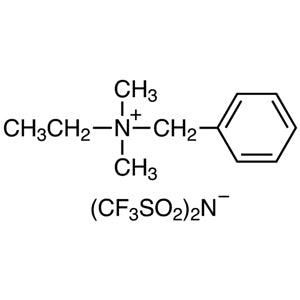
Butyltrimethylammonium Bis(trifluoromethanesulfonyl)imide is an ionic liquid widely utilized in specialized chemical reactions within laboratory settings. As a member of the ionic liquid family, it serves as a versatile solvent and reaction medium, enabling chemists to conduct reactions under milder conditions compared to traditional organic solvents. Its unique molecular structure provides stability and enhances the efficiency of various synthetic processes. This material is particularly valued for its ability to support both organic and inorganic chemical transformations, making it an essential tool in modern chemical research.
The properties of this ionic liquid make it a preferred choice for advanced laboratory applications. It is non-volatile and has a high boiling point, which allows it to remain stable under high-temperature conditions without evaporating. This characteristic is especially beneficial for reactions requiring prolonged heating. Additionally, it exhibits excellent dielectric properties, making it suitable for electrochemical and catalytic processes. Its non-toxic and non-flammable nature also contributes to its safety profile, reducing the risk of hazardous exposure in laboratory environments.
In Indonesian laboratories, this ionic liquid is commonly used in research and development projects focused on the synthesis of complex compounds. It is particularly popular in academic and industrial settings where sustainable and efficient chemical processes are prioritized. Its eco-friendly nature, as it does not produce harmful waste, aligns with the growing emphasis on green chemistry practices. This material supports innovation in fields such as materials science, pharmaceuticals, and chemical engineering, contributing to scientific advancements in Indonesia.
TCI brochures (PDF)
- Ionic Liquids for Battery Research 2026-04-13 · p. 1
- Ionic Liquids 2026-06-08 · p. 6
- Quaternary Ammonium Salts 2025-11-10 · p. 8
Related TCI products
- TCI T2761 268536-05-6 Trimethylpropylammonium Bis(trifluoromethanesulfonyl)imide
- TCI T2679 405514-94-5 Tributylmethylammonium Bis(trifluoromethanesulfonyl)imide
- TCI B5427 1186103-43-4 Benzyl(ethyl)dimethylammonium Bis(trifluoromethanesulfonyl)imide
- TCI A2274 906478-91-9 Amyltriethylammonium Bis(trifluoromethanesulfonyl)imide
- TCI M1660 375395-33-8 Methyltri-n-octylammonium Bis(trifluoromethanesulfonyl)imide
- TCI E1283 1804970-28-2 Ethyl(dimethyl)(2-phenylethyl)ammonium Bis(trifluoromethanesulfonyl)imide
- Organic synthesis reactions benefit from its stable ionic structure and ability to dissolve a wide range of compounds, enhancing reaction efficiency and yield.
- Electrochemical studies utilize its high dielectric constant, which supports the movement of ions and improves conductivity in experimental setups.
- Catalytic processes are enhanced by its non-volatile nature, ensuring consistent reaction conditions without solvent loss during prolonged experiments.
- Material science research employs it as a medium for synthesizing advanced polymers and nanomaterials due to its thermal stability and solvation properties.
- Green chemistry initiatives favor its use as a sustainable alternative to traditional solvents, reducing environmental impact and waste generation.
| Brand | TCI |
|---|---|
| CAS number | 258273-75-5 |
| Molecular formula | — |
| Purity | — |
| Category | Chemistry > Specialty Synthesis > Ionic Liquids |
| Pack sizes | Available in various sizes as per standard laboratory supply options |
| Physical form | Liquid |
| Storage | Store in a cool, dry place away from direct sunlight and incompatible materials |
This ionic liquid should be stored in a cool, dry location, away from direct sunlight and sources of heat. It is recommended to use sealed, airtight containers made of materials compatible with its chemical properties, such as glass or high-density polyethylene. Due to its non-volatile nature, it does not require refrigeration but should be kept in a controlled environment to prevent contamination. General laboratory precautions include avoiding inhalation of vapors, wearing appropriate personal protective equipment, and ensuring proper ventilation when handling. This material is not flammable, but it is important to maintain safe handling practices to ensure the integrity of the substance and the safety of laboratory personnel.
—
Produk Terkait
-
TrimethylpropylammoniumBis(trifluoromethanesulfonyl)imide TCI T2761
Regular price From Rp 1.908.900,00Regular priceRp 1.350.300,00Sale price From Rp 1.908.900,00 -
TributylmethylammoniumBis(trifluoromethanesulfonyl)imide TCI T2679
Regular price From Rp 1.749.300,00Regular priceRp 1.239.000,00Sale price From Rp 1.749.300,00 -
Benzyl(ethyl)dimethylammoniumBis(trifluoromethanesulfonyl)imide TCI B5427
Regular price Rp 3.790.500,00Regular priceRp 2.665.950,00Sale price Rp 3.790.500,00 -
AmyltriethylammoniumBis(trifluoromethanesulfonyl)imide TCI A2274
Regular price Rp 2.994.600,00Regular priceRp 2.109.450,00Sale price Rp 2.994.600,00 -
Methyltri-n-octylammoniumBis(trifluoromethanesulfonyl)imide TCI M1660
Regular price Rp 1.801.800,00Regular priceRp 1.275.750,00Sale price Rp 1.801.800,00 -
Ethyl(dimethyl)(2-phenylethyl)ammoniumBis(trifluoromethanesulfonyl)imide TCI E1283
Regular price From Rp 2.147.250,00Regular priceRp 1.517.250,00Sale price From Rp 2.147.250,00 -
Ethyl(3-methoxypropyl)dimethylammoniumBis(trifluoromethanesulfonyl)imide TCI E1282
Regular price Rp 3.021.900,00Regular priceRp 2.128.350,00Sale price Rp 3.021.900,00 -
Ethyl(2-methoxyethyl)dimethylammoniumBis(trifluoromethanesulfonyl)imide TCI E1281
Regular price Rp 3.021.900,00Regular priceRp 2.128.350,00Sale price Rp 3.021.900,00