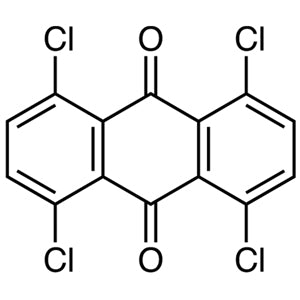
1,4-Anthraquinone is a versatile chemical compound widely used in laboratory settings, particularly in organic synthesis. As a fundamental building block, it plays a crucial role in the formation of complex molecular structures through various chemical reactions, including reduction and oxidation processes. Its chemical stability and reactivity make it an essential component for researchers working in organic and pharmaceutical fields. This compound is commonly used as a reagent or intermediate in the development of new chemical compounds and drug candidates. Its presence in laboratory workflows highlights its importance in both academic and industrial research environments.
The compound's aromatic structure contributes to its high chemical stability, making it a reliable choice for controlled chemical reactions. It exhibits good solubility in organic solvents such as ethylamine and acetone, which enhances its utility in a wide range of experimental procedures. The yellow-brown color of 1,4-Anthraquinone also aids in visual identification during laboratory work, ensuring accurate handling and application. These properties collectively make it a preferred material for researchers who require predictable and consistent chemical behavior in their experiments.
In Indonesian laboratories, 1,4-Anthraquinone is frequently used in both fundamental and applied chemical research. It is a common reagent in organic synthesis, pharmaceutical development, and analytical chemistry. Its availability and reliability make it a standard component in many research facilities across Indonesia, supporting a variety of scientific investigations and educational purposes.
- Organic synthesis: 1,4-Anthraquinone is widely used in the synthesis of complex organic compounds due to its reactivity and structural versatility.
- Pharmaceutical research: It serves as a key intermediate in the development of pharmaceutical compounds, particularly in the synthesis of dyes and drugs.
- Analytical chemistry: Its distinct color and solubility properties make it useful for qualitative and quantitative analysis in laboratory settings.
- Industrial chemical processes: It is employed in the production of various chemical products, including pigments and dyes, due to its stability and reactivity.
- Educational laboratories: It is commonly used in teaching and research environments to demonstrate chemical reactions and structural transformations.
| Brand | TCI |
|---|---|
| CAS number | 635-12-1 |
| Molecular formula | — |
| Purity | — |
| Category | Chemistry > Building Blocks > Non-Heterocyclic Building Blocks |
| Pack sizes | Available in various quantities as per standard laboratory requirements |
| Physical form | Solid |
| Storage | Store in a cool, dry place away from direct sunlight and moisture |
1,4-Anthraquinone should be stored in a cool, dry environment to maintain its chemical stability and prevent degradation. It is recommended to keep it in airtight containers to minimize exposure to moisture and air, which can affect its reactivity. Due to its chemical nature, it should be handled in a well-ventilated area to avoid inhalation of vapors. Proper personal protective equipment, such as gloves and safety goggles, should be worn during handling to ensure safety. The compound is non-hazardous under normal storage conditions but should be kept away from incompatible materials. Regular inspection of storage conditions is advised to ensure the integrity of the material remains unaffected.
—
Produk Terkait
-
2-Amino-3-hydroxyanthraquinone TCI A0315
Regular price From Rp 903.000,00Regular priceRp 631.050,00Sale price From Rp 903.000,00 -
Anthraquinone TCI A0502
Regular price From Rp 477.750,00Regular priceRp 333.900,00Sale price From Rp 477.750,00 -
Anthraquinone-2-carbonylChloride TCI A0503
Regular price From Rp 3.232.950,00Regular priceRp 2.276.400,00Sale price From Rp 3.232.950,00 -
Anthraquinone-2-carboxylicAcid TCI A0504
Regular price From Rp 2.942.100,00Regular priceRp 2.072.700,00Sale price From Rp 2.942.100,00 -
2-Vinylanthraquinone TCI V0139
Regular price From Rp 2.384.550,00Regular priceRp 1.683.150,00Sale price From Rp 2.384.550,00 -
1,4,5,8-Tetrachloroanthraquinone TCI T3300
Regular price From Rp 4.081.350,00Regular priceRp 2.869.650,00Sale price From Rp 4.081.350,00 -
2-Bromoanthraquinone TCI B2689
Regular price From Rp 1.140.300,00Regular priceRp 812.700,00Sale price From Rp 1.140.300,00 -
1-Bromoanthraquinone TCI B2688
Regular price From Rp 4.001.550,00Regular priceRp 2.814.000,00Sale price From Rp 4.001.550,00