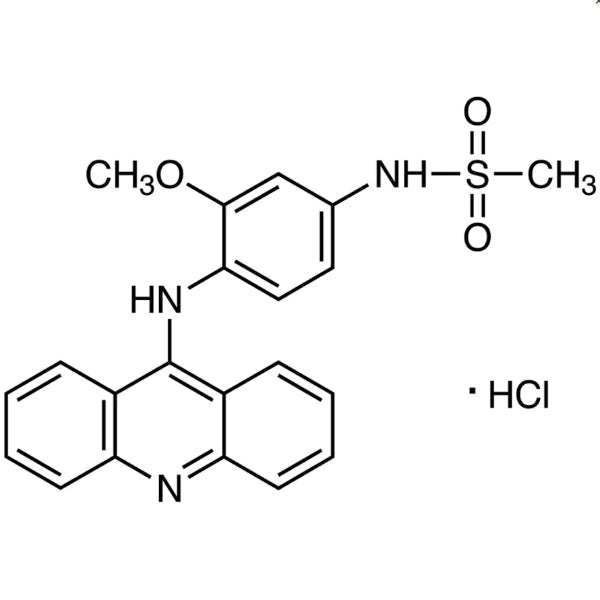
Amsacrine Hydrochloride is a chemical compound widely used in biochemical experiments and scientific research. It belongs to the category of enzyme inhibitors and enzyme substrates, playing a crucial role in studying biochemical reaction mechanisms and their impact on enzyme activity. This compound is essential for researchers aiming to understand molecular interactions and metabolic processes in biological systems. Its stability and high purity make it a reliable choice for experiments requiring precision and accuracy.
The compound’s complex chemical structure allows it to bind with DNA, influencing processes such as replication and transcription. This property makes it particularly valuable in pharmacological and molecular biology applications. Its resistance to degradation under various laboratory conditions ensures consistent performance during experiments. Additionally, its ability to maintain activity over time when stored properly enhances its utility in long-term research projects.
In Indonesian laboratories, Amsacrine Hydrochloride is commonly used for molecular and biochemical studies. Its role in exploring DNA interactions and enzyme inhibition is vital for both academic and industrial research. Due to its reliability and effectiveness, it is a preferred material for researchers focusing on drug development and biological mechanisms. Its versatility and stability make it a key component in many scientific investigations conducted in Indonesia.
TCI brochures (PDF)
- Antimicrobials and Antitumor Agents for Research and Experimental Use 2025-04-24 · p. 18
- Pharmaceutical Ingredients for Research and Experimental Use 2026-03-09 · p. 18
- Enzyme Inhibition Studies: Amsacrine Hydrochloride is ideal for investigating how it inhibits specific enzymes, offering insights into biochemical pathways and potential therapeutic applications.
- DNA Binding Research: Its ability to bind with DNA makes it suitable for studies on DNA replication, transcription, and the effects of chemical interactions on genetic material.
- Pharmacological Research: It is used in drug development to evaluate its potential as a therapeutic agent, particularly in cancer treatment and molecular targeting.
- Molecular Biology Experiments: The compound supports research into molecular interactions, providing valuable data for understanding cellular processes and disease mechanisms.
- Biochemical Assays: Its stability and purity make it a reliable reagent for various biochemical assays, ensuring accurate and reproducible results in laboratory settings.
| Brand | TCI |
|---|---|
| CAS number | 54301-15-4 |
| Molecular formula | — |
| Purity | — |
| Category | Life Science > Biochemicals and Reagents > Enzymes, Enzyme Inhibitors, Enzyme Substrates |
| Pack sizes | — |
| Physical form | — |
| Storage | Store in a cool, dry place away from light |
Amsacrine Hydrochloride should be stored in a cool, dry place away from direct light to maintain its stability and effectiveness. It is recommended to use sealed containers to prevent moisture and contamination. Proper labeling of storage containers is essential for safe handling and easy identification. Laboratory personnel should wear appropriate personal protective equipment when handling the compound. It is important to ensure good ventilation in the workspace to minimize exposure. The compound should be kept out of reach of children and not stored near incompatible materials. Following these guidelines ensures safe and effective use in laboratory environments.
—
Product Categories
- Biochemicals and ReagentsEnzymes, Enzyme Inhibitors, Enzyme SubstratesEnzyme Inhibitors [Biochemicals and Reagents]
- Biochemicals and ReagentsPharmaceutical Research Reagents (for Experimental Use)Antitumor Research Reagents (for Experimental Use)
- Cell BiologyCancer ResearchAntitumor Agents for Research
- Pharmaceutical Development and Drug Discovery ResearchPharmaceutical Research Reagents (for Experimental Use)Antitumor Research Reagents (for Experimental Use)
Produk Terkait
-
Imatinib TCI I0906
Regular price From Rp 1.378.650,00Regular priceRp 979.650,00Sale price From Rp 1.378.650,00 -
SunitinibMalate TCI U0095
Regular price Rp 3.074.400,00Regular priceRp 2.165.100,00Sale price Rp 3.074.400,00 -
TyrphostinAG835 TCI T3540
Regular price From Rp 2.068.500,00Regular priceRp 1.461.600,00Sale price From Rp 2.068.500,00 -
TyrphostinA1 TCI T3074
Regular price From Rp 1.723.050,00Regular priceRp 1.220.100,00Sale price From Rp 1.723.050,00 -
TyrphostinAG490 TCI T2962
Regular price Rp 1.431.150,00Regular priceRp 1.016.400,00Sale price Rp 1.431.150,00 -
TyrphostinAG1478 TCI T2944
Regular price Rp 6.704.250,00Regular priceRp 4.704.000,00Sale price Rp 6.704.250,00 -
TopotecanHydrocholoride TCI T2795
Regular price Rp 4.664.100,00Regular priceRp 3.277.050,00Sale price Rp 4.664.100,00 -
Afatinib TCI A2870
Regular price From Rp 2.757.300,00Regular priceRp 1.943.550,00Sale price From Rp 2.757.300,00