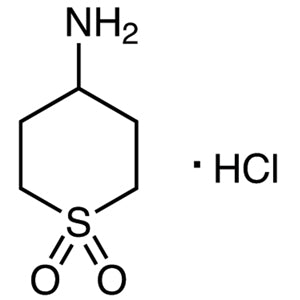
4-Aminotetrahydro-2H-thiopyran 1,1-Dioxide Hydrochloride is a chemical compound widely used in laboratory settings as a building block for the synthesis of complex heterocyclic compounds. This material plays a crucial role in organic chemistry by enabling the formation of cyclic structures containing sulfur atoms. Its unique molecular structure allows it to participate in various chemical reactions, making it a versatile tool for researchers. In the laboratory, it is commonly employed to develop new compounds with potential applications in pharmaceuticals and industrial chemistry.
The compound is valued for its chemical stability under controlled conditions, which ensures consistent performance during synthesis processes. Its sensitivity to moisture and air necessitates careful handling, but this also means it can be highly reactive in specific chemical environments. The presence of both amino and sulfurous functional groups enhances its reactivity, allowing it to engage in substitution and redox reactions. These properties make it a preferred choice for chemists working on complex molecular designs.
In Indonesian laboratories, 4-Aminotetrahydro-2H-thiopyran 1,1-Dioxide Hydrochloride is widely used in scientific research, particularly in organic chemistry and pharmacology. It is a key component in the development of new compounds with medicinal or industrial applications. Its availability supports academic and research institutions in advancing their studies and innovations.
Related TCI products
- TCI T2100 64096-87-3 Tetrahydro-2H-thiopyran-4-carboxylic Acid 1,1-Dioxide
- TCI T3320 17396-35-9 Tetrahydrothiopyran-4-one 1,1-Dioxide
- TCI T2193 39093-93-1 Thiomorpholine 1,1-Dioxide
- TCI T2050 1894677-16-7 Thiomorpholinoacetic Acid 1',1'-Dioxide Monohydrate
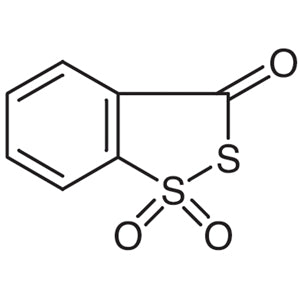
- TCI B3125 66304-01-6 3H-1,2-Benzodithiol-3-one 1,1-Dioxide
- TCI B2434 26475-66-1 4-Benzylthiomorpholine 1,1-Dioxide
- Organic synthesis of heterocyclic compounds due to its sulfur-containing structure and reactivity.
- Development of pharmaceuticals and bioactive molecules through its ability to participate in redox and substitution reactions.
- Research in medicinal chemistry for the creation of new therapeutic agents with complex molecular frameworks.
- Use in industrial chemical processes requiring the formation of cyclic structures with sulfur atoms.
- Support for academic research in Indonesian universities and research institutes focused on chemical innovation.
| Brand | TCI |
|---|---|
| CAS number | 116529-31-8 |
| Molecular formula | — |
| Purity | — |
| Category | Chemistry > Building Blocks > Heterocyclic Building Blocks |
| Pack sizes | Available in various quantities as per standard laboratory supply options |
| Physical form | Solid powder |
| Storage | Requires storage in a dry, cool, and airtight environment to prevent degradation |
This compound should be stored in a dry, cool, and airtight container to prevent moisture and air exposure, which can lead to degradation. It is recommended to use glass or sealed plastic containers that are resistant to chemical reactions. Due to its sensitivity, it should be handled in a well-ventilated area and with appropriate personal protective equipment. Avoid direct contact with skin and eyes, and ensure proper disposal following standard chemical waste protocols. Its reactivity in certain conditions means it should be used in controlled laboratory environments to maintain safety and effectiveness.
—
Produk Terkait
-
Tetrahydro-2H-thiopyran-4-carboxylicAcid1,1-Dioxide TCI T2100
Regular price Rp 1.458.450,00Regular priceRp 1.035.300,00Sale price Rp 1.458.450,00 -
Tetrahydrothiopyran-4-one1,1-Dioxide TCI T3320
Regular price Rp 1.696.800,00Regular priceRp 1.202.250,00Sale price Rp 1.696.800,00 -
Thiomorpholine1,1-Dioxide TCI T2193
Regular price Rp 4.611.600,00Regular priceRp 3.240.300,00Sale price Rp 4.611.600,00 -
ThiomorpholinoaceticAcid1',1'-DioxideMonohydrate TCI T2050
Regular price Rp 1.829.100,00Regular priceRp 1.294.650,00Sale price Rp 1.829.100,00 -
3H-1,2-Benzodithiol-3-one1,1-Dioxide TCI B3125
Regular price From Rp 1.988.700,00Regular price -
4-Benzylthiomorpholine1,1-Dioxide TCI B2434
Regular price From Rp 1.696.800,00Regular price -
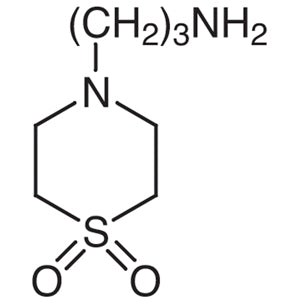
4-(3-Aminopropyl)thiomorpholine1,1-Dioxide TCI A1804
Regular price From Rp 2.306.850,00Regular price -
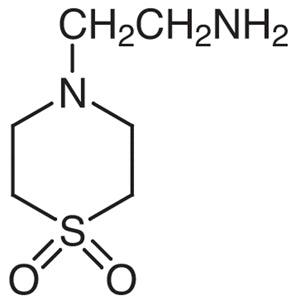
4-(2-Aminoethyl)thiomorpholine1,1-Dioxide TCI A1803
Regular price From Rp 2.597.700,00Regular price