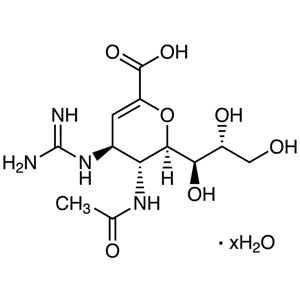
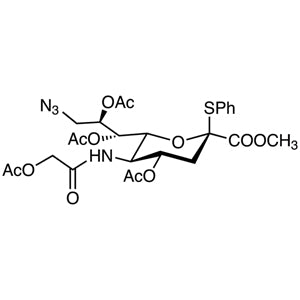
Zanamivir Azide Triacetate Methyl Ester is a chemical compound widely utilized in chemical biology and glycoscience research. It plays a crucial role in the study of influenza viruses and the inhibition of neuraminidase enzymes, which are essential for viral replication. This compound is commonly used as a substrate or inhibitor in biochemical reactions aimed at developing antiviral drugs. Its importance lies in its ability to interact specifically with enzymes, making it a valuable tool for researchers seeking to understand viral mechanisms and design targeted therapies.
The compound's chemical stability under specific conditions and its reactivity with various reagents make it a preferred choice for laboratory applications. Its molecular structure enables precise interactions with enzymes, which is vital for experiments requiring high specificity and accuracy. This characteristic allows it to be used in a wide range of biochemical and pharmaceutical studies. Additionally, its reactivity supports the synthesis of new compounds, expanding its utility in drug development and research.
In Indonesian laboratories, Zanamivir Azide Triacetate Methyl Ester is frequently used in applied research focused on drug and vaccine development. Research institutions and universities rely on this compound to study viral mechanisms and antiviral therapies. Its availability supports local researchers in accessing essential materials for their scientific work, contributing to advancements in biomedical research and public health initiatives.
Related TCI products
- TCI Z0023 551942-41-7 Zanamivir Hydrate
- TCI M2696 1195053-25-8 Methyl (Phenyl 5-Acetoxyacetamido-4,7,8-tri-O-acetyl-9-azido-3,5,9-trideoxy-2-thio-D-glycero-beta-D-galacto-2-nonulopyranosid)onate
- TCI M2695 219814-65-0 Methyl (Phenyl 5-Acetamido-4,7,8-tri-O-acetyl-9-azido-3,5,9-trideoxy-2-thio-D-glycero-beta-D-galacto-2-nonulopyranosid)onate
- TCI M2319 934591-76-1 Methyl 5-Acetamido-7,8,9-tri-O-acetyl-5-N,4-O-carbonyl-3,5-dideoxy-2-S-phenyl-2-thio-D-glycero-beta-D-galacto-2-nonulopyranosylonate
- TCI A0522 497-76-7 Arbutin
- TCI V0011 63223-57-4 N-Valeryl-D-glucosamine
- Antiviral Drug Development: This compound is used to study the inhibition of neuraminidase enzymes, aiding in the design of new antiviral agents.
- Enzyme Kinetics Research: Its ability to interact with specific enzymes makes it ideal for studying enzyme activity and inhibition mechanisms.
- Glycoscience Studies: It is employed in research related to carbohydrate-based molecules and their biological functions.
- Biochemical Assays: Its reactivity and specificity make it suitable for use in various biochemical assays and reaction systems.
- Vaccine Research: It supports studies on viral replication and immune response, contributing to vaccine development efforts.
| Brand | TCI |
|---|---|
| CAS number | 130525-58-5 |
| Molecular formula | — |
| Purity | — |
| Category | Chemistry > Chemical Biology > Glycoscience |
| Pack sizes | — |
| Physical form | — |
| Storage | Store in a cool, dry place away from light |
This compound should be stored in a cool, dry environment, away from direct light to maintain its chemical stability. It is recommended to use airtight containers to prevent exposure to moisture and contaminants. Due to its reactivity, it should be handled with care in a well-ventilated laboratory setting. Personal protective equipment, such as gloves and safety goggles, should be worn when handling the compound to ensure safety. Proper labeling of containers is essential to prevent accidental exposure. Regular monitoring of storage conditions ensures the compound remains suitable for use in research applications.
—
Product Categories
Produk Terkait
-
ZanamivirHydrate TCI Z0023
Regular price Rp 3.472.350,00Regular priceRp 2.443.350,00Sale price Rp 3.472.350,00 -
Methyl(Phenyl5-Acetoxyacetamido-4,7,8-tri-O-acetyl-9-azido-3,5,9-trideoxy-2-thio-D-glycero-beta-D-galacto-2-nonulopyranosid)onate TCI M2696
Regular price Rp 10.890.600,00Regular priceRp 7.631.400,00Sale price Rp 10.890.600,00 -
Methyl(Phenyl5-Acetamido-4,7,8-tri-O-acetyl-9-azido-3,5,9-trideoxy-2-thio-D-glycero-beta-D-galacto-2-nonulopyranosid)onate TCI M2695
Regular price Rp 24.088.050,00Regular priceRp 16.859.850,00Sale price Rp 24.088.050,00 -
Methyl5-Acetamido-7,8,9-tri-O-acetyl-5-N,4-O-carbonyl-3,5-dideoxy-2-S-phenyl-2-thio-D-glycero-beta-D-galacto-2-nonulopyranosylonate TCI M2319
Regular price From Rp 6.413.400,00Regular priceRp 4.500.300,00Sale price From Rp 6.413.400,00 -
Arbutin TCI A0522
Regular price From Rp 505.050,00Regular priceRp 368.550,00Sale price From Rp 505.050,00 -
N-Valeryl-D-glucosamine TCI V0011
Regular price Rp 1.618.050,00Regular priceRp 1.146.600,00Sale price Rp 1.618.050,00 -
1,2,3,4-Tetra-O-acetyl-beta-D-xylopyranose TCI T4066
Regular price From Rp 1.696.800,00Regular priceRp 1.202.250,00Sale price From Rp 1.696.800,00 -
2-Acetamido-1,3,4,6-tetra-O-acetyl-2-deoxy-beta-D-galactopyranose TCI T4028
Regular price Rp 2.464.350,00Regular priceRp 1.738.800,00Sale price Rp 2.464.350,00