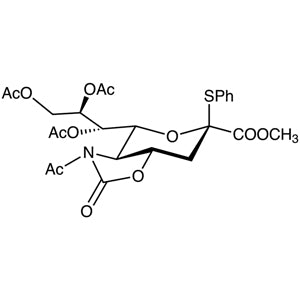
Methyl 5-Acetamido-7,8,9-tri-O-acetyl-5-N,4-O-carbonyl-3,5-dideoxy-2-S-phenyl-2-thio-D-glycero-beta-D-galacto-2-nonulopyranosylonate is a highly specialized chemical compound used in advanced research within the fields of chemical biology and glycoscience. This complex molecule plays a critical role in laboratory studies focused on molecular interactions, particularly in the investigation of receptor-binding mechanisms and biological activity. Its unique structure, incorporating both glycosidic and amine groups, makes it an essential tool for understanding the behavior of complex carbohydrates in biological systems. This compound is widely utilized in academic and industrial research settings to explore the pharmacological and biochemical properties of intricate molecular structures.
The compound's chemical stability under controlled conditions and its ability to interact with specific protein receptors make it a preferred choice for researchers. Its structural specificity allows for the study of biological responses to various stimuli, making it a valuable asset in molecular and medicinal research. The compound's versatility supports a wide range of applications, including drug development and the analysis of molecular interactions. These properties ensure its relevance in both fundamental and applied research, contributing to advancements in pharmaceutical and biochemical sciences.
In Indonesian laboratories, this compound is commonly used in pharmacology, biochemistry, and glycoscience research. It is a key component in studies aimed at understanding the molecular mechanisms of drug action and the role of complex carbohydrates in biological processes. Researchers across various institutions rely on this compound to expand their knowledge of molecular interactions and to develop new therapeutic approaches. Its use is particularly prominent in academic and research-focused environments where advanced chemical analysis is required.
- Molecular interaction studies benefit from this compound's ability to bind with specific protein receptors, aiding in the investigation of biological responses.
- Drug development research utilizes its structural complexity to model and analyze the pharmacological properties of complex molecules.
- Glycoscience research leverages its unique glycosidic structure to study carbohydrate-based interactions and their biological significance.
- Biochemical analysis employs its chemical stability to ensure accurate and reproducible results in experimental settings.
- Pharmacological studies use its molecular specificity to explore the mechanisms of drug action and receptor-ligand interactions.
| Brand | TCI |
|---|---|
| CAS number | 934591-76-1 |
| Molecular formula | — |
| Purity | — |
| Category | Chemistry > Chemical Biology > Glycoscience |
| Pack sizes | Available in standard laboratory quantities as per supplier specifications |
| Physical form | Solid powder (as per standard chemical compound presentation) |
| Storage | Store in a cool, dry place away from direct light and moisture |
This compound should be stored in a cool, dry environment, away from direct sunlight and sources of moisture. It is recommended to use airtight containers to prevent exposure to humidity and potential degradation. Due to its complex molecular structure, it is important to handle the compound with care, using appropriate personal protective equipment such as gloves and safety goggles. Avoid contact with incompatible substances and ensure proper ventilation in the laboratory. Storage conditions should be maintained to preserve the compound's chemical integrity and ensure its effectiveness in research applications. Regular monitoring of storage conditions is advised to maintain optimal stability and usability.
—
Produk Terkait
-
TCI B5774 5,10-Bis(4,4,5,5-tetramethyl-1,3,2-dioxaborolan-2-yl)naphtho[1,2-c:5,6-c']bis([1,2,5]oxadiazole)
Regular price Rp 10.255.350,00Regular price -
Dihydroiodide TCI B6569
Regular price From Rp 1.936.200,00Regular price -
Trifluoromethanesulfonate TCI B7003
Regular price From Rp 1.936.200,00Regular price
![5,10-Bis(4,4,5,5-tetramethyl-1,3,2-dioxaborolan-2-yl)naphtho[1,2-c:5,6-c']bis([1,2,5]oxadiazole) - TCI B5774 - AMI Scientific](http://amiscientific.com/cdn/shop/files/TCI2510B5774.jpg?v=1769180228&width=533)