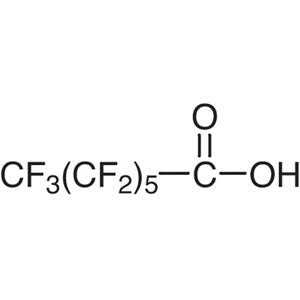
Tridecafluoroheptanoic Acid (TCI A5716), with CAS number 375-85-9, is a specialized chemical reagent used in analytical chemistry, particularly in liquid chromatography-mass spectrometry (LC-MS) applications. It functions as an ion-pair reagent, enabling the analysis of non-ionized or difficult-to-detect compounds by forming ion-pair complexes with target ions. This reagent plays a crucial role in enhancing the resolution and sensitivity of chromatographic separations, making it indispensable in modern analytical laboratories. Its unique molecular structure, rich in fluorine atoms, allows for specific interactions with ions in solution, facilitating accurate and reliable detection.
The chemical properties of Tridecafluoroheptanoic Acid make it a preferred choice for analytical applications. It exhibits high stability and minimal reactivity, ensuring consistent performance across various experimental conditions. Its solubility in organic solvents further enhances its utility, allowing for easy integration into chromatographic systems. Additionally, its compatibility with a wide range of analytical instruments and methodologies contributes to its widespread adoption in both research and industrial settings.
In Indonesian laboratories, Tridecafluoroheptanoic Acid is extensively used in chemical analysis, pharmaceutical research, and environmental studies. It is commonly employed in the analysis of complex samples such as drugs, chemical compounds, and environmental matrices. Its ability to improve detection limits and separation efficiency makes it a valuable tool for researchers and analysts working in diverse scientific fields.
TCI brochures (PDF)
- Ion-Pair Reagents for HPLC 2025-12-09 · p. 4
Related TCI products
- TCI A5721 375-85-9 Tridecafluoroheptanoic Acid High Grade [Ion-Pair Reagent for LC-MS]
- TCI A5722 307-24-4 Undecafluorohexanoic Acid High Grade [Ion-Pair Reagent for LC-MS]
- TCI A5715 307-24-4 Undecafluorohexanoic Acid (ca. 5mmol) [Ion-Pair Reagent for LC-MS]
- TCI A5714 2706-90-3 Nonafluorovaleric Acid (ca. 0.5mol/L in Water) [Ion-Pair Reagent for LC-MS]
- TCI A5713 375-22-4 Heptafluorobutyric Acid (ca. 0.5mol/L in Water) [Ion-Pair Reagent for LC-MS]
- TCI A5712 422-64-0 Pentafluoropropionic Acid (ca. 0.5mol/L in Water) [Ion-Pair Reagent for LC-MS]
- Liquid Chromatography-Mass Spectrometry (LC-MS) analysis benefits from this reagent's ability to enhance ionization efficiency and improve detection of non-volatile compounds.
- Environmental Sample Analysis utilizes its solubility and stability for the accurate quantification of pollutants in water and soil matrices.
- Pharmaceutical Research employs it to analyze drug metabolites and active pharmaceutical ingredients with high sensitivity and specificity.
- Food and Beverage Testing uses the reagent to detect trace contaminants and additives in complex matrices with improved resolution.
- Chemical Compound Identification leverages its ion-pairing properties to facilitate the separation and detection of structurally similar compounds.
| Brand | TCI |
|---|---|
| CAS number | 375-85-9 |
| Molecular formula | — |
| Purity | — |
| Category | Analytical Reagents > Chromatography Reagents and Solvents |
| Pack sizes | ca. 5mmol |
| Physical form | Solid |
| Storage | Store in a cool, dry place away from light and moisture |
Tridecafluoroheptanoic Acid should be stored in a cool, dry environment, away from direct light and moisture to maintain its chemical integrity. It is recommended to use airtight containers made of materials compatible with its chemical nature, such as glass or high-density polyethylene. As a fluorinated compound, it is generally inert and does not react under normal laboratory conditions, but care should be taken to avoid exposure to high temperatures or reactive substances. Proper labeling and storage in designated chemical cabinets are essential for safety and compliance with laboratory protocols. Always ensure that handling procedures follow standard safety practices to minimize any potential risks associated with its use.
—
Produk Terkait
-
TridecafluoroheptanoicAcidHighGrade[Ion-PairReagentforLC-MS] TCI A5721
Regular price From Rp 1.856.400,00Regular priceRp 1.313.550,00Sale price From Rp 1.856.400,00 -
UndecafluorohexanoicAcidHighGrade[Ion-PairReagentforLC-MS] TCI A5722
Regular price From Rp 1.881.600,00Regular priceRp 1.331.400,00Sale price From Rp 1.881.600,00 -
UndecafluorohexanoicAcid(ca.5mmol)[Ion-PairReagentforLC-MS] TCI A5715
Regular price Rp 2.623.950,00Regular priceRp 1.850.100,00Sale price Rp 2.623.950,00 -
NonafluorovalericAcid(ca.0.5mol/LinWater)[Ion-PairReagentforLC-MS] TCI A5714
Regular price Rp 2.227.050,00Regular priceRp 1.572.900,00Sale price Rp 2.227.050,00 -
HeptafluorobutyricAcid(ca.0.5mol/LinWater)[Ion-PairReagentforLC-MS] TCI A5713
Regular price From Rp 980.700,00Regular priceRp 701.400,00Sale price From Rp 980.700,00 -
PentafluoropropionicAcid(ca.0.5mol/LinWater)[Ion-PairReagentforLC-MS] TCI A5712
Regular price Rp 742.350,00Regular priceRp 534.450,00Sale price Rp 742.350,00 -
TrifluoroaceticAcid(ca.0.5mol/LinWater)[Ion-PairReagentforLC-MS] TCI A5711
Regular price Rp 742.350,00Regular priceRp 534.450,00Sale price Rp 742.350,00 -
TridecafluoroheptanoicAcid TCI T1545
Regular price From Rp 1.829.100,00Regular priceRp 1.294.650,00Sale price From Rp 1.829.100,00