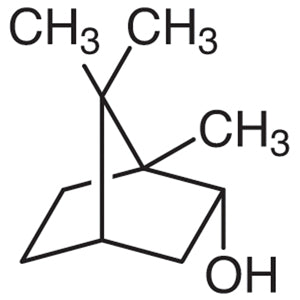
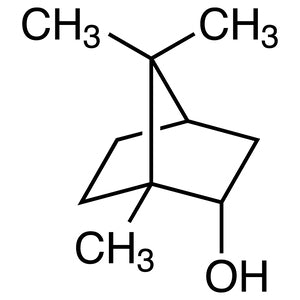
Borneol is an organic compound belonging to the terpenoid family, known for its complex molecular structure and versatile applications in both chemical and biochemical research. It is widely used in laboratories for its ability to interact with various compounds, making it a key component in extraction, synthesis, and characterization processes. This material plays a crucial role in the development of pharmaceuticals, cosmetics, and food additives due to its unique chemical properties and aromatic nature. Its presence in laboratory settings is essential for a range of experiments that require precise chemical interactions and functional group manipulations.
Borneol is valued for its physical and chemical properties, including solubility in organic solvents and the ability to form complexes with metals. These characteristics make it a preferred choice for researchers working in organic chemistry, pharmacology, and biochemistry. Its natural occurrence and availability in a form containing approximately 20% isoborneol add to its utility, as it allows for varied chemical applications. The compound’s distinct aroma also makes it an important ingredient in the fragrance and flavor industries, further expanding its relevance in both academic and industrial research.
In Indonesian laboratories, Borneol is commonly used in chemical synthesis, pharmacological studies, and biochemical experiments. Its role in research related to natural products, drug development, and sensory analysis is well-established. Researchers in Indonesia rely on Borneol for its reliability and consistency, making it a staple in both academic and industrial laboratory environments.
TCI brochures (PDF)
- Terpenes 2025-09-22 · p. 5
- Borneol is ideal for organic synthesis experiments due to its ability to participate in various chemical reactions and form complexes with metal ions, enhancing reaction efficiency and product yield.
- In pharmacological research, Borneol is used to study its antimicrobial and antiseptic properties, which are crucial for developing new therapeutic agents and natural remedies.
- Borneol is widely applied in biochemical studies for its role in enzyme activity assays and as a component in the preparation of reagents for analytical techniques such as chromatography and spectroscopy.
- In the development of cosmetic products, Borneol is used for its aromatic and skin-friendly properties, contributing to the formulation of fragrances and topical treatments.
- Borneol is also used in food science for its role in flavoring and aroma enhancement, particularly in the creation of natural food additives and flavor compounds.
| Brand | TCI |
|---|---|
| CAS number | 507-70-0 |
| Molecular formula | — |
| Purity | — |
| Category | Life Science > Biochemicals and Reagents > Terpenes |
| Pack sizes | Available in various quantities as per standard laboratory supply |
| Physical form | Solid, crystalline or powder |
| Storage | Store in a cool, dry place away from direct sunlight and moisture |
Borneol should be stored in a cool, dry environment to maintain its chemical integrity and prevent degradation. It is recommended to use airtight containers made of glass or stainless steel to avoid contamination and ensure stability. Due to its potential reactivity with certain substances, it should be handled with care in a well-ventilated area. Proper labeling of containers is essential for safety and identification. Laboratory personnel should wear appropriate personal protective equipment, such as gloves and safety goggles, when handling Borneol. Regular monitoring of storage conditions is advised to ensure optimal preservation and safe usage.
—
Produk Terkait
-
(+/-)-Isoborneol TCI I0275
Regular price From Rp 530.250,00Regular priceRp 386.400,00Sale price From Rp 530.250,00 -
(-)-Borneol TCI B1012
Regular price From Rp 928.200,00Regular priceRp 664.650,00Sale price From Rp 928.200,00 -
(+)-Borneol TCI B6417
Regular price From Rp 1.167.600,00Regular priceRp 831.600,00Sale price From Rp 1.167.600,00 -
BornylAcetate(containsca.20%IsobornylAcetate) TCI B0526
Regular price Rp 717.150,00Regular priceRp 500.850,00Sale price Rp 717.150,00 -
(+/-)-Camphene(containsca.20%Tricyclene) TCI C0009
Regular price From Rp 530.250,00Regular priceRp 370.650,00Sale price From Rp 530.250,00 -
(+)-Camphor TCI C0010
Regular price From Rp 530.250,00Regular priceRp 386.400,00Sale price From Rp 530.250,00 -
(+)-Terpinen-4-ol(contains35%(-)-Terpinen-4-olatmaximum) TCI T2581
Regular price Rp 4.425.750,00Regular priceRp 1.277.850,00Sale price Rp 4.425.750,00 -
beta-SitosterolAcetate(containsCampesterolAcetate) TCI S0221
Regular price From Rp 2.359.350,00Regular priceRp 1.649.550,00Sale price From Rp 2.359.350,00