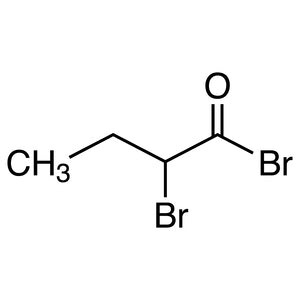
2-Bromobutyric Acid (TCI B0564) is a versatile chemical compound widely utilized in laboratory settings for various synthetic reactions. As a key component in organic chemistry, it serves as a fundamental building block for the synthesis of more complex molecules. Its bromo group makes it particularly valuable in nucleophilic substitution reactions and other chemical transformations where reactivity and selectivity are essential. This compound is commonly found in research laboratories, especially in fields such as pharmaceutical development and chemical synthesis.
One of the main reasons 2-Bromobutyric Acid is preferred is its chemical stability and reactivity. It maintains its structural integrity under standard laboratory conditions, making it easy to store and handle. Its ability to react with a wide range of reagents allows chemists to create diverse molecular structures, which is crucial for developing new compounds. Additionally, its predictable behavior in different reaction environments enhances its reliability in both academic and industrial research.
In Indonesian laboratories, 2-Bromobutyric Acid is frequently used in chemical research, pharmaceutical development, and industrial applications. Its role in creating new compounds and its adaptability to various synthetic methods make it a valuable resource for scientists. This compound is essential in the production of pharmaceuticals and other chemical products, supporting both academic and commercial research efforts. Its availability and reliability ensure that it remains a staple in the chemical supply chain in Indonesia.
- Organic synthesis: This compound is widely used in the synthesis of complex organic molecules due to its reactive bromo group, which facilitates nucleophilic substitution reactions.
- Pharmaceutical research: It plays a key role in the development of new drugs, as it can be modified to create various therapeutic agents through chemical modifications.
- Chemical modification studies: Its bromo functionality makes it ideal for studying substitution reactions and structural changes in organic compounds.
- Industrial chemical production: It is utilized in the manufacturing of specialty chemicals and intermediates for various industrial applications.
- Academic research: It is a common reagent in university and research laboratory settings for teaching and experimental purposes.
| Brand | TCI |
|---|---|
| CAS number | 80-58-0 |
| Molecular formula | — |
| Purity | — |
| Category | Chemistry > Building Blocks > Non-Heterocyclic Building Blocks |
| Pack sizes | Available in various quantities as per standard laboratory supply options |
| Physical form | Solid, crystalline appearance |
| Storage | Store in a cool, dry place away from moisture and direct sunlight |
2-Bromobutyric Acid should be stored in a cool, dry environment to maintain its chemical stability. It is recommended to keep it in a sealed container to prevent exposure to moisture and air. Due to its reactivity, it should be handled with appropriate personal protective equipment, such as gloves and safety goggles. Avoid direct contact with skin and eyes, and ensure proper ventilation in the workspace. While it is generally stable under standard laboratory conditions, it should be stored away from incompatible substances to prevent any potential chemical interactions. Proper storage and handling practices help ensure the safety and effectiveness of this compound in laboratory applications.
—
Produk Terkait
-
4-BromobutyricAcid TCI B1279
Regular price Rp 2.199.750,00Regular priceRp 1.554.000,00Sale price Rp 2.199.750,00 -
4-BromobutylAcetate TCI B4958
Regular price From Rp 769.650,00Regular priceRp 537.600,00Sale price From Rp 769.650,00 -
2-BromobutyrylChloride TCI B4105
Regular price From Rp 2.969.400,00Regular priceRp 2.091.600,00Sale price From Rp 2.969.400,00 -
Methyl4-Bromobutyrate TCI B2308
Regular price From Rp 2.147.250,00Regular priceRp 1.517.250,00Sale price From Rp 2.147.250,00 -
Methyl2-Bromobutyrate TCI B1462
Regular price From Rp 689.850,00Regular priceRp 497.700,00Sale price From Rp 689.850,00 -
Ethyl4-Bromobutyrate TCI B0999
Regular price From Rp 900.900,00Regular priceRp 645.750,00Sale price From Rp 900.900,00 -
Ethyl2-Bromobutyrate TCI B0800
Regular price From Rp 662.550,00Regular priceRp 478.800,00Sale price From Rp 662.550,00 -
2-BromobutyrylBromide TCI B0566
Regular price Rp 2.518.950,00Regular priceRp 1.776.600,00Sale price Rp 2.518.950,00