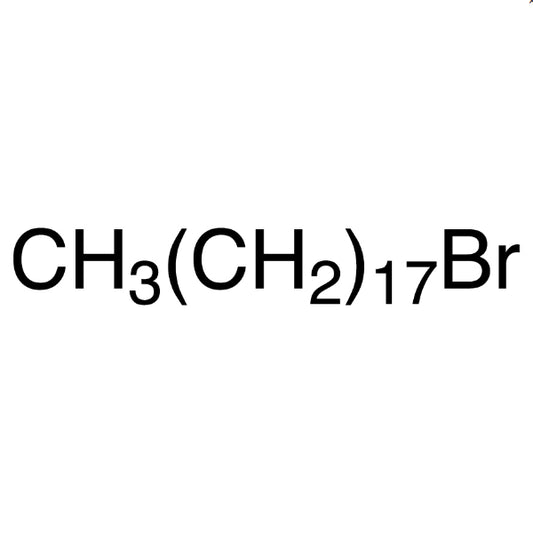
1-Bromononane is a chemical compound widely used as a foundational building block in various chemical reactions. It serves as a key reagent in organic synthesis, particularly in the creation of complex organic molecules. Its simple molecular structure plays a crucial role in facilitating chemical transformations, making it an essential material for researchers in chemical laboratories. Due to its reactivity, it is frequently employed in substitution and elimination reactions, contributing to the development of new compounds with specific functional groups.
The compound is highly reactive towards nucleophiles such as hydroxide ions and amines, which makes it ideal for substitution reactions. Its bromine group is easily replaceable, allowing for versatile chemical modifications. This reactivity, combined with its chemical stability under controlled conditions, ensures its reliability in laboratory settings. Its ability to participate in multiple reaction types enhances its utility across different synthetic pathways.
In Indonesian laboratories, 1-Bromonanane is extensively used in organic chemistry research, particularly in academic institutions and research centers. It is commonly applied in experiments requiring high reactivity and stability. Its availability in various packaging options makes it suitable for both small-scale and large-scale experimental needs. Its role in the synthesis of new compounds underscores its importance in advancing chemical research in Indonesia.
TCI brochures (PDF)
- Building Blocks for Organic Semiconductor 2026-03-24 · p. 41
- Organic synthesis: 1-Bromononane is ideal for creating complex organic molecules due to its reactivity and substitution capabilities.
- Nucleophilic substitution reactions: The compound's bromine group facilitates efficient substitution with nucleophiles like hydroxide or amine ions.
- Elimination reactions: Its structure allows for the formation of alkenes through elimination processes, making it valuable in synthetic pathways.
- Research in chemical engineering: It is used to develop new materials and compounds with specific functional groups.
- Educational experiments: It is commonly used in teaching environments to demonstrate substitution and elimination reactions.
| Brand | TCI |
|---|---|
| CAS number | 693-58-3 |
| Molecular formula | — |
| Purity | — |
| Category | Chemistry > Building Blocks > Non-Heterocyclic Building Blocks |
| Pack sizes | Available in various sizes to suit different experimental scales. |
| Physical form | Liquid at room temperature. |
| Storage | Store in a cool, dry place away from direct sunlight. |
1-Bromononane should be stored in a cool, dry environment to maintain its chemical stability. It is recommended to keep it in tightly sealed containers to prevent exposure to air and moisture. Due to its reactivity, it should be handled in a well-ventilated area, preferably under a fume hood. Avoid contact with incompatible substances such as strong bases or oxidizing agents. Always use appropriate personal protective equipment, including gloves and safety goggles, when handling this compound. Proper storage and handling ensure the safety of laboratory personnel and the integrity of the compound during experiments.
—
Product Categories
Produk Terkait
-
1,9-Dibromononane TCI D1746
Regular price Rp 1.936.200,00Regular priceRp 1.353.450,00Sale price Rp 1.936.200,00 -
1-Bromoheptadecane TCI B0937
Regular price From Rp 3.340.050,00Regular priceRp 2.335.200,00Sale price From Rp 3.340.050,00 -
1-Bromopentadecane TCI B0936
Regular price From Rp 3.949.050,00Regular priceRp 2.761.500,00Sale price From Rp 3.949.050,00 -
1-Bromotridecane TCI B0935
Regular price From Rp 2.518.950,00Regular priceRp 1.760.850,00Sale price From Rp 2.518.950,00 -
1-Bromoundecane TCI B0934
Regular price From Rp 1.035.300,00Regular priceRp 723.450,00Sale price From Rp 1.035.300,00 -
1-Bromopentane TCI B0628
Regular price From Rp 530.250,00Regular priceRp 370.650,00Sale price From Rp 530.250,00 -
1-Bromooctane TCI B0626
Regular price From Rp 452.550,00Regular priceRp 316.050,00Sale price From Rp 452.550,00 -
1-Bromooctadecane TCI B0625
Regular price From Rp 452.550,00Regular priceRp 316.050,00Sale price From Rp 452.550,00