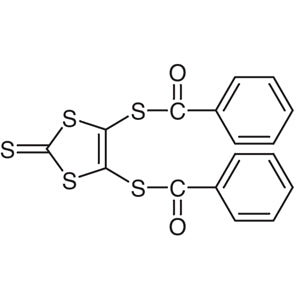
Bis(tetrabutylammonium) Bis(1,3-dithiole-2-thione-4,5-dithiolato)palladium(II) is a specialized organopalladium compound used in advanced materials research, particularly in the fields of electronics and molecular conductors. This compound plays a crucial role in the synthesis of complex organic materials, where its unique chemical properties enable the formation of stable metal complexes. Its presence in laboratory settings supports the development of new materials with tailored electronic properties, making it an essential tool for researchers working on next-generation electronic devices and conductive systems.
The compound is valued for its ability to form stable complexes with heavy metal ions and its high reactivity, which facilitates efficient chemical reactions. These properties make it a preferred choice for catalytic applications, especially in reactions requiring metal activation. Its molecular structure also allows for the design of novel materials with unique electronic behaviors, enhancing its utility in both academic and industrial research environments. The compound’s versatility supports a wide range of experimental approaches in materials science.
In Indonesian laboratories, this compound is commonly used in molecular conductor research and organic catalyst development. Its application is particularly relevant for institutions focused on material science and information technology, where the synthesis of advanced electronic materials is a key area of study. Researchers in Indonesia rely on this compound to explore new pathways in electronic material innovation and conductive system development.
TCI brochures (PDF)
- Magnetic Metal Complexes 2024-12-16 · p. 2
- Molecular Conductors 2025-11-13 · p. 4
Related TCI products
- TCI T1416 105029-70-7 Tetrabutylphosphonium Bis(1,3-dithiole-2-thione-4,5-dithiolato)nickel(III) Complex
- TCI T1272 68401-88-7 Tetrabutylammonium Bis(1,3-dithiole-2-thione-4,5-dithiolato)nickel(III) Complex
- TCI D2134 120141-26-6 Dioctadecyldimethylammonium Bis(1,3-dithiole-2-thione-4,5-dithiolato)aurate(III)
- TCI B1221 68449-38-7 Bis(tetrabutylammonium) Bis(1,3-dithiole-2-thione-4,5-dithiolato)zinc Complex [Organic Electronic Material]
- TCI B2228 132765-35-6 4,5-Bis(2-cyanoethylthio)-1,3-dithiole-2-thione
- TCI B1778 49638-64-4 4,5-Bis(methylthio)-1,3-dithiole-2-thione
- Molecular Conductor Research: This compound is used to synthesize and study new materials with unique electronic properties, supporting the development of advanced conductive systems.
- Organic Catalyst Development: Its high reactivity and ability to form stable metal complexes make it ideal for catalytic reactions requiring metal activation in organic synthesis.
- Electronic Material Innovation: The compound’s structural versatility enables the creation of novel electronic materials with tailored properties for next-generation devices.
- Conductive System Design: It supports the development of molecular conductors, which are essential for applications in flexible electronics and energy storage.
- Advanced Material Synthesis: Its role in forming stable metal complexes makes it a valuable tool for the synthesis of complex organic compounds in materials science research.
| Brand | TCI |
|---|---|
| CAS number | 72688-90-5 |
| Molecular formula | — |
| Purity | — |
| Category | Materials Science > Electronic Materials > Molecular Conductors |
| Pack sizes | Available in various quantities as per standard laboratory supply |
| Physical form | Solid (exact form may vary based on supplier specifications) |
| Storage | Store in a cool, dry place away from moisture and direct sunlight |
This compound should be stored in a cool, dry environment to maintain its chemical stability. It is recommended to use airtight containers to prevent exposure to moisture and air, which can affect its reactivity. Due to its potential reactivity, it should be handled in a well-ventilated area, and appropriate personal protective equipment should be worn. The compound is not typically hazardous under normal storage conditions but should be kept away from incompatible substances. Regular inspection of storage conditions is advised to ensure the material remains in optimal condition for laboratory use.
—
Produk Terkait
-
TetrabutylphosphoniumBis(1,3-dithiole-2-thione-4,5-dithiolato)nickel(III)Complex TCI T1416
Regular price Rp 4.266.150,00Regular priceRp 2.998.800,00Sale price Rp 4.266.150,00 -
TetrabutylammoniumBis(1,3-dithiole-2-thione-4,5-dithiolato)nickel(III)Complex TCI T1272
Regular price Rp 1.590.750,00Regular priceRp 1.127.700,00Sale price Rp 1.590.750,00 -
DioctadecyldimethylammoniumBis(1,3-dithiole-2-thione-4,5-dithiolato)aurate(III) TCI D2134
Regular price Rp 2.121.000,00Regular priceRp 1.498.350,00Sale price Rp 2.121.000,00 -
Bis(tetrabutylammonium)Bis(1,3-dithiole-2-thione-4,5-dithiolato)zincComplex[OrganicElectronicMaterial] TCI B1221
Regular price From Rp 5.592.300,00Regular priceRp 3.925.950,00Sale price From Rp 5.592.300,00 -
4,5-Bis(2-cyanoethylthio)-1,3-dithiole-2-thione TCI B2228
Regular price Rp 4.479.300,00Regular priceRp 3.147.900,00Sale price Rp 4.479.300,00 -
4,5-Bis(methylthio)-1,3-dithiole-2-thione TCI B1778
Regular price Rp 3.658.200,00Regular priceRp 2.573.550,00Sale price Rp 3.658.200,00 -
4,5-Bis(benzoylthio)-1,3-dithiole-2-thione TCI B1199
Regular price From Rp 2.782.500,00Regular priceRp 1.961.400,00Sale price From Rp 2.782.500,00 -
5-Propyl-1,3-dithiolo[4,5-d][1,3]dithiole-2-thione TCI P1635
Regular price From Rp 2.252.250,00Regular priceRp 1.590.750,00Sale price From Rp 2.252.250,00