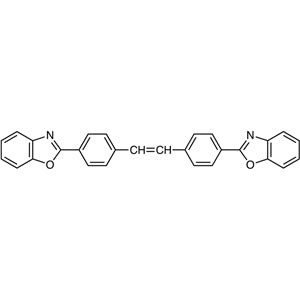
4-(2-Benzoxazolyl)-4'-(5-methyl-2-benzoxazolyl)stilbene is a complex organic compound widely used in laboratory settings for various synthetic reactions. As a heterocyclic building block, it plays a crucial role in the development of more complex organic molecules. Its unique molecular structure makes it a valuable reagent in the field of organic chemistry, particularly in the synthesis of aromatic and heterocyclic compounds. This compound is frequently employed as a starting material in the preparation of compounds with intricate molecular frameworks.
The compound's chemical stability and reactivity with a wide range of organic reagents make it a preferred choice for researchers. Its molecular structure, which includes two benzoxazole units, contributes to its unique reactivity profile. This allows it to participate in various types of reactions, such as substitution, condensation, and aromatic reactions. The compound’s versatility and reliability in synthetic processes make it a go-to material for scientists working in both academic and industrial research environments.
In Indonesian laboratories, this compound is commonly used in organic chemistry and pharmacological research. It is a key component in experiments aimed at developing new compounds with potential applications in drug discovery and material science. Its availability and purity make it a popular choice among researchers in various scientific institutions and universities across Indonesia.
- Organic synthesis applications benefit from this compound's ability to participate in a wide range of reaction mechanisms, making it ideal for creating complex molecular structures.
- Pharmacological research utilizes this material due to its potential in developing new drugs, particularly those with heterocyclic frameworks.
- Material science experiments leverage its unique molecular structure to explore new properties in synthetic polymers and advanced materials.
- Educational institutions use it as a teaching tool to demonstrate the principles of heterocyclic chemistry and synthetic pathways.
- Industrial research labs incorporate it into their workflows for the development of novel chemical compounds with specialized functions.
| Brand | TCI |
|---|---|
| CAS number | 5242-49-9 |
| Molecular formula | — |
| Purity | — |
| Category | Chemistry > Building Blocks > Heterocyclic Building Blocks |
| Pack sizes | Available in various quantities as per standard laboratory supply formats |
| Physical form | Solid, typically in crystalline or powder form |
| Storage | Store in a cool, dry place away from light and moisture |
This compound should be stored in a cool, dry environment, away from direct sunlight and sources of moisture. It is recommended to use airtight containers to prevent exposure to air and humidity. Due to its chemical stability, it does not require refrigeration but should be kept in a controlled laboratory setting. When handling, it is advisable to use appropriate personal protective equipment, such as gloves and safety goggles, to ensure safety. The compound is non-hazardous under normal conditions but should be treated with care to avoid any accidental contamination or exposure. Proper storage and handling are essential to maintain its integrity and effectiveness in laboratory applications.
—
Produk Terkait
-
4,4'-Bis(2-benzoxazolyl)stilbene TCI B2729
Regular price Rp 637.350,00Regular priceRp 460.950,00Sale price Rp 637.350,00 -
1,4-Bis(2-benzoxazolyl)naphthalene TCI B2728
Regular price From Rp 1.776.600,00Regular priceRp 1.257.900,00Sale price From Rp 1.776.600,00 -
trans-StilbeneOxide TCI S0262
Regular price From Rp 1.803.900,00Regular priceRp 1.261.050,00Sale price From Rp 1.803.900,00 -
Benzoxazole TCI B0095
Regular price Rp 1.881.600,00Regular priceRp 1.331.400,00Sale price Rp 1.881.600,00 -
2-(2-Pyridyl)benzoxazole TCI P2098
Regular price Rp 1.483.650,00Regular priceRp 1.053.150,00Sale price Rp 1.483.650,00 -
6-Methyl-1,3-benzoxazole-2(3H)-thione TCI M3063
Regular price From Rp 1.908.900,00Regular priceRp 1.350.300,00Sale price From Rp 1.908.900,00 -
2-(Methylthio)benzoxazole TCI M2454
Regular price From Rp 1.483.650,00Regular priceRp 1.053.150,00Sale price From Rp 1.483.650,00 -
2-(2-Hydroxyphenyl)benzoxazole TCI H0291
Regular price From Rp 557.550,00Regular priceRp 405.300,00Sale price From Rp 557.550,00