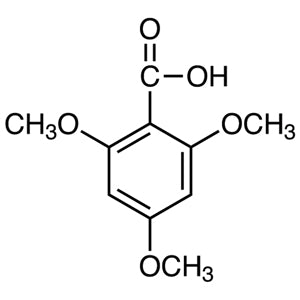
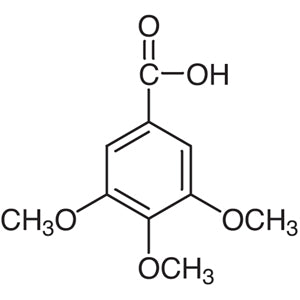
3-Bromo-2,5,6-trimethoxybenzoic Acid is a chemical compound widely used in organic synthesis reactions within laboratory settings. This compound serves as a fundamental building block for the development of more complex molecular structures. Its versatility makes it an essential material for chemists engaged in research and development. In laboratory environments, it plays a crucial role in the modification of molecular frameworks and the creation of new chemical entities. Its presence supports both academic and industrial research by providing a reliable starting material for various synthetic pathways.
The compound's unique combination of bromo and methoxy groups contributes to its reactivity and functional versatility. These substituents allow for a range of chemical transformations, including substitution and electrophilic reactions. This reactivity, combined with its chemical stability, makes it a preferred choice for synthetic chemists. The compound’s predictable behavior under different reaction conditions enables researchers to design and execute experiments with greater precision. Its well-defined structure also facilitates the synthesis of derivatives with specific functional properties.
In Indonesian laboratories, this compound is commonly used in chemical research and applied sciences. It is a key component in experiments related to the synthesis of aromatic compounds and pharmaceutical development. Its availability supports the work of researchers and students in both academic and industrial settings. The compound is widely utilized in the study of organic chemistry, particularly in the context of drug discovery and molecular modification. Its role in Indonesian laboratories underscores its importance in advancing scientific knowledge and innovation.
Related TCI products
- Organic synthesis of aromatic compounds due to its bromo and methoxy functional groups enabling diverse chemical transformations.
- Pharmaceutical research for the development of new drugs through structural modification and functional group manipulation.
- Molecular modification studies to explore reactivity and stability under various reaction conditions.
- Academic research in chemical education for teaching and experimental purposes in undergraduate and graduate programs.
- Drug discovery projects where the compound serves as a starting material for the synthesis of bioactive molecules.
| Brand | TCI |
|---|---|
| CAS number | 101460-22-4 |
| Molecular formula | — |
| Purity | — |
| Category | Chemistry > Building Blocks > Non-Heterocyclic Building Blocks |
| Pack sizes | Available in various quantities as per standard laboratory supply formats |
| Physical form | Solid (exact form may vary based on supplier packaging) |
| Storage | Store in a cool, dry place away from light and moisture |
This compound should be stored in a cool, dry environment, away from direct light and moisture to maintain its chemical integrity. It is recommended to use sealed containers to prevent exposure to air and humidity, which can affect its stability. Proper labeling of storage containers is essential to ensure safe handling and prevent accidental use. In laboratory settings, it should be handled with appropriate personal protective equipment, including gloves and safety goggles, to minimize exposure. Due to its chemical nature, it is advisable to keep it in a well-ventilated area and avoid contact with incompatible substances. Regular inspection of storage conditions ensures the compound remains suitable for use in research applications.
—
Produk Terkait
-
2,4,5-TrimethoxybenzoicAcid TCI T2627
Regular price From Rp 582.750,00Regular priceRp 423.150,00Sale price From Rp 582.750,00 -
2,4,6-TrimethoxybenzoicAcid TCI T2408
Regular price Rp 7.844.550,00Regular priceRp 5.500.950,00Sale price Rp 7.844.550,00 -
2,3,6-TrimethoxybenzoicAcid TCI T1563
Regular price From Rp 1.483.650,00Regular priceRp 1.053.150,00Sale price From Rp 1.483.650,00 -
2,3,4-TrimethoxybenzoicAcid TCI T1116
Regular price From Rp 1.378.650,00Regular priceRp 979.650,00Sale price From Rp 1.378.650,00 -
3,4,5-TrimethoxybenzoicAnhydride TCI T1093
Regular price From Rp 2.306.850,00Regular priceRp 1.628.550,00Sale price From Rp 2.306.850,00 -
3,4,5-TrimethoxybenzoicAcid TCI T0705
Regular price From Rp 530.250,00Regular priceRp 386.400,00Sale price From Rp 530.250,00 -
3-(3,4,5-Trimethoxyphenyl)propanoicAcid TCI T4336
Regular price From Rp 1.829.100,00Regular priceRp 1.294.650,00Sale price From Rp 1.829.100,00 -
2,4,6-Trimethoxybenzene-1,3,5-tricarbaldehyde TCI T4301
Regular price From Rp 3.155.250,00Regular priceRp 2.206.050,00Sale price From Rp 3.155.250,00