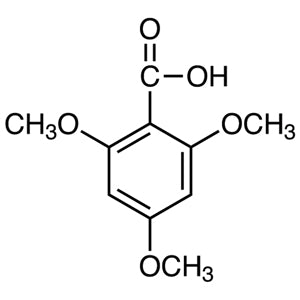
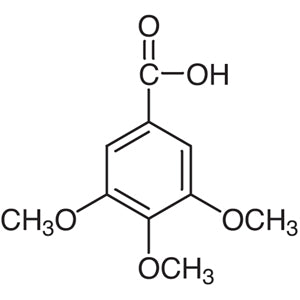
TCI T1116 is 2,3,4-Trimethoxybenzoic Acid, CAS number 573-11-5. It is a benzoic acid whose aromatic ring carries three adjacent methoxy groups at positions 2, 3, and 4. In the TCI catalogue it is classified under Non-Heterocyclic Building Blocks. In the laboratory it serves as a starting material for organic synthesis, mainly when a researcher needs a methoxylated aryl unit that also carries a carboxylic acid handle for further transformation.
The carboxylic acid group can be converted into esters, amides, acid chlorides, or alcohols, which makes this material a flexible linking piece in a synthetic design. The 2,3,4 substitution pattern differs from the more common 3,4,5 isomer, and that difference changes the steric and electronic environment around the carboxyl group. The methoxy group ortho to the acid can influence conformation and reactivity, which is of interest to researchers studying substituent effects. Having this specific isomer available also makes it easier to assemble comparison series of related compounds for medicinal chemistry and for structure-activity studies.
For laboratories in Indonesia, this building block suits organic synthesis research groups, medicinal chemistry programmes, and advanced practical courses. It fits teams that need a defined aromatic substitution pattern as an intermediate or as a reference point when comparing isomers. Ordering it through a local supplier such as AMI Scientific saves research groups the effort of sourcing a niche reagent from abroad on their own.
Related TCI products
- TCI T2627 490-64-2 2,4,5-Trimethoxybenzoic Acid
- TCI T2408 570-02-5 2,4,6-Trimethoxybenzoic Acid
- TCI T1563 60241-74-9 2,3,6-Trimethoxybenzoic Acid
- TCI B1740 101460-22-4 3-Bromo-2,5,6-trimethoxybenzoic Acid
- TCI T1093 1719-88-6 3,4,5-Trimethoxybenzoic Anhydride
- TCI T0705 118-41-2 3,4,5-Trimethoxybenzoic Acid
- Organic synthesis starting material: the trimethoxy-substituted aromatic ring with a reactive carboxylic acid lets chemists build more complex molecules through well-known coupling and functional group chemistry.
- Ester and amide preparation: the carboxylic acid group can be converted into esters or amides, so this compound suits researchers who build derivative libraries from a single, clearly defined aromatic core.
- Medicinal chemistry comparison series: the 2,3,4 isomer can be set beside the 3,4,5 isomer and other substitution patterns, which helps teams examine how methoxy placement affects the properties of related compounds.
- Structure and activity studies: because the methoxy group ortho to the acid affects conformation and reactivity, the material is useful for investigating how substituent position changes steric and electronic behaviour.
- Advanced teaching laboratories: instructors can use this reagent in higher-level practical sessions on aromatic substitution patterns, carboxylic acid transformations, and the comparison of closely related isomers.
| Brand | TCI |
|---|---|
| CAS number | 573-11-5 |
| Molecular formula | — |
| Purity | — |
| Category | Chemistry > Building Blocks > Non-Heterocyclic Building Blocks |
| Pack sizes | please contact AMI Scientific to confirm the pack sizes currently offered |
| Physical form | — |
| Storage | keep in a tightly closed container in a cool, dry place, and follow the label and safety data sheet |
- Product code: T1116
Store the container tightly closed in a cool, dry, well-ventilated place, away from direct sunlight, heat sources, and incompatible materials such as strong oxidizing agents. Keep the product in its original container, or transfer it to a clean, dry, properly labelled glass or chemically compatible bottle with a secure cap. Follow the storage conditions on the label and in the supplier's safety data sheet. Wear standard laboratory protective equipment, including gloves, safety glasses, and a lab coat. Handle the material in a fume hood or well-ventilated area, avoid creating or inhaling dust, and avoid contact with skin and eyes. Wash hands after use, and dispose of waste according to your institution's chemical waste procedures.
—
Produk Terkait
-
2,4,5-TrimethoxybenzoicAcid TCI T2627
Regular price From Rp 582.750,00Regular priceRp 423.150,00Sale price From Rp 582.750,00 -
2,4,6-TrimethoxybenzoicAcid TCI T2408
Regular price Rp 7.844.550,00Regular priceRp 5.500.950,00Sale price Rp 7.844.550,00 -
2,3,6-TrimethoxybenzoicAcid TCI T1563
Regular price From Rp 1.483.650,00Regular priceRp 1.053.150,00Sale price From Rp 1.483.650,00 -
3-Bromo-2,5,6-trimethoxybenzoicAcid TCI B1740
Regular price Rp 2.597.700,00Regular priceRp 1.832.250,00Sale price Rp 2.597.700,00 -
3,4,5-TrimethoxybenzoicAnhydride TCI T1093
Regular price From Rp 2.306.850,00Regular priceRp 1.628.550,00Sale price From Rp 2.306.850,00 -
3,4,5-TrimethoxybenzoicAcid TCI T0705
Regular price From Rp 530.250,00Regular priceRp 386.400,00Sale price From Rp 530.250,00 -
3-(3,4,5-Trimethoxyphenyl)propanoicAcid TCI T4336
Regular price From Rp 1.829.100,00Regular priceRp 1.294.650,00Sale price From Rp 1.829.100,00 -
2,4,6-Trimethoxybenzene-1,3,5-tricarbaldehyde TCI T4301
Regular price From Rp 3.155.250,00Regular priceRp 2.206.050,00Sale price From Rp 3.155.250,00