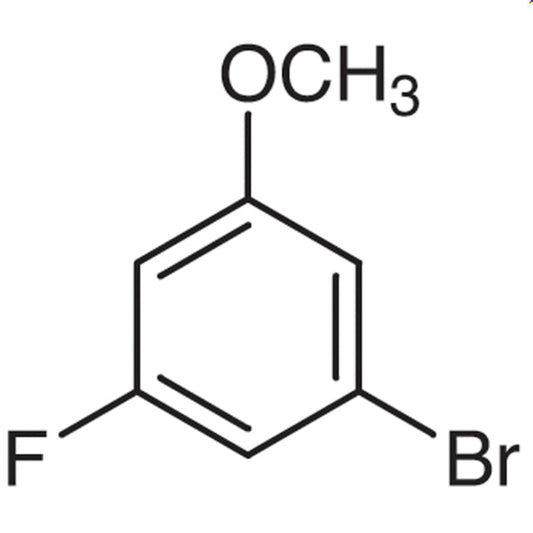
2-Bromo-4-fluoroanisole is a chemical compound widely used as a building block in the synthesis of complex organic molecules. It plays a crucial role in laboratory settings where researchers aim to modify molecular structures through various chemical reactions. This compound is particularly valuable in organic chemistry due to its ability to participate in substitution and electrophilic reactions, making it a versatile reagent. Its presence in synthetic pathways allows scientists to create a wide range of fluorinated compounds, which are essential in multiple scientific disciplines.
The compound’s reactivity and stability make it a preferred choice for laboratory applications. It exhibits good solubility in organic solvents, facilitating easy mixing and reaction processes. Its molecular structure is stable yet highly reactive, enabling it to undergo various chemical transformations under controlled conditions. These properties make it ideal for use in both academic and industrial research environments. The compound’s ability to engage in multiple reaction types enhances its utility in the development of new materials and pharmaceutical compounds.
In Indonesian laboratories, 2-Bromo-4-fluoroanisole is commonly used in chemical, pharmaceutical, and materials research. It is a key component in experiments aimed at synthesizing new compounds with specific functional groups. Many educational and research institutions in Indonesia rely on this compound for its reliability and effectiveness in experimental processes. Its widespread use highlights its importance in advancing scientific knowledge and innovation in the region.
TCI brochures (PDF)
- Fluorination Reagents, Fluorinated Building Blocks 2026-03-18 · p. 24
- Organic synthesis experiments benefit from this compound due to its reactivity and ability to participate in electrophilic substitution reactions.
- Pharmaceutical research utilizes it to develop fluorinated compounds with enhanced biological activity and stability.
- Material science applications leverage its chemical versatility for creating advanced polymers and functional materials.
- Academic institutions use it as a standard reagent in teaching and research to demonstrate complex chemical transformations.
- Industrial laboratories incorporate it into processes that require precise molecular modifications for product development.
| Brand | TCI |
|---|---|
| CAS number | 452-08-4 |
| Molecular formula | — |
| Purity | — |
| Category | Chemistry > Building Blocks > Fluorinated Building Blocks |
| Pack sizes | Available in various quantities as per standard laboratory supply |
| Physical form | Solid or liquid, depending on supplier packaging |
| Storage | Store in a cool, dry place away from light and incompatible materials |
This compound should be stored in a cool, dry place, away from direct sunlight and sources of heat. It is recommended to keep it in airtight containers to prevent moisture absorption and contamination. Due to its reactivity, it should be handled in a well-ventilated area, preferably under a fume hood, to minimize exposure. Appropriate personal protective equipment, such as gloves and safety goggles, should be worn when handling the compound. It is important to avoid contact with incompatible substances, such as strong oxidizers or acids, to ensure safe storage and use in the laboratory.
—
Produk Terkait
-
5-Bromo-2-chloro-4-fluoroanisole TCI B5354
Regular price From Rp 664.650,00Regular priceRp 464.100,00Sale price From Rp 664.650,00 -
2-Bromo-5-fluoroanisole TCI B3875
Regular price Rp 2.016.000,00Regular priceRp 1.409.100,00Sale price Rp 2.016.000,00 -
4-Bromo-3-fluoroanisole TCI B3743
Regular price From Rp 1.670.550,00Regular priceRp 1.167.600,00Sale price From Rp 1.670.550,00 -
3-Bromo-5-fluoroanisole TCI B2945
Regular price Rp 1.510.950,00Regular priceRp 1.056.300,00Sale price Rp 1.510.950,00 -
4-Bromo-2-fluoroanisole TCI B1855
Regular price Rp 980.700,00Regular priceRp 685.650,00Sale price Rp 980.700,00 -
4-Bromo-3,5-difluoroanisole TCI B3392
Regular price Rp 2.625.000,00Regular priceRp 1.835.400,00Sale price Rp 2.625.000,00 -
4-Bromo-2,6-difluoroanisole TCI B3391
Regular price Rp 4.320.750,00Regular priceRp 3.020.850,00Sale price Rp 4.320.750,00 -
4-Bromo-2,5-difluoroanisole TCI B3097
Regular price Rp 1.298.850,00Regular priceRp 908.250,00Sale price Rp 1.298.850,00