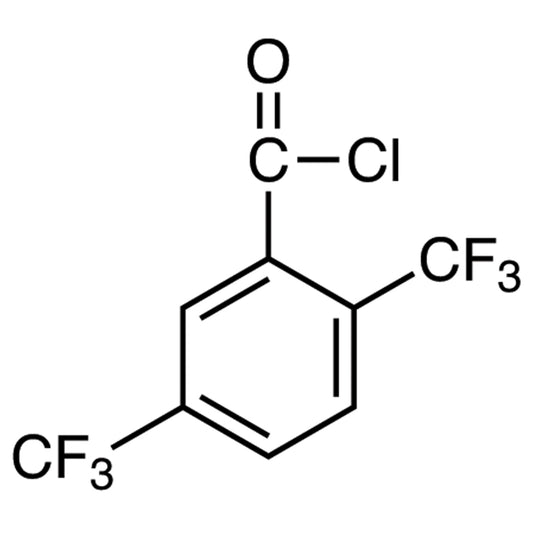
3,5-Bis(trifluoromethyl)benzoyl Chloride is a chemical compound widely used in organic reactions for the synthesis of complex molecules. It plays a crucial role in laboratories as a building block for creating compounds with specific structural features. This reagent is particularly valuable in fluorination processes, which are essential in the development of advanced materials and pharmaceuticals. Its unique chemical structure enables it to participate in various reaction mechanisms, making it a versatile tool for synthetic chemists.
The compound's key properties include the presence of trifluoromethyl groups, which contribute to both stability and reactivity. These groups enhance the molecule’s ability to undergo substitution and bond-forming reactions, making it ideal for a range of synthetic applications. The compound’s chemical and physical characteristics are well-suited for use in research settings where precision and reliability are paramount. Its performance in controlled laboratory environments ensures consistent results in complex chemical syntheses.
In Indonesian laboratories, 3,5-Bis(trifluoromethyl)benzoyl Chloride is commonly used in organic chemistry research, especially in the development of new compounds with medical and industrial applications. Research institutions and universities rely on this compound as a fundamental reagent in experiments requiring high reactivity and chemical stability. Its widespread use underscores its importance in advancing scientific knowledge and innovation in the field of chemistry.
Related TCI products
- TCI T1335 2251-65-2 3-(Trifluoromethyl)benzoyl Chloride
- TCI T1301 329-15-7 4-(Trifluoromethyl)benzoyl Chloride
- TCI T1280 312-94-7 2-(Trifluoromethyl)benzoyl Chloride
- TCI B3980 393-82-8 2,5-Bis(trifluoromethyl)benzoyl Chloride
- TCI F0767 171243-30-4 3-Fluoro-5-(trifluoromethyl)benzoyl Chloride
- TCI F0764 207981-46-2 2-Fluoro-5-(trifluoromethyl)benzoyl Chloride
- Fluorination Synthesis: This compound is ideal for creating fluorinated compounds, which are essential in pharmaceutical and material sciences due to their enhanced stability and bioavailability.
- Organic Reaction Development: Its reactivity makes it suitable for substitution and bond-forming reactions, supporting the creation of complex molecular structures in synthetic chemistry.
- Medicinal Chemistry Research: It is used in the synthesis of drug candidates, where fluorine atoms can significantly alter the pharmacological properties of the final product.
- Material Science Innovation: The compound contributes to the development of advanced materials with unique physical and chemical properties.
- Academic Research Projects: It is a key reagent in university laboratories, supporting both teaching and research in organic chemistry and related disciplines.
| Brand | TCI |
|---|---|
| CAS number | 785-56-8 |
| Molecular formula | — |
| Purity | — |
| Category | Chemistry > Building Blocks > Fluorinated Building Blocks |
| Pack sizes | Available in various quantities as per standard laboratory requirements |
| Physical form | Liquid |
| Storage | Store in a cool, dry place away from moisture and direct sunlight |
This compound should be stored in a cool, dry environment, away from moisture and direct sunlight to maintain its chemical integrity. It is recommended to use airtight containers made of materials compatible with its chemical nature, such as glass or high-density polyethylene. Due to its reactivity, it should be handled in a well-ventilated area, preferably under a fume hood, to minimize exposure. Laboratory personnel should wear appropriate personal protective equipment, including gloves and safety goggles, when working with this substance. Proper labeling of containers is essential to ensure safe handling and prevent accidental contact. Always follow standard laboratory safety protocols to maintain a secure working environment.
—
Produk Terkait
-
3-(Trifluoromethyl)benzoylChloride TCI T1335
Regular price From Rp 928.200,00Regular priceRp 664.650,00Sale price From Rp 928.200,00 -
4-(Trifluoromethyl)benzoylChloride TCI T1301
Regular price Rp 2.359.350,00Regular priceRp 1.665.300,00Sale price Rp 2.359.350,00 -
2-(Trifluoromethyl)benzoylChloride TCI T1280
Regular price Rp 1.723.050,00Regular priceRp 1.220.100,00Sale price Rp 1.723.050,00 -
2,5-Bis(trifluoromethyl)benzoylChloride TCI B3980
Regular price From Rp 1.087.800,00Regular priceRp 775.950,00Sale price From Rp 1.087.800,00 -
3-Fluoro-5-(trifluoromethyl)benzoylChloride TCI F0767
Regular price From Rp 1.008.000,00Regular priceRp 720.300,00Sale price From Rp 1.008.000,00 -
2-Fluoro-5-(trifluoromethyl)benzoylChloride TCI F0764
Regular price Rp 2.252.250,00Regular priceRp 1.590.750,00Sale price Rp 2.252.250,00 -
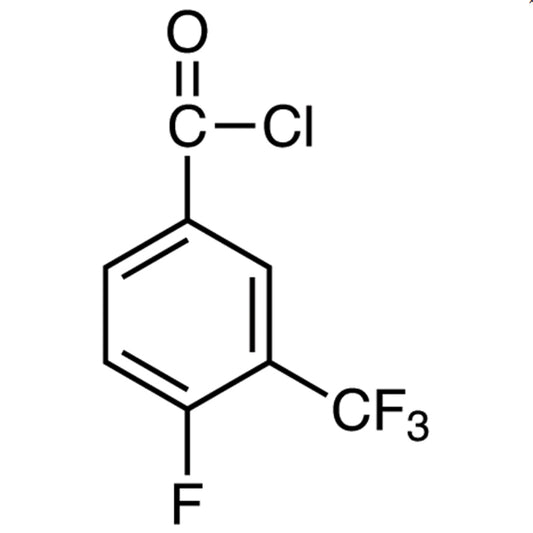
4-Fluoro-3-(trifluoromethyl)benzoylChloride TCI F0659
Regular price From Rp 662.550,00Regular priceRp 478.800,00Sale price From Rp 662.550,00 -
4-(Trifluoromethoxy)benzoylChloride TCI T2341
Regular price From Rp 742.350,00Regular priceRp 534.450,00Sale price From Rp 742.350,00