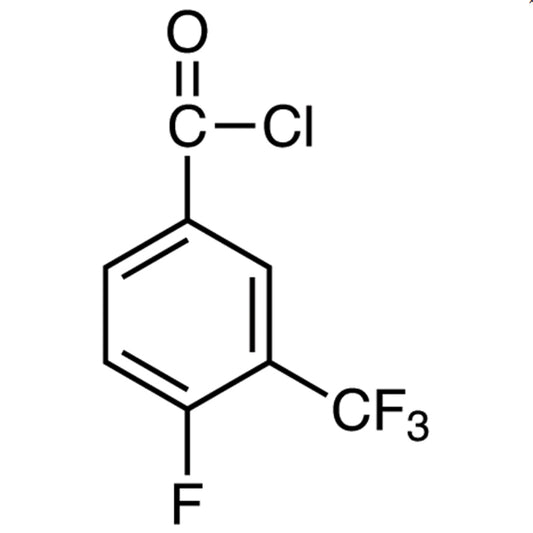
2,5-Bis(trifluoromethyl)benzoyl Chloride is a chemical compound widely used as a building block in the synthesis of complex organic compounds. Its unique structure and reactivity make it an essential material for chemists working in research and development environments. This compound plays a critical role in various chemical reactions, particularly those involving halogen substitution or carbon-carbon bond formation. Its presence in laboratory settings supports the creation of compounds with specific functional properties, such as antioxidant activity or biological activity.
The compound's fluorinated structure contributes to its stability and reactivity, making it a preferred choice for synthetic chemists. The presence of trifluoromethyl groups enhances its chemical versatility, allowing it to participate in a wide range of reactions. Its chemical and physical properties ensure safe handling under standard laboratory conditions. This makes it a reliable and effective reagent for advanced chemical synthesis.
In Indonesian laboratories, 2,5-Bis(trifluoromethyl)benzoyl Chloride is commonly used by researchers and scientists in the fields of pharmacy, materials science, and organic chemistry. It is particularly relevant for experiments requiring fluorinated compounds, supporting innovation in drug development and material synthesis. Its availability through AMI Scientific ensures that Indonesian researchers have access to high-quality reagents for their work.
TCI brochures (PDF)
- Fluorination Reagents, Fluorinated Building Blocks 2026-03-18 · p. 41
Related TCI products
- TCI T1335 2251-65-2 3-(Trifluoromethyl)benzoyl Chloride
- TCI T1301 329-15-7 4-(Trifluoromethyl)benzoyl Chloride
- TCI T1280 312-94-7 2-(Trifluoromethyl)benzoyl Chloride
- TCI B2000 785-56-8 3,5-Bis(trifluoromethyl)benzoyl Chloride
- TCI F0767 171243-30-4 3-Fluoro-5-(trifluoromethyl)benzoyl Chloride
- TCI F0764 207981-46-2 2-Fluoro-5-(trifluoromethyl)benzoyl Chloride
- Fluorinated Compound Synthesis: This compound is ideal for creating fluorinated derivatives due to its stable and reactive trifluoromethyl groups.
- Organic Reaction Research: It supports various organic reactions, especially those involving halogen substitution and carbon-carbon bond formation.
- Drug Development Studies: Its ability to form compounds with specific biological activities makes it valuable in pharmaceutical research.
- Material Science Investigations: The compound is used to develop new materials with enhanced chemical and physical properties.
- Academic Research Projects: It is a key reagent in university and research institute experiments focused on synthetic chemistry and functional compound development.
| Brand | TCI |
|---|---|
| CAS number | 393-82-8 |
| Molecular formula | — |
| Purity | — |
| Category | Chemistry > Building Blocks > Fluorinated Building Blocks |
| Pack sizes | Available in standard laboratory quantities |
| Physical form | Liquid |
| Storage | Store in a cool, dry place away from light |
This compound should be stored in a cool, dry environment, away from direct sunlight and sources of heat. It is recommended to keep it in a tightly sealed container to prevent exposure to moisture and air. Due to its chemical nature, it should be handled in a well-ventilated area, with appropriate personal protective equipment such as gloves and safety goggles. Avoid contact with skin and eyes, and ensure proper disposal according to local regulations. While it is stable under normal storage conditions, it is important to follow standard laboratory safety protocols to ensure safe handling and use.
—
Produk Terkait
-
3-(Trifluoromethyl)benzoylChloride TCI T1335
Regular price From Rp 928.200,00Regular priceRp 664.650,00Sale price From Rp 928.200,00 -
4-(Trifluoromethyl)benzoylChloride TCI T1301
Regular price Rp 2.359.350,00Regular priceRp 1.665.300,00Sale price Rp 2.359.350,00 -
2-(Trifluoromethyl)benzoylChloride TCI T1280
Regular price Rp 1.723.050,00Regular priceRp 1.220.100,00Sale price Rp 1.723.050,00 -
3,5-Bis(trifluoromethyl)benzoylChloride TCI B2000
Regular price From Rp 1.431.150,00Regular priceRp 1.016.400,00Sale price From Rp 1.431.150,00 -
3-Fluoro-5-(trifluoromethyl)benzoylChloride TCI F0767
Regular price From Rp 1.008.000,00Regular priceRp 720.300,00Sale price From Rp 1.008.000,00 -
2-Fluoro-5-(trifluoromethyl)benzoylChloride TCI F0764
Regular price Rp 2.252.250,00Regular priceRp 1.590.750,00Sale price Rp 2.252.250,00 -
4-Fluoro-3-(trifluoromethyl)benzoylChloride TCI F0659
Regular price From Rp 662.550,00Regular priceRp 478.800,00Sale price From Rp 662.550,00 -
4-(Trifluoromethoxy)benzoylChloride TCI T2341
Regular price From Rp 742.350,00Regular priceRp 534.450,00Sale price From Rp 742.350,00