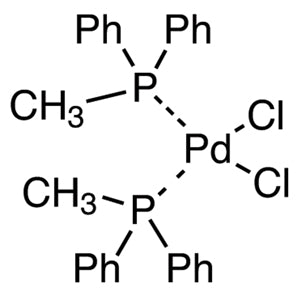
Bis(methyldiphenylphosphine)palladium(II) Dichloride (cis- and trans- mixture) is a chemical compound widely used in catalytic reactions, particularly in organic synthesis. This material functions as a metal-based catalyst, playing a crucial role in promoting various coupling reactions such as the Suzuki-Miyaura and Heck reactions. Its ability to facilitate electron activation and metal transition makes it an essential reagent in synthetic chemistry. The compound is known for its high reactivity and stability, which are key factors in its effectiveness in laboratory settings.
The compound’s unique structure, consisting of a palladium(II) ion coordinated with two methyldiphenylphosphine ligands, contributes to its high reactivity and versatility. This structural configuration allows it to interact efficiently with a wide range of organic substrates, making it a preferred choice for researchers. Its stability under various reaction conditions ensures consistent performance, while its ability to produce high-purity products enhances the reliability of experimental outcomes.
In Indonesian laboratories, this compound is extensively used in organic chemistry research and the synthesis of complex molecules. Its demand is driven by the need for high-quality catalysts in academic and industrial research settings. It is commonly employed in universities and research institutions for the development of new compounds and the application of chemical processes in various industries.
TCI brochures (PDF)
- C-H Bond Activation Reaction 2025-06-20 · p. 4
- Transition Metal Catalysts 2026-04-10 · p. 13
- Suzuki-Miyaura Cross Coupling Reaction 2025-12-01 · p. 23
Related TCI products
- TCI B3160 95408-45-0 [1,1'-Bis(di-tert-butylphosphino)ferrocene]palladium(II) Dichloride
- TCI B2244 16483-18-4 Bis(ethylenediamine)palladium(II) Dichloride
- TCI B2192 59831-02-6 [1,3-Bis(diphenylphosphino)propane]palladium(II) Dichloride
- TCI B2064 95464-05-4 [1,1'-Bis(diphenylphosphino)ferrocene]palladium(II) Dichloride Dichloromethane Adduct
- TCI B2055 29934-17-6 Bis(tricyclohexylphosphine)palladium(II) Dichloride
- TCI B2031 29964-62-3 [1,4-Bis(diphenylphosphino)butane]palladium(II) Dichloride
- Organic synthesis reactions benefit from this catalyst due to its ability to promote efficient coupling reactions and enhance reaction yields.
- Catalytic cross-coupling processes, such as Suzuki-Miyaura and Heck reactions, rely on its high reactivity and stability for successful outcomes.
- Research into complex molecule synthesis utilizes this compound for its capacity to interact with diverse organic substrates.
- Industrial applications in chemical development leverage its effectiveness in producing high-purity products under controlled conditions.
- Academic laboratories use it for teaching and research purposes, demonstrating its role in both theoretical and practical chemical studies.
| Brand | TCI |
|---|---|
| CAS number | 52611-08-2 |
| Molecular formula | — |
| Purity | — |
| Category | Chemistry > Catalysis and Inorganic Chemistry > Transition Elements [Catalysis and Inorganic Chemistry] |
| Pack sizes | Available in various quantities as per supplier specifications |
| Physical form | Solid powder |
| Storage | Store in a cool, dry place away from moisture and direct sunlight |
This compound should be stored in a cool, dry environment, away from moisture and direct sunlight to maintain its stability and reactivity. It is recommended to use airtight containers made of inert materials such as glass or polyethylene to prevent contamination and degradation. Proper ventilation should be ensured when handling the material to minimize exposure to vapors. Due to its chemical nature, it is important to avoid contact with incompatible substances and to follow standard laboratory safety protocols. Regular monitoring of storage conditions is advised to ensure the compound remains effective for its intended applications.
—
Produk Terkait
-
[1,1'-Bis(di-tert-butylphosphino)ferrocene]palladium(II)Dichloride TCI B3160
Regular price From Rp 6.811.350,00Regular priceRp 4.778.550,00Sale price From Rp 6.811.350,00 -
Bis(ethylenediamine)palladium(II)Dichloride TCI B2244
Regular price Rp 5.830.650,00Regular priceRp 4.092.900,00Sale price Rp 5.830.650,00 -
[1,3-Bis(diphenylphosphino)propane]palladium(II)Dichloride TCI B2192
Regular price From Rp 2.199.750,00Regular priceRp 1.554.000,00Sale price From Rp 2.199.750,00 -
[1,1'-Bis(diphenylphosphino)ferrocene]palladium(II)DichlorideDichloromethaneAdduct TCI B2064
Regular price From Rp 2.121.000,00Regular priceRp 1.498.350,00Sale price From Rp 2.121.000,00 -
Bis(tricyclohexylphosphine)palladium(II)Dichloride TCI B2055
Regular price From Rp 2.199.750,00Regular priceRp 1.554.000,00Sale price From Rp 2.199.750,00 -
[1,4-Bis(diphenylphosphino)butane]palladium(II)Dichloride TCI B2031
Regular price From Rp 3.074.400,00Regular priceRp 2.165.100,00Sale price From Rp 3.074.400,00 -
Bis(tri-o-tolylphosphine)palladium(II)Dichloride TCI B2026
Regular price From Rp 2.121.000,00Regular priceRp 1.498.350,00Sale price From Rp 2.121.000,00 -
[1,2-Bis(diphenylphosphino)ethane]palladium(II)Dichloride TCI B2016
Regular price From Rp 2.121.000,00Regular priceRp 1.498.350,00Sale price From Rp 2.121.000,00