


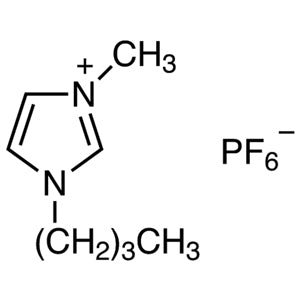
1-Butyl-3-methylimidazolium hexafluorophosphate is an ionic liquid with a unique molecular structure and exceptional chemical properties. It is widely used in laboratory settings for its versatility and stability, making it a key component in various chemical processes. This compound is particularly valuable in organic synthesis, electrochemical studies, and material research due to its ability to function as a non-volatile solvent and reaction medium. Its high boiling point ensures that it remains stable under high-temperature conditions, which is essential for maintaining the integrity of chemical reactions.
As an ionic liquid, this material is non-flammable, non-toxic, and chemically stable, making it a preferred choice for modern laboratory applications. These properties contribute to a safer and more sustainable research environment, reducing the risks associated with traditional volatile solvents. Additionally, its low viscosity and compatibility with a wide range of organic solvents enhance its usability in diverse experimental setups. The combination of these characteristics makes it an ideal candidate for both academic and industrial research.
In Indonesian laboratories, 1-Butyl-3-methylimidazolium hexafluorophosphate is commonly used in universities, research institutions, and industrial laboratories. It plays a crucial role in various scientific investigations, including the development of new materials, electrochemical devices, and advanced chemical processes. Its availability through suppliers like AMI Scientific ensures that researchers have access to this essential compound for their experiments and innovations.
TCI brochures (PDF)
- Ionic Liquids for Battery Research 2026-04-13 · p. 1
- Ionic Liquids 2026-06-08 · p. 7
Related TCI products
- TCI H1098 304680-35-1 1-Hexyl-3-methylimidazolium Hexafluorophosphate
- TCI E0493 155371-19-0 1-Ethyl-3-methylimidazolium Hexafluorophosphate
- TCI B5726 433337-11-2 1-Benzyl-3-methylimidazolium Hexafluorophosphate
- TCI B2474 227617-70-1 1-Butyl-2,3-dimethylimidazolium Hexafluorophosphate
- TCI M3211 57367-08-5 1-Methyl-1H-imidazol-3-ium Hexafluorophosphate
- TCI M2063 304680-36-2 1-Methyl-3-n-octylimidazolium Hexafluorophosphate
- Organic synthesis applications benefit from this ionic liquid due to its non-volatile nature and high thermal stability, allowing for prolonged reaction times and reduced solvent loss.
- Electrochemical studies utilize this compound as a non-corrosive and stable medium, enabling precise control over reaction conditions without interference from volatile solvents.
- Material research leverages its unique properties for the synthesis and processing of advanced polymers and nanomaterials, offering a safe and efficient alternative to traditional solvents.
- Separation and purification processes benefit from its low viscosity and solubility in organic solvents, facilitating efficient extraction and purification techniques.
- Industrial research applications take advantage of its chemical stability and low toxicity, making it suitable for large-scale chemical processes and sustainable manufacturing practices.
| Brand | TCI |
|---|---|
| CAS number | 174501-64-5 |
| Molecular formula | — |
| Purity | — |
| Category | Chemistry > Specialty Synthesis > Ionic Liquids |
| Pack sizes | Available in various sizes as per supplier specifications |
| Physical form | Liquid |
| Storage | Store in a cool, dry place away from direct sunlight |
This ionic liquid should be stored in a cool, dry environment to maintain its chemical stability and prevent degradation. It is recommended to use airtight containers made of materials that are chemically inert, such as glass or high-density polyethylene, to avoid any unwanted reactions. Due to its non-flammable and non-toxic nature, it poses minimal risk in standard laboratory conditions, but it is still important to handle it with care and follow standard safety protocols. Always ensure proper ventilation when working with this material, and avoid direct contact with skin or inhalation of vapors. Its safe handling and storage contribute to a secure and efficient laboratory environment.
—
Produk Terkait
-
1-Hexyl-3-methylimidazoliumHexafluorophosphate TCI H1098
Regular price From Rp 875.700,00Regular priceRp 627.900,00Sale price From Rp 875.700,00 -
1-Ethyl-3-methylimidazoliumHexafluorophosphate TCI E0493
Regular price From Rp 1.829.100,00Regular priceRp 1.294.650,00Sale price From Rp 1.829.100,00 -
1-Benzyl-3-methylimidazoliumHexafluorophosphate TCI B5726
Regular price Rp 1.749.300,00Regular priceRp 1.239.000,00Sale price Rp 1.749.300,00 -
1-Butyl-2,3-dimethylimidazoliumHexafluorophosphate TCI B2474
Regular price From Rp 1.538.250,00Regular priceRp 1.090.950,00Sale price From Rp 1.538.250,00 -
1-Methyl-1H-imidazol-3-iumHexafluorophosphate TCI M3211
Regular price From Rp 1.934.100,00Regular priceRp 1.368.150,00Sale price From Rp 1.934.100,00 -
1-Methyl-3-n-octylimidazoliumHexafluorophosphate TCI M2063
Regular price From Rp 1.618.050,00Regular priceRp 1.146.600,00Sale price From Rp 1.618.050,00 -
1-Butyl-3-methylimidazoliumTricyanomethanide TCI B5487
Regular price From Rp 1.856.400,00Regular priceRp 1.313.550,00Sale price From Rp 1.856.400,00 -
1-Butyl-3-methylimidazoliumDicyanamide TCI B5447
Regular price From Rp 1.749.300,00Regular priceRp 1.239.000,00Sale price From Rp 1.749.300,00


