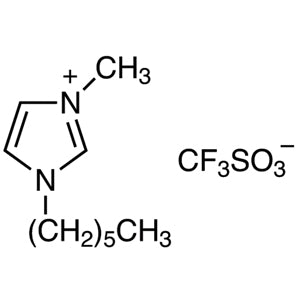
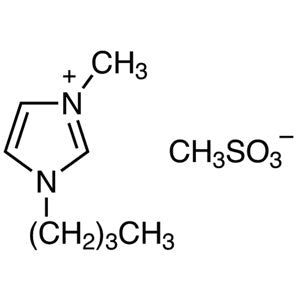
1-Butyl-3-methylimidazolium Trifluoromethanesulfonate is a versatile ionic liquid widely utilized in chemical and synthetic applications within laboratory settings. As a member of the ionic liquid family, it plays a crucial role in facilitating chemical reactions that require stable and non-volatile environments. Its unique molecular structure allows it to function as both a solvent and a reaction medium, making it an essential component in various synthetic processes. This material is particularly valuable for its ability to maintain consistent reaction conditions without the risk of evaporation or volatility.
The properties of 1-Butyl-3-methylimidazolium Trifluoromethanesulfonate make it a preferred choice for laboratory use. It exhibits high chemical stability, which ensures it remains inert under a wide range of reaction conditions. Its non-volatile nature minimizes the risk of environmental contamination and simplifies waste management. Additionally, its low volatility and high thermal stability allow it to be used in high-temperature or vacuum-based reactions without degradation. These characteristics make it ideal for applications where maintaining a controlled and stable reaction environment is critical.
In Indonesian laboratories, this ionic liquid is commonly used in chemical research and organic synthesis. Its stability and non-volatile properties make it suitable for a variety of experimental setups, including those requiring prolonged reaction times or extreme conditions. It is frequently employed in studies involving catalytic reactions, polymer synthesis, and electrochemical processes. Its reliability and performance in diverse chemical environments have made it a staple in many research laboratories across Indonesia.
TCI brochures (PDF)
- Ionic Liquids for Battery Research 2026-04-13 · p. 1
- Ionic Liquids 2026-06-08 · p. 7
Related TCI products
- TCI H1100 460345-16-8 1-Hexyl-3-methylimidazolium Trifluoromethanesulfonate
- TCI E0494 145022-44-2 1-Ethyl-3-methylimidazolium Trifluoromethanesulfonate
- TCI B5487 878027-73-7 1-Butyl-3-methylimidazolium Tricyanomethanide
- TCI B5447 448245-52-1 1-Butyl-3-methylimidazolium Dicyanamide
- TCI B4091 344790-87-0 1-Butyl-3-methylimidazolium Thiocyanate
- TCI B3596 820965-08-0 1-Butyl-3-methylimidazolium Tribromide
- Organic synthesis reactions benefit from this ionic liquid due to its non-volatile nature and ability to maintain consistent reaction conditions.
- It is ideal for catalytic processes as it provides a stable and inert environment that supports various catalysts without interference.
- In electrochemical studies, the material’s high thermal stability and low volatility make it suitable for use in battery and fuel cell research.
- It is commonly used in polymerization reactions because of its ability to dissolve a wide range of organic compounds and facilitate controlled polymer formation.
- The material supports green chemistry initiatives by reducing the need for volatile organic solvents and minimizing environmental impact.
| Brand | TCI |
|---|---|
| CAS number | 174899-66-2 |
| Molecular formula | — |
| Purity | — |
| Category | Chemistry > Specialty Synthesis > Ionic Liquids |
| Pack sizes | Available in various sizes as per standard laboratory supply |
| Physical form | Liquid |
| Storage | Store in a cool, dry place away from direct sunlight |
This ionic liquid should be stored in a cool, dry location, away from direct sunlight and sources of heat. It is recommended to use sealed containers made of materials compatible with its chemical properties, such as glass or high-density polyethylene. Due to its non-volatile nature, it does not require special containment for vapor control. However, it is important to ensure that the storage area is well-ventilated to prevent the accumulation of any potential fumes. General laboratory safety practices should be followed, including the use of personal protective equipment when handling the material. Proper labeling of containers is essential to ensure safe handling and prevent accidental exposure.
—
Produk Terkait
-
1-Hexyl-3-methylimidazoliumTrifluoromethanesulfonate TCI H1100
Regular price Rp 2.306.850,00Regular priceRp 1.628.550,00Sale price Rp 2.306.850,00 -
1-Ethyl-3-methylimidazoliumTrifluoromethanesulfonate TCI E0494
Regular price From Rp 2.677.500,00Regular priceRp 1.887.900,00Sale price From Rp 2.677.500,00 -
1-Butyl-3-methylimidazoliumTricyanomethanide TCI B5487
Regular price From Rp 1.856.400,00Regular priceRp 1.313.550,00Sale price From Rp 1.856.400,00 -
1-Butyl-3-methylimidazoliumDicyanamide TCI B5447
Regular price From Rp 1.749.300,00Regular priceRp 1.239.000,00Sale price From Rp 1.749.300,00 -
1-Butyl-3-methylimidazoliumThiocyanate TCI B4091
Regular price From Rp 1.167.600,00Regular priceRp 831.600,00Sale price From Rp 1.167.600,00 -
1-Butyl-3-methylimidazoliumTribromide TCI B3596
Regular price Rp 3.922.800,00Regular priceRp 2.758.350,00Sale price Rp 3.922.800,00 -
1-Butyl-3-methylimidazoliumTrifluoro(trifluoromethyl)borate TCI B3542
Regular price Rp 3.312.750,00Regular priceRp 2.332.050,00Sale price Rp 3.312.750,00 -
1-Butyl-3-methylimidazoliumMethanesulfonate TCI B3231
Regular price From Rp 848.400,00Regular priceRp 609.000,00Sale price From Rp 848.400,00