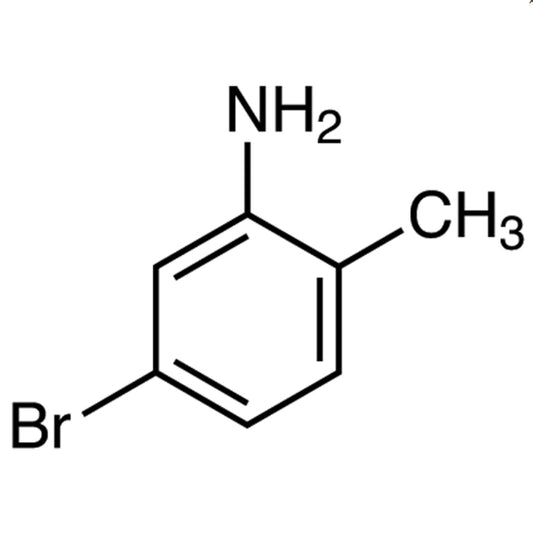
3-Bromo-4-methylaniline is a chemical compound widely used in organic reactions for the synthesis of complex molecules. As a building block, it serves as a fundamental component in the creation of larger chemical structures. In the laboratory, this compound is frequently utilized as a starting material in substitution reactions, coupling reactions, or the synthesis of heterocyclic compounds. Its reactivity makes it a key reagent in both pure and applied chemical research. The aromatic structure of 3-Bromo-4-methylaniline, combined with bromo and methyl substituents, provides unique chemical properties that are essential for various synthetic pathways.
This compound is known for its basic nature and ability to participate in nucleophilic reactions. These characteristics make it highly suitable for electrophilic substitution reactions and processes requiring aromatic activation. Its stability under certain conditions also allows for safe storage and use across a range of research scales. In Indonesian laboratories, 3-Bromo-4-methylaniline is commonly employed in organic chemistry research, particularly in projects focused on the synthesis of complex compounds. Many research institutions and universities rely on this compound for its versatility and effectiveness in chemical synthesis.
In the context of Indonesian laboratories, 3-Bromo-4-methylaniline is a staple in organic chemistry research. It is frequently used in academic and industrial settings where the synthesis of complex molecules is required. Its availability and chemical properties make it a preferred choice for researchers aiming to explore new synthetic methods and pathways. The compound’s role in both fundamental and applied research underscores its importance in the chemical sciences.
- Organic synthesis is a primary application where 3-Bromo-4-methylaniline is used for the preparation of complex molecules through substitution and coupling reactions.
- Heterocyclic compound synthesis benefits from its aromatic structure and reactivity, allowing for the formation of diverse ring systems.
- Nucleophilic reaction studies utilize its basic nature to explore reaction mechanisms and pathway development in chemical research.
- Industrial chemical processes incorporate this compound due to its versatility in producing a wide range of derivatives.
- Research and development projects in chemical innovation rely on its unique properties for the exploration of new synthetic strategies.
| Brand | TCI |
|---|---|
| CAS number | 7745-91-7 |
| Molecular formula | — |
| Purity | — |
| Category | Chemistry > Building Blocks > Non-Heterocyclic Building Blocks |
| Pack sizes | Available in various quantities as per supplier specifications |
| Physical form | Liquid or solid, depending on the specific product variant |
| Storage | Store in a cool, dry place away from light and incompatible materials |
3-Bromo-4-methylaniline should be stored in a cool, dry place away from direct sunlight and sources of heat. It is recommended to keep the compound in a tightly sealed container to prevent exposure to air and moisture. Due to its reactivity, it should be stored separately from strong oxidizing agents and acids to avoid potential chemical interactions. In laboratory settings, proper ventilation is essential when handling this compound to minimize inhalation risks. Personal protective equipment, including gloves and safety goggles, should always be worn when working with this material. Regular monitoring of storage conditions ensures the compound remains stable and safe for use in research applications.
—
Produk Terkait
-
2-Bromo-5-methylaniline TCI B4507
Regular price From Rp 980.700,00Regular priceRp 685.650,00Sale price From Rp 980.700,00 -
5-Bromo-2-methylaniline TCI B3687
Regular price From Rp 530.250,00Regular priceRp 370.650,00Sale price From Rp 530.250,00 -
3-Bromo-2-methylaniline TCI B3482
Regular price From Rp 3.021.900,00Regular priceRp 2.112.600,00Sale price From Rp 3.021.900,00 -
4-Bromo-3-methylaniline TCI B1990
Regular price From Rp 689.850,00Regular priceRp 481.950,00Sale price From Rp 689.850,00 -
4-Bromo-2-methylaniline TCI B1281
Regular price Rp 1.378.650,00Regular priceRp 963.900,00Sale price Rp 1.378.650,00 -
2-Bromo-4-methylaniline TCI B0540
Regular price From Rp 664.650,00Regular priceRp 464.100,00Sale price From Rp 664.650,00 -
2-Chloro-6-methylaniline TCI A1959
Regular price From Rp 1.431.150,00Regular priceRp 1.000.650,00Sale price From Rp 1.431.150,00 -
4-Chloro-3-methylaniline TCI A1610
Regular price Rp 1.565.550,00Regular priceRp 1.094.100,00Sale price Rp 1.565.550,00