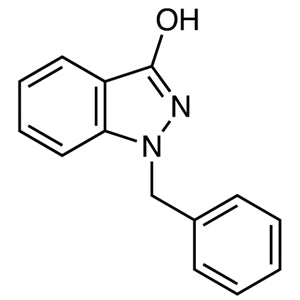
1-Benzyl-1H-indazol-3-ol is a chemical compound widely used in laboratory settings as a building block for the synthesis of heterocyclic compounds. It plays a crucial role in organic chemistry research, particularly in the development of bioactive molecules and pharmaceuticals. Its unique structure allows it to participate in various chemical reactions, making it an essential component in synthetic pathways that require indazole-based scaffolds. This compound is commonly employed in academic and industrial laboratories for its versatility and reactivity in functional group transformations.
The compound is valued for its chemical stability and reactivity under controlled conditions. Its molecular structure enables it to undergo substitution, coupling, and modification reactions, which are fundamental in the synthesis of complex organic molecules. The compound's ability to maintain its integrity during chemical transformations makes it a preferred choice for researchers aiming to create new compounds with specific biological activities. Its compatibility with a wide range of reagents and solvents further enhances its utility in laboratory applications.
In Indonesian laboratories, 1-Benzyl-1H-indazol-3-ol is frequently used by chemists, pharmacologists, and biochemists in the development of novel compounds. Its availability in the local market supports research efforts without the need for costly imports. This accessibility ensures that scientists can conduct experiments efficiently, contributing to advancements in drug discovery and chemical synthesis. Its role in local research underscores its importance in the scientific community.
Related TCI products
- TCI A3355 21443-96-9 1H-Indazol-7-amine
- TCI B5404 63874-95-3 1-Benzyl-1H-pyrazole-4-carboxaldehyde
- TCI B4918 287930-73-8 4-Benzyl-2-hydroxymorpholin-3-one
- TCI B4100 78818-15-2 Benzyl 3-Oxopiperazine-1-carboxylate
- TCI B3941 37734-89-7 1-Benzyl-2-phenyl-1H-imidazole
- TCI B3086 18489-25-3 5-Benzyl-1H-tetrazole
- Heterocyclic Synthesis: This compound is ideal for creating indazole-based structures, which are common in bioactive molecules and pharmaceuticals.
- Organic Chemistry Research: Its reactivity and structural versatility make it a key component in developing new chemical compounds with specific biological properties.
- Pharmaceutical Development: It is used in the synthesis of compounds that may lead to new drug candidates with therapeutic potential.
- Biochemical Studies: Researchers use it to explore molecular interactions and develop compounds with targeted biological effects.
- Academic Research: It supports teaching and experimental work in universities and research institutions focused on synthetic chemistry.
| Brand | TCI |
|---|---|
| CAS number | 2215-63-6 |
| Molecular formula | — |
| Purity | — |
| Category | Chemistry > Building Blocks > Heterocyclic Building Blocks |
| Pack sizes | Available in standard laboratory quantities |
| Physical form | Solid |
| Storage | Store in a cool, dry place away from light |
This compound should be stored in a cool, dry environment, away from direct sunlight and sources of heat. It is recommended to use airtight containers to prevent moisture absorption and contamination. Due to its chemical nature, it should be handled in a well-ventilated area, with appropriate personal protective equipment such as gloves and safety goggles. Avoid exposure to incompatible substances, and ensure that storage conditions are consistent with standard laboratory safety protocols. Proper labeling and secure storage are essential to maintain the integrity and safety of the compound during handling and use.
—
Produk Terkait
-
1H-Indazol-7-amine TCI A3355
Regular price From Rp 1.856.400,00Regular priceRp 1.313.550,00Sale price From Rp 1.856.400,00 -
1-Benzyl-1H-pyrazole-4-carboxaldehyde TCI B5404
Regular price From Rp 1.326.150,00Regular priceRp 942.900,00Sale price From Rp 1.326.150,00 -
4-Benzyl-2-hydroxymorpholin-3-one TCI B4918
Regular price From Rp 530.250,00Regular priceRp 386.400,00Sale price From Rp 530.250,00 -
Benzyl3-Oxopiperazine-1-carboxylate TCI B4100
Regular price From Rp 1.378.650,00Regular priceRp 979.650,00Sale price From Rp 1.378.650,00 -
1-Benzyl-2-phenyl-1H-imidazole TCI B3941
Regular price From Rp 928.200,00Regular priceRp 664.650,00Sale price From Rp 928.200,00 -
5-Benzyl-1H-tetrazole TCI B3086
Regular price Rp 2.013.900,00Regular priceRp 1.423.800,00Sale price Rp 2.013.900,00 -
1-Benzyl-5-ethoxyhydantoin TCI B3085
Regular price Rp 742.350,00Regular priceRp 534.450,00Sale price Rp 742.350,00 -
1-Benzyl-5-phenylbarbituricAcid TCI B2789
Regular price Rp 1.803.900,00Regular priceRp 1.261.050,00Sale price Rp 1.803.900,00