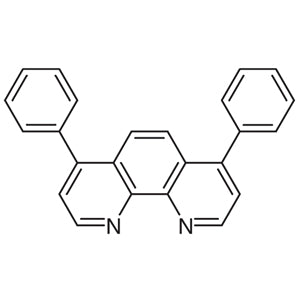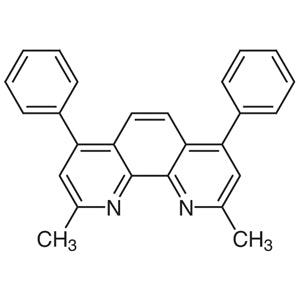
Bathocuproine is a chemical compound widely used as a nitrogen-donor ligand in catalytic reactions and organic synthesis. It plays a crucial role in laboratory settings by facilitating the formation of stable metal-ligand complexes, which are essential in various chemical processes. This compound is particularly valuable in catalysis due to its ability to interact with transition metal ions, making it a key component in the development of efficient catalytic systems. Its versatility allows it to be applied across multiple fields of chemistry, including inorganic and coordination chemistry.
One of the main reasons Bathocuproine is preferred is its structural complexity and its capacity to bind with a variety of metal ions such as copper, silver, and tin. These properties enable it to modify catalytic activity and enhance the specificity of chemical reactions. Additionally, its stability under certain conditions makes it a reliable choice for researchers aiming to achieve consistent results in their experiments. The compound's ability to act as a ligand in diverse chemical environments further contributes to its popularity in both academic and industrial research.
In Indonesian laboratories, Bathocuproine is commonly used by chemists and material scientists to expand their understanding of catalytic reactions and complex synthesis. Its presence in research settings supports the development of new chemical methodologies and contributes to advancements in both theoretical and applied chemistry. As a result, it remains a fundamental tool for those working in the field of catalysis and inorganic chemistry.
TCI brochures (PDF)
- Electron Transport Material for OLED NBPhen 2025-02-27 · p. 1
- Chemical Compounds Purified by Sublimation 2025-05-07 · p. 4
- Organic Light-Emitting Diode (OLED) Materials 2026-08-18 · p. 6
- Solar Cell Materials 2026-04-21 · p. 9
- Ligands 2025-12-01 · p. 15
Related TCI products
- TCI B2695 1662-01-7 Bathophenanthroline (purified by sublimation)
- TCI D0711 4733-39-5 Bathocuproine
- TCI T3266 15546-43-7 N,N,N',N'-Tetraphenylbenzidine (purified by sublimation)
- TCI T2233 517-51-1 5,6,11,12-Tetraphenylnaphthacene (purified by sublimation)
- TCI D3970 123847-85-8 N,N'-Di-1-naphthyl-N,N'-diphenylbenzidine (purified by sublimation)
- TCI D3236 65181-78-4 N,N'-Diphenyl-N,N'-di(m-tolyl)benzidine (purified by sublimation)
- Catalytic Reaction Development: Bathocuproine is ideal for designing new catalytic systems due to its ability to form stable metal-ligand complexes, enhancing reaction efficiency and selectivity.
- Organic Synthesis Research: Its role as a nitrogen-donor ligand makes it suitable for organic synthesis, where it helps in the formation of complex molecular structures with high precision.
- Inorganic Chemistry Studies: The compound is frequently used in inorganic chemistry to investigate metal-ligand interactions and their impact on reaction mechanisms.
- Coordination Chemistry Experiments: Its capacity to bind with various metal ions makes it a valuable tool for studying coordination compounds and their properties.
- Material Science Investigations: Researchers use Bathocuproine to explore its potential in creating new materials with unique catalytic properties and structural characteristics.
| Brand | TCI |
|---|---|
| CAS number | 4733-39-5 |
| Molecular formula | — |
| Purity | — |
| Category | Chemistry > Catalysis and Inorganic Chemistry > Nitrogen-Donor Ligands [Catalysis] |
| Pack sizes | As listed on product page |
| Physical form | Solid |
| Storage | Store in a cool, dry place away from light |
Bathocuproine should be stored in a cool, dry environment, away from direct light to maintain its chemical integrity. It is recommended to use airtight containers to prevent moisture absorption and contamination. Due to its chemical nature, it should be handled with care, using appropriate personal protective equipment such as gloves and safety goggles. Avoid exposure to incompatible substances, and ensure proper ventilation when working with the compound. Storage conditions should be consistent to preserve its stability and effectiveness in laboratory applications. Always follow standard safety protocols to minimize risks during handling and experimentation.
—
Product Categories
- Electronic MaterialsOrganic Light-Emitting Diode (OLED) MaterialsElectron Transport Materials (ETM) [Organic Light-Emitting Diode (OLED) Materials]
- Electronic MaterialsPerovskite Solar Cell (PSC) MaterialsCarrier Transport Materials [Perovskite Solar Cell (PSC) Materials]
- High Purity CompoundsCompounds Purified by SublimationOrganic Semiconductors [Compounds Purified by Sublimation]
- Material Building BlocksLigands for Functional Metal ComplexesPhenanthroline Ligands
Produk Terkait
-
Bathophenanthroline(purifiedbysublimation) TCI B2695
Regular price Rp 5.485.200,00Regular priceRp 3.851.400,00Sale price Rp 5.485.200,00 -
Bathocuproine TCI D0711
Regular price From Rp 3.285.450,00Regular priceRp 2.313.150,00Sale price From Rp 3.285.450,00 -
N,N,N',N'-Tetraphenylbenzidine(purifiedbysublimation) TCI T3266
Regular price From Rp 2.173.500,00Regular priceRp 1.535.100,00Sale price From Rp 2.173.500,00 -
5,6,11,12-Tetraphenylnaphthacene(purifiedbysublimation) TCI T2233
Regular price From Rp 2.279.550,00Regular priceRp 1.593.900,00Sale price From Rp 2.279.550,00 -
N,N'-Di-1-naphthyl-N,N'-diphenylbenzidine(purifiedbysublimation) TCI D3970
Regular price Rp 3.232.950,00Regular priceRp 2.276.400,00Sale price Rp 3.232.950,00 -
N,N'-Diphenyl-N,N'-di(m-tolyl)benzidine(purifiedbysublimation) TCI D3236
Regular price From Rp 2.306.850,00Regular priceRp 1.628.550,00Sale price From Rp 2.306.850,00 -
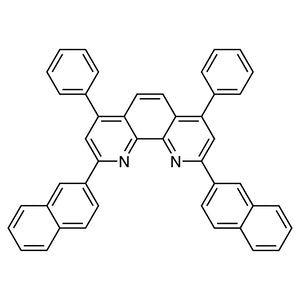
2,9-Di(naphthalen-2-yl)-4,7-diphenyl-1,10-phenanthroline TCI D5581
Regular price From Rp 3.207.750,00Regular priceRp 2.258.550,00Sale price From Rp 3.207.750,00 -
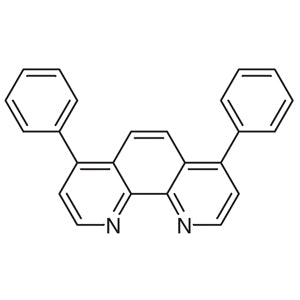
Bathophenanthroline TCI D0905
Regular price From Rp 3.207.750,00Regular priceRp 2.258.550,00Sale price From Rp 3.207.750,00