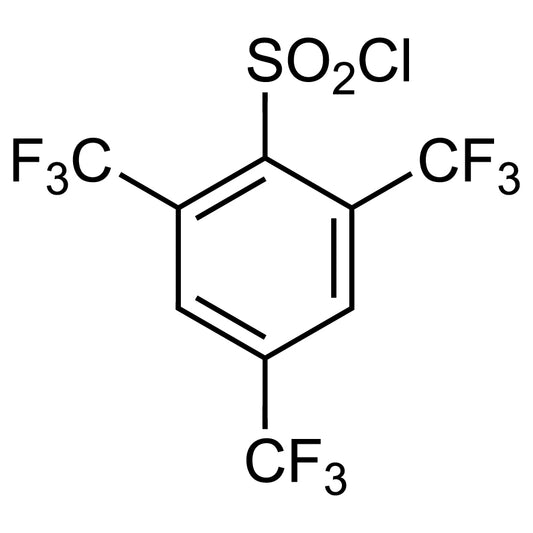
3,5-Bis(trifluoromethyl)-2-chloroaniline is a chemical compound widely used as a building block in the synthesis of complex organic molecules. This compound plays a crucial role in laboratory settings, particularly in organic chemistry research, where it serves as a versatile intermediate. Its unique structure, featuring both fluorinated and chlorinated substituents, makes it an essential component in the development of new materials and pharmaceutical compounds. The presence of the trifluoromethyl group significantly enhances its reactivity and functional versatility, allowing it to participate in a variety of chemical transformations.
The compound's high electronegativity and polarity, attributed to the trifluoromethyl groups, make it an ideal candidate for substitution reactions, coupling reactions, and oxidation processes. The chloro group further contributes to its reactivity, enabling it to form complex structures under controlled conditions. These properties make it a preferred choice for chemists seeking to design and synthesize compounds with specific functional groups and molecular architectures. Its stability and compatibility with various reagents also contribute to its widespread use in laboratory applications.
In Indonesian laboratories, this compound is commonly utilized in organic synthesis, particularly in the fields of pharmacology, material science, and environmental chemistry. It is frequently employed in the development of bioactive compounds and industrial chemicals. Its role in creating complex molecular structures makes it a valuable tool for researchers working on drug discovery, polymer synthesis, and environmental remediation projects.
TCI brochures (PDF)
- Fluorination Reagents, Fluorinated Building Blocks 2026-03-18 · p. 43
Related TCI products
- TCI I0766 16588-74-2 3,5-Bis(trifluoromethyl)phenyl Isocyanate
- TCI I0794 163444-17-5 2-Iodo-4-(trifluoromethyl)aniline
- TCI T4379 728-86-9 Phenyl[4-(trifluoromethyl)phenyl]methanone
- TCI T4302 944453-80-9 2,4,6-Tris(trifluoromethyl)benzenesulfonyl Chloride
- TCI T4250 711-33-1 1-[4-(Trifluoromethyl)phenyl]propan-1-one
- TCI T4165 6185-76-8 (4-Methoxyphenyl)[4-(trifluoromethyl)phenyl]methanone
- Organic synthesis of fluorinated and chlorinated compounds due to its reactive functional groups and structural versatility.
- Development of pharmaceuticals and bioactive molecules by enabling the formation of complex molecular architectures.
- Creation of advanced materials in material science through its ability to participate in coupling and substitution reactions.
- Environmental chemistry research for the synthesis of compounds used in pollution control and remediation processes.
- Industrial chemical production where fluorinated and chlorinated intermediates are required for the manufacture of specialty chemicals.
| Brand | TCI |
|---|---|
| CAS number | 201593-90-0 |
| Molecular formula | — |
| Purity | — |
| Category | Chemistry > Building Blocks > Fluorinated Building Blocks |
| Pack sizes | — |
| Physical form | — |
| Storage | Store in a cool, dry place away from light and moisture |
This compound should be stored in a cool, dry environment, away from direct sunlight and sources of heat. It is recommended to keep it in a tightly sealed container to prevent exposure to moisture and air. Due to its chemical nature, it should be handled with appropriate personal protective equipment, such as gloves and safety goggles, to ensure laboratory safety. The compound is not flammable but may react with strong oxidizing agents, so it should be stored separately from such substances. Proper ventilation is also advised when handling this material to minimize inhalation risks. Regular monitoring of storage conditions is essential to maintain the integrity and stability of the compound over time.
—
Produk Terkait
-
3,5-Bis(trifluoromethyl)phenylIsocyanate TCI I0766
Regular price From Rp 4.108.650,00Regular priceRp 2.872.800,00Sale price From Rp 4.108.650,00 -
2-Iodo-4-(trifluoromethyl)aniline TCI I0794
Regular price From Rp 1.485.750,00Regular priceRp 1.038.450,00Sale price From Rp 1.485.750,00 -
Phenyl[4-(trifluoromethyl)phenyl]methanone TCI T4379
Regular price Rp 1.988.700,00Regular priceRp 1.405.950,00Sale price Rp 1.988.700,00 -
2,4,6-Tris(trifluoromethyl)benzenesulfonylChloride TCI T4302
Regular price From Rp 3.949.050,00Regular priceRp 2.761.500,00Sale price From Rp 3.949.050,00 -
1-[4-(Trifluoromethyl)phenyl]propan-1-one TCI T4250
Regular price Rp 2.173.500,00Regular priceRp 1.535.100,00Sale price Rp 2.173.500,00 -
(4-Methoxyphenyl)[4-(trifluoromethyl)phenyl]methanone TCI T4165
Regular price From Rp 2.227.050,00Regular priceRp 1.572.900,00Sale price From Rp 2.227.050,00 -
1-Methoxy-4-(trifluoromethyl)benzene TCI T4045
Regular price From Rp 2.016.000,00Regular priceRp 1.409.100,00Sale price From Rp 2.016.000,00 -
1-(Trifluoromethyl)cyclopropane-1-carboxylicAcid TCI T3765
Regular price From Rp 795.900,00Regular priceRp 572.250,00Sale price From Rp 795.900,00