


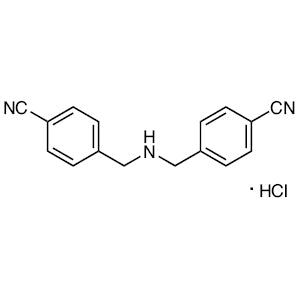
Bis(4-cyanobenzyl)amine Hydrochloride is a chemical compound widely used as a building block in organic synthesis. It serves as a versatile intermediate in the creation of complex molecules, particularly in the development of heterocyclic compounds, pharmaceuticals, and other organic materials. This compound is valued for its structural simplicity and functional reactivity, making it a key reagent in various synthetic pathways. Its molecular structure features two amine groups attached to a benzene ring with cyanide substituents, contributing to its unique chemical behavior and reactivity in laboratory settings.
The compound is known for its stability and controlled reactivity, which make it a preferred choice for organic chemists. It exhibits good solubility in organic solvents and maintains high reactivity under various reaction conditions. These properties allow it to be used in a wide range of chemical transformations, including coupling reactions and functional group modifications. Its thermal stability further enhances its usability, ensuring it remains effective during prolonged storage and use.
In Indonesian laboratories, Bis(4-cyanobenzyl)amine Hydrochloride is commonly used in research related to pharmaceutical development, material science, and organic chemistry. Its reliability and consistency make it an essential component in academic and industrial research settings. It is particularly favored in studies involving the synthesis of new compounds and the exploration of chemical reactivity in controlled environments.
- Organic synthesis of heterocyclic compounds due to its reactive amine groups and structural versatility.
- Pharmaceutical research for the development of new drug molecules and chemical intermediates.
- Material science applications in the creation of advanced polymers and functional materials.
- Academic research in chemistry departments for teaching and experimental studies.
- Industrial chemical production for the manufacture of specialty chemicals and fine chemicals.
| Brand | TCI |
|---|---|
| CAS number | 1802566-49-9 |
| Molecular formula | — |
| Purity | — |
| Category | Chemistry > Building Blocks > Non-Heterocyclic Building Blocks |
| Pack sizes | Available in standard laboratory quantities |
| Physical form | Solid powder |
| Storage | Store in a cool, dry place away from moisture and direct sunlight |
Bis(4-cyanobenzyl)amine Hydrochloride should be stored in a cool, dry environment to maintain its chemical stability. It is recommended to keep the compound in a sealed container to prevent exposure to moisture and air. The storage area should be well-ventilated to minimize the risk of inhalation of any vapors. Avoid direct sunlight and extreme temperatures to ensure the material remains in optimal condition. Due to its chemical nature, it is advisable to handle the compound with appropriate personal protective equipment, such as gloves and safety goggles. Regular monitoring of storage conditions is essential to ensure the integrity and safety of the compound in the laboratory setting.
—
Produk Terkait
-
3-CyanobenzylChloride TCI C2751
Regular price Rp 1.192.800,00Regular priceRp 849.450,00Sale price Rp 1.192.800,00 -
2-CyanobenzylChloride TCI C2656
Regular price From Rp 822.150,00Regular priceRp 590.100,00Sale price From Rp 822.150,00 -
4-CyanobenzylChloride TCI C1985
Regular price From Rp 928.200,00Regular priceRp 664.650,00Sale price From Rp 928.200,00 -
2-CyanobenzylBromide TCI C1556
Regular price From Rp 1.988.700,00Regular priceRp 1.405.950,00Sale price From Rp 1.988.700,00 -
3-CyanobenzylAlcohol TCI C1510
Regular price From Rp 1.192.800,00Regular priceRp 849.450,00Sale price From Rp 1.192.800,00 -
4-CyanobenzylBromide TCI C1398
Regular price From Rp 5.009.550,00Regular priceRp 3.518.550,00Sale price From Rp 5.009.550,00 -
Tris[2-(dimethylamino)ethyl]amine TCI T2898
Regular price From Rp 2.254.350,00Regular priceRp 1.576.050,00Sale price From Rp 2.254.350,00 -
Tris(2-cyanoethyl)amine TCI T1577
Regular price From Rp 2.914.800,00Regular priceRp 2.053.800,00Sale price From Rp 2.914.800,00


