

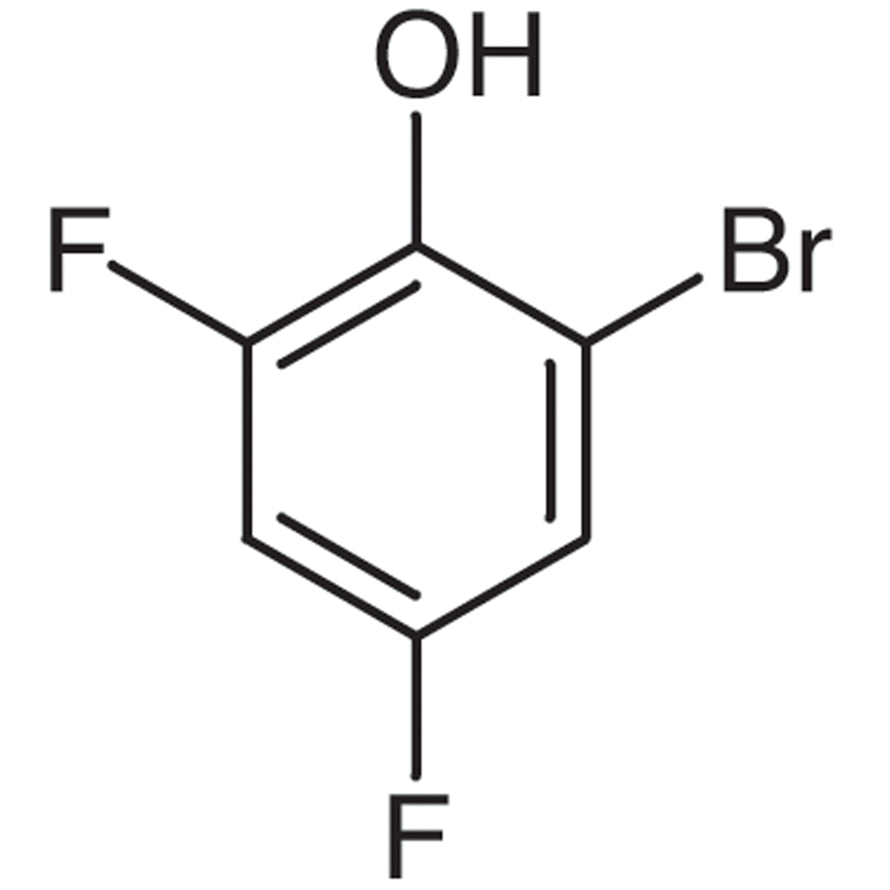
2-Bromo-4,6-difluorophenol is a chemical compound widely used in organic synthesis reactions. This compound features an aromatic ring with bromo and difluoro substituents at specific positions, making it a key building block in the development of complex molecules. In laboratory settings, it serves as a foundational material for the synthesis of pharmaceutical compounds, industrial chemicals, and bioactive substances. Its structural characteristics enable it to participate in various chemical transformations, making it a versatile tool for researchers.
The presence of bromine and fluorine atoms in its molecular structure contributes to its unique reactivity and chemical behavior. These atoms enhance the compound’s ability to undergo substitution, reduction, and nucleophilic reactions, which are essential in synthetic pathways. The stability of the compound under normal conditions, combined with its controlled reactivity, makes it a preferred choice for chemists seeking predictable and reliable chemical behavior. Its chemical properties allow it to be tailored for specific applications in both academic and industrial research.
In Indonesian laboratories, 2-Bromo-4,6-difluorophenol is commonly used in organic chemistry research, particularly in pharmaceutical development, material science, and environmental chemistry. Its availability and reliability support local research efforts, enabling scientists to create innovative solutions and meet the demands of various scientific fields. The compound’s role in these areas highlights its importance in advancing chemical research and development in Indonesia.
TCI brochures (PDF)
- Fluorination Reagents, Fluorinated Building Blocks 2026-03-18 · p. 29
Related TCI products
- TCI B4490 186590-26-1 5-Bromo-2,3-difluorophenol
- TCI B3845 166281-37-4 2-Bromo-4,5-difluorophenol
- TCI D3913 144292-32-0 4-Bromo-2,3-difluorophenol
- TCI T3756 132123-45-6 3,4,5-Trifluorophenyl trans,trans-4'-Propylbicyclohexyl-4-carboxylate
- TCI T3129 113798-74-6 2,3,6-Trifluorophenol
- TCI T2407 209995-38-0 2,4,5-Trifluorophenylacetic Acid
- Organic synthesis is a key application where this compound serves as a building block for creating complex pharmaceutical and industrial compounds.
- Pharmaceutical research benefits from its reactivity and structural versatility, allowing the synthesis of bioactive molecules with specific functionalities.
- Material science applications utilize its chemical stability and reactivity to develop new polymers and functional materials.
- Environmental chemistry studies employ it to investigate the behavior of fluorinated compounds in natural systems and their impact on ecosystems.
- Academic research in chemistry relies on its predictable chemical behavior to explore reaction mechanisms and synthetic pathways.
| Brand | TCI |
|---|---|
| CAS number | 98130-56-4 |
| Molecular formula | — |
| Purity | — |
| Category | Chemistry > Building Blocks > Fluorinated Building Blocks |
| Pack sizes | 50g, 250g, 1kg |
| Physical form | Crystalline solid |
| Storage | Store in a cool, dry place away from light and moisture |
This compound should be stored in a cool, dry environment, away from direct light and moisture to maintain its chemical integrity. It is recommended to use airtight containers made of glass or high-density polyethylene to prevent contamination and degradation. Due to its bromine and fluorine content, it is advisable to handle it with appropriate personal protective equipment, including gloves and safety goggles. In laboratory settings, it should be kept in a well-ventilated area to minimize exposure. Proper labeling and storage practices are essential to ensure safe handling and prevent accidental contact with skin or inhalation. Always follow standard safety protocols when working with reactive chemical compounds.
—
Produk Terkait
-
5-Bromo-2,3-difluorophenol TCI B4490
Regular price From Rp 769.650,00Regular priceRp 537.600,00Sale price From Rp 769.650,00 -
2-Bromo-4,5-difluorophenol TCI B3845
Regular price From Rp 584.850,00Regular priceRp 408.450,00Sale price From Rp 584.850,00 -
4-Bromo-2,3-difluorophenol TCI D3913
Regular price From Rp 1.115.100,00Regular priceRp 779.100,00Sale price From Rp 1.115.100,00 -
3,4,5-Trifluorophenyltrans,trans-4'-Propylbicyclohexyl-4-carboxylate TCI T3756
Regular price From Rp 1.483.650,00Regular priceRp 1.053.150,00Sale price From Rp 1.483.650,00 -
2,3,6-Trifluorophenol TCI T3129
Regular price From Rp 955.500,00Regular priceRp 667.800,00Sale price From Rp 955.500,00 -
2,4,5-TrifluorophenylaceticAcid TCI T2407
Regular price Rp 1.246.350,00Regular priceRp 887.250,00Sale price Rp 1.246.350,00 -
3,4,5-Trifluorophenol TCI T2299
Regular price From Rp 1.220.100,00Regular priceRp 852.600,00Sale price From Rp 1.220.100,00 -
MethylTrifluoropyruvate TCI T1785
Regular price From Rp 637.350,00Regular priceRp 460.950,00Sale price From Rp 637.350,00


