

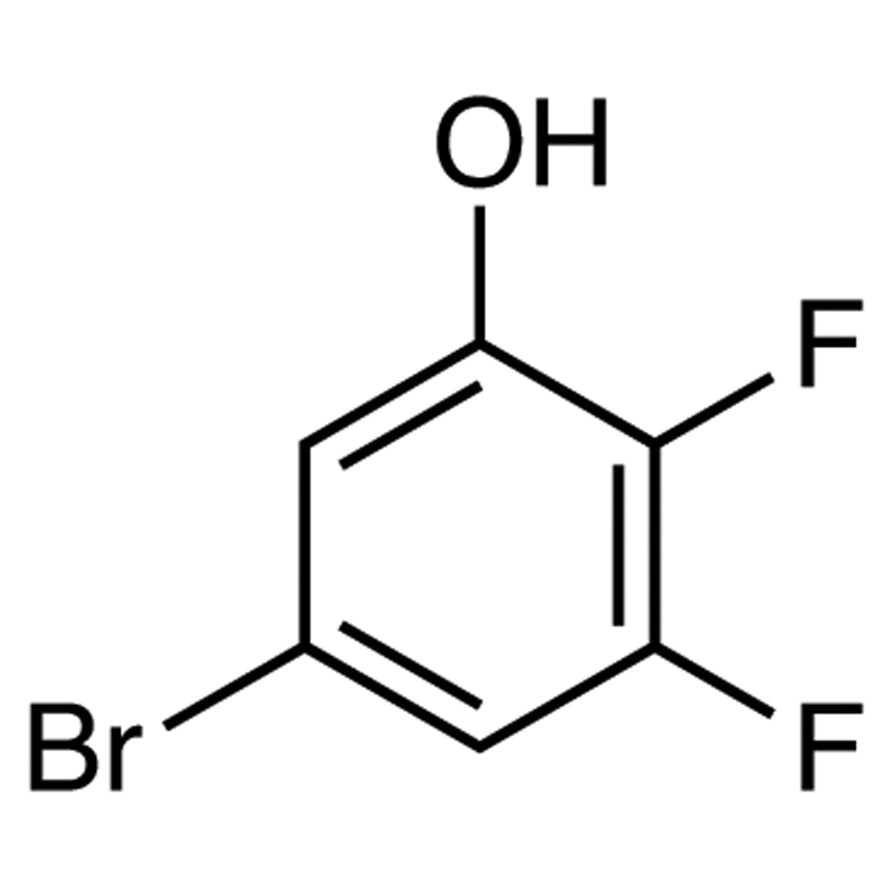
5-Bromo-2,3-difluorophenol is a chemical compound widely used in organic synthesis reactions within laboratory settings. This compound features an aromatic ring substituted with bromo and difluoro groups, making it a versatile building block for the creation of complex molecules. Its unique structure allows it to participate in various chemical reactions, providing researchers with a reliable and adaptable material for their experiments. In the context of Indonesian laboratories, it is a key component in the development of pharmaceutical and organic chemistry projects.
The compound’s chemical properties, including its stability and reactivity, make it a preferred choice for synthetic applications. The combination of bromo and fluoro substituents enhances its reactivity towards substitution and electrophilic reactions, offering precise control over reaction outcomes. Its solubility in organic solvents further simplifies its handling and integration into experimental workflows. These characteristics ensure that it remains a valuable resource for chemists seeking to achieve specific molecular transformations.
In Indonesian laboratories, 5-Bromo-2,3-difluorophenol is commonly used in research focused on drug development and organic synthesis. Its role as a starting material in the synthesis of complex compounds makes it essential for scientists working in pharmaceutical and chemical research. The compound’s predictable behavior and compatibility with various reaction conditions make it a reliable choice for both academic and industrial research settings.
TCI brochures (PDF)
- Fluorination Reagents, Fluorinated Building Blocks 2026-03-18 · p. 27
Related TCI products
- TCI B3845 166281-37-4 2-Bromo-4,5-difluorophenol
- TCI B3004 98130-56-4 2-Bromo-4,6-difluorophenol
- TCI D3913 144292-32-0 4-Bromo-2,3-difluorophenol
- TCI T3756 132123-45-6 3,4,5-Trifluorophenyl trans,trans-4'-Propylbicyclohexyl-4-carboxylate
- TCI T3129 113798-74-6 2,3,6-Trifluorophenol
- TCI T2407 209995-38-0 2,4,5-Trifluorophenylacetic Acid
- Organic synthesis projects benefit from 5-Bromo-2,3-difluorophenol due to its reactivity and structural versatility, enabling the creation of complex molecules with precise functional groups.
- Pharmaceutical research utilizes this compound as a building block for the development of new drugs, leveraging its halogen substituents for targeted chemical modifications.
- Fluorinated compound studies rely on this material to explore the effects of fluorine substitution on molecular reactivity and stability in various chemical environments.
- Analytical chemistry applications use it as a reference standard for identifying and quantifying compounds with similar structural features in complex mixtures.
- Environmental chemistry research incorporates it to study the behavior of halogenated aromatic compounds in different chemical and biological systems.
| Brand | TCI |
|---|---|
| CAS number | 186590-26-1 |
| Molecular formula | — |
| Purity | — |
| Category | Chemistry > Building Blocks > Fluorinated Building Blocks |
| Pack sizes | 25 g, 100 g |
| Physical form | Crystalline solid |
| Storage | Store in a cool, dry place away from light and moisture |
5-Bromo-2,3-difluorophenol should be stored in a cool, dry environment to maintain its chemical integrity. It is recommended to keep it in a tightly sealed container to prevent exposure to moisture and air. Due to its halogenated nature, it should be handled in a well-ventilated area to minimize inhalation risks. The compound is generally stable under normal laboratory conditions but should be stored away from incompatible substances such as strong oxidizers. Proper personal protective equipment, including gloves and safety goggles, should be worn when handling this material to ensure laboratory safety.
—
Produk Terkait
-
2-Bromo-4,5-difluorophenol TCI B3845
Regular price From Rp 584.850,00Regular priceRp 408.450,00Sale price From Rp 584.850,00 -
2-Bromo-4,6-difluorophenol TCI B3004
Regular price From Rp 795.900,00Regular priceRp 556.500,00Sale price From Rp 795.900,00 -
4-Bromo-2,3-difluorophenol TCI D3913
Regular price From Rp 1.115.100,00Regular priceRp 779.100,00Sale price From Rp 1.115.100,00 -
3,4,5-Trifluorophenyltrans,trans-4'-Propylbicyclohexyl-4-carboxylate TCI T3756
Regular price From Rp 1.483.650,00Regular priceRp 1.053.150,00Sale price From Rp 1.483.650,00 -
2,3,6-Trifluorophenol TCI T3129
Regular price From Rp 955.500,00Regular priceRp 667.800,00Sale price From Rp 955.500,00 -
2,4,5-TrifluorophenylaceticAcid TCI T2407
Regular price Rp 1.246.350,00Regular priceRp 887.250,00Sale price Rp 1.246.350,00 -
3,4,5-Trifluorophenol TCI T2299
Regular price From Rp 1.220.100,00Regular priceRp 852.600,00Sale price From Rp 1.220.100,00 -
MethylTrifluoropyruvate TCI T1785
Regular price From Rp 637.350,00Regular priceRp 460.950,00Sale price From Rp 637.350,00


