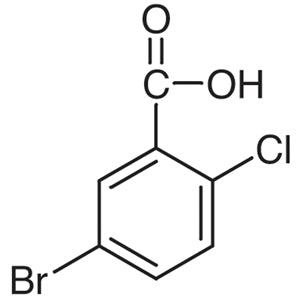
2-Bromo-5-chlorobenzoic Acid is an organic chemical compound widely used in laboratory settings for its versatility in chemical reactions. As a key building block in synthetic chemistry, it plays a crucial role in the development of complex molecules. This compound is particularly valuable in the synthesis of both heterocyclic and non-heterocyclic compounds, making it a fundamental reagent in organic chemistry research. Its presence in various industrial and pharmaceutical applications highlights its importance in modern chemical processes.
The compound is known for its chemical stability and reactivity, which make it suitable for substitution and electrophilic reactions. It exhibits good solubility in organic solvents such as ethyl acetate and ethanol, enhancing its utility in a wide range of experimental conditions. These properties contribute to its popularity among chemists seeking reliable and efficient reagents for their experiments. Its ability to participate in complex chemical reactions further solidifies its position as a preferred choice in laboratory environments.
In Indonesian laboratories, 2-Bromo-5-chlorobenzoic Acid is commonly used in chemical research, especially in the synthesis of organic compounds. It is a key component in experiments requiring specific structural intermediates. Many research institutions and universities rely on this compound for their chemical synthesis projects. Its availability and quality ensure that researchers can conduct their experiments with confidence and precision.
Related TCI products
- Organic synthesis is a primary application where this compound is used to build complex molecular structures due to its reactivity and versatility.
- Pharmaceutical research benefits from its role in the development of new drugs and therapeutic agents through its chemical properties.
- Industrial chemical production utilizes this compound as a precursor for various chemical intermediates and specialty products.
- Academic research in chemistry laboratories relies on it for teaching and experimental purposes, especially in synthetic organic chemistry courses.
- Environmental analysis may incorporate this compound in the study of chemical behavior and degradation processes in various matrices.
| Brand | TCI |
|---|---|
| CAS number | 21739-93-5 |
| Molecular formula | — |
| Purity | — |
| Category | Chemistry > Building Blocks > Non-Heterocyclic Building Blocks |
| Pack sizes | Available in various quantities as per supplier specifications |
| Physical form | Solid, crystalline appearance |
| Storage | Store in a cool, dry place away from direct sunlight |
This compound should be stored in a cool, dry environment to maintain its chemical stability. It is recommended to keep it in a sealed container to prevent exposure to moisture and air. Due to its reactivity, it should be handled with care, using appropriate personal protective equipment such as gloves and safety goggles. It is advisable to store it away from incompatible substances to avoid any potential chemical reactions. Proper labeling of containers ensures safe handling and easy identification in the laboratory setting. Regular inspection of storage conditions helps maintain the integrity of the compound over time.
—
Produk Terkait
-
2-Bromo-6-chlorobenzoicAcid TCI B4820
Regular price From Rp 557.550,00Regular priceRp 405.300,00Sale price From Rp 557.550,00 -
2-Bromo-4-chlorobenzoicAcid TCI B4592
Regular price Rp 1.881.600,00Regular priceRp 1.331.400,00Sale price Rp 1.881.600,00 -
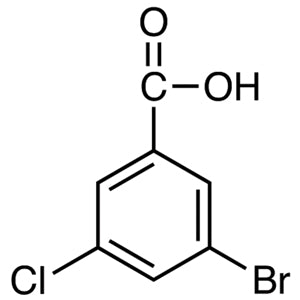
3-Bromo-5-chlorobenzoicAcid TCI B4191
Regular price From Rp 875.700,00Regular priceRp 627.900,00Sale price From Rp 875.700,00 -
4-Bromo-3-chlorobenzoicAcid TCI B3791
Regular price From Rp 1.378.650,00Regular priceRp 979.650,00Sale price From Rp 1.378.650,00 -
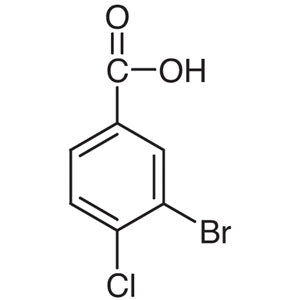
3-Bromo-4-chlorobenzoicAcid TCI B3308
Regular price From Rp 1.458.450,00Regular priceRp 1.035.300,00Sale price From Rp 1.458.450,00 -
4-Bromo-2-chlorobenzoicAcid TCI B1407
Regular price From Rp 1.749.300,00Regular priceRp 1.239.000,00Sale price From Rp 1.749.300,00 -
5-Bromo-2-chlorobenzoicAcid TCI B1344
Regular price From Rp 822.150,00Regular priceRp 590.100,00Sale price From Rp 822.150,00 -
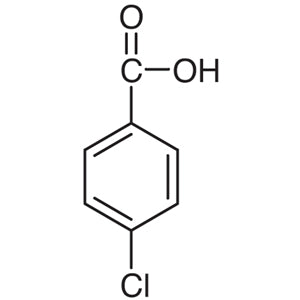
4-ChlorobenzoicAcid TCI C0134
Regular price From Rp 557.550,00Regular priceRp 405.300,00Sale price From Rp 557.550,00