

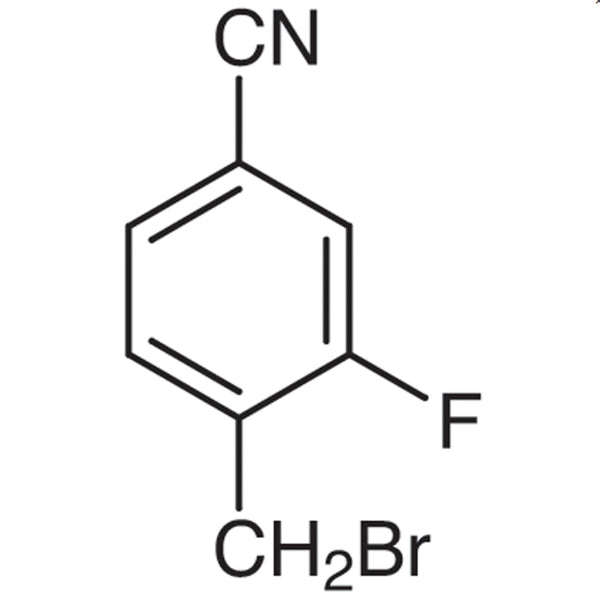
4-(Bromomethyl)-3-fluorobenzonitrile is a chemical compound widely used in organic reactions, particularly in the synthesis of complex molecules requiring bromo and fluoro substitutions. This compound serves as a crucial building block in chemical laboratories, enabling the development of new compounds with specific structural and functional properties. Its presence in laboratory settings is essential for researchers working on advanced chemical synthesis, especially in the creation of heterocyclic compounds and materials with tailored electronic properties.
The compound’s unique combination of a bromomethyl group and a fluorine atom gives it high reactivity and versatility in various chemical reactions. These groups allow it to participate in nucleophilic substitution, coupling reactions, and electrophilic reactions, making it a valuable reagent for synthetic chemists. Its predictable chemical behavior also ensures reliable outcomes in laboratory experiments, supporting precise control over reaction conditions and product formation.
In Indonesian laboratories, 4-(Bromomethyl)-3-fluorobenzonitrile is commonly used in research and development projects related to pharmaceuticals, industrial chemicals, and functional materials. Its role in creating compounds with specific electronic and structural characteristics makes it a preferred choice for scientists aiming to innovate in these fields. The compound’s stability and reactivity make it a reliable component in diverse chemical applications within the Indonesian scientific community.
TCI brochures (PDF)
- Fluorination Reagents, Fluorinated Building Blocks 2026-03-18 · p. 21
Related TCI products
- TCI B4988 421552-12-7 2-(Bromomethyl)-4-fluorobenzonitrile
- TCI B4600 179898-34-1 3-Bromo-5-fluorobenzonitrile
- TCI B4022 133059-44-6 4-Bromo-3-fluorobenzonitrile
- TCI B3183 79544-27-7 2-Bromo-6-fluorobenzonitrile
- TCI B3010 57381-39-2 2-Bromo-5-fluorobenzonitrile
- TCI B2745 105942-08-3 4-Bromo-2-fluorobenzonitrile
- Organic synthesis of heterocyclic compounds due to its bromomethyl and fluoro groups enabling versatile functionalization.
- Development of pharmaceutical intermediates where precise substitution patterns are required for drug molecule design.
- Preparation of functional materials with tailored electronic properties for advanced chemical applications.
- Research in industrial chemistry for the creation of specialty chemicals with specific reactivity profiles.
- Synthesis of compounds with unique electronic characteristics for use in material science and nanotechnology.
| Brand | TCI |
|---|---|
| CAS number | 105942-09-4 |
| Molecular formula | — |
| Purity | — |
| Category | Chemistry > Building Blocks > Fluorinated Building Blocks |
| Pack sizes | Available in standard laboratory quantities as per supplier specifications |
| Physical form | Liquid or solid, depending on supplier packaging |
| Storage | Store in a cool, dry place away from light and incompatible substances |
This compound should be stored in a cool, dry environment, away from direct sunlight and sources of heat. It is recommended to use airtight containers made of materials compatible with its chemical properties, such as glass or high-density polyethylene. Proper ventilation should be maintained in the laboratory to minimize exposure to vapors. Due to its reactivity, it should be handled with care, using appropriate personal protective equipment. Storage should be in a location that is inaccessible to unauthorized personnel and away from incompatible substances such as strong bases or reducing agents. Regular monitoring of storage conditions is advised to ensure the compound remains stable and safe for use.
—
Produk Terkait
-
2-(Bromomethyl)-4-fluorobenzonitrile TCI B4988
Regular price From Rp 1.033.200,00Regular priceRp 738.150,00Sale price From Rp 1.033.200,00 -
3-Bromo-5-fluorobenzonitrile TCI B4600
Regular price From Rp 822.150,00Regular priceRp 590.100,00Sale price From Rp 822.150,00 -
4-Bromo-3-fluorobenzonitrile TCI B4022
Regular price From Rp 2.782.500,00Regular priceRp 1.961.400,00Sale price From Rp 2.782.500,00 -
2-Bromo-6-fluorobenzonitrile TCI B3183
Regular price Rp 795.900,00Regular priceRp 572.250,00Sale price Rp 795.900,00 -
2-Bromo-5-fluorobenzonitrile TCI B3010
Regular price From Rp 1.326.150,00Regular priceRp 942.900,00Sale price From Rp 1.326.150,00 -
4-Bromo-2-fluorobenzonitrile TCI B2745
Regular price From Rp 1.881.600,00Regular priceRp 1.331.400,00Sale price From Rp 1.881.600,00 -
2-Bromo-4-fluorobenzonitrile TCI B2744
Regular price From Rp 2.173.500,00Regular priceRp 1.535.100,00Sale price From Rp 2.173.500,00 -
5-Bromo-2-fluorobenzonitrile TCI B2425
Regular price From Rp 1.483.650,00Regular priceRp 1.053.150,00Sale price From Rp 1.483.650,00


